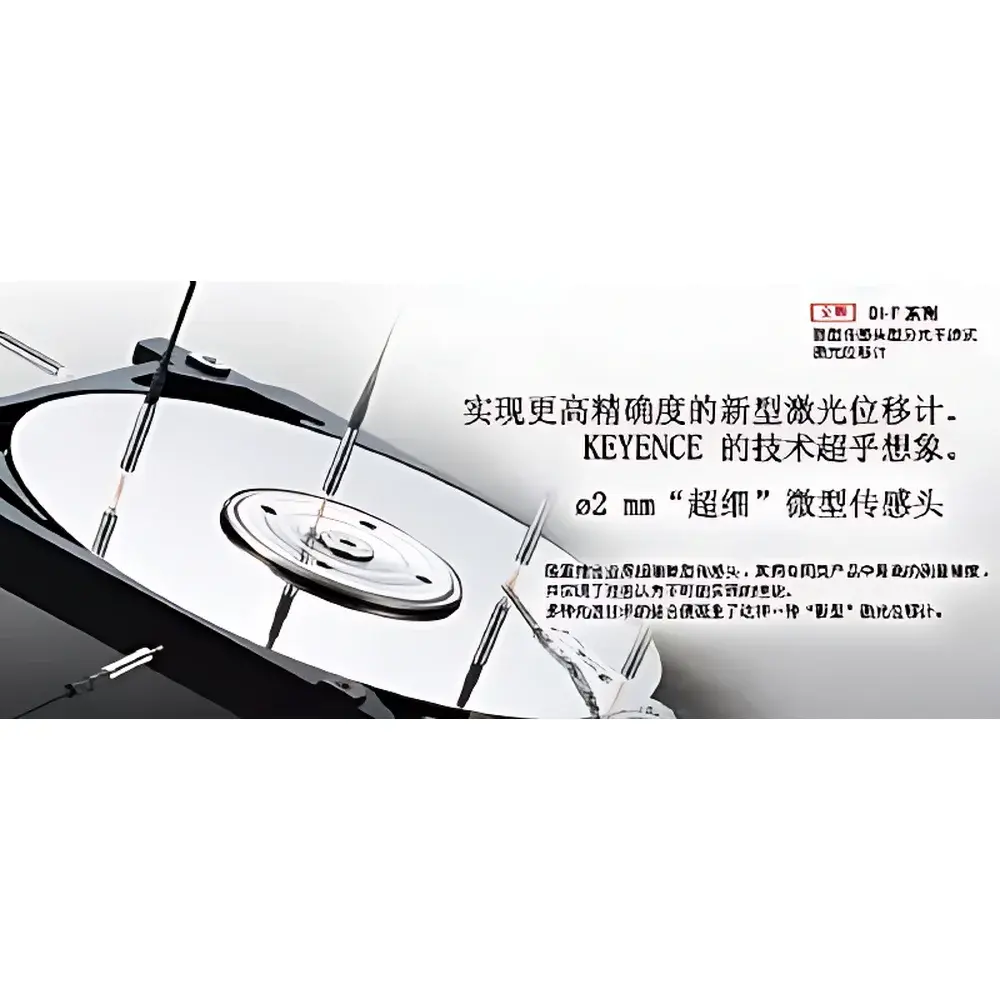
SI-F Micro-Sized Spectral Interferometric Laser Displacement Sensor Head
| Origin | Japan |
|---|---|
| Manufacturer Type | Authorized Distributor |
| Origin Category | Imported |
| Model | SI-F |
| Pricing | Available Upon Request |
Overview
The SI-F Micro-Sized Spectral Interferometric Laser Displacement Sensor Head is an ultra-compact, high-fidelity displacement measurement solution engineered for nanoscale geometric metrology in constrained environments. Unlike conventional triangulation-based or confocal laser sensors, the SI-F employs spectral interferometry—a principle rooted in the wavelength-dependent interference pattern generated when broadband light reflects from both the reference and target surfaces. This optical architecture enables absolute distance measurement with sub-micrometer resolution without mechanical scanning or moving parts, delivering exceptional stability against thermal drift and vibration. Designed specifically for integration into precision profilometers, in-line semiconductor inspection systems, and MEMS characterization platforms, the SI-F sensor head operates as a standalone metrological node—capable of real-time, non-contact surface topography acquisition at micron-level repeatability. Its ø2 mm cylindrical form factor allows deployment in boreholes, microfluidic channels, and multi-axis probe arrays where traditional optics cannot fit.
Key Features
- Sub-micron resolution: 0.25 µm typical displacement resolution under controlled environmental conditions (temperature-stabilized lab environment, < ±0.5 °C variation)
- Ultra-miniaturized optical head: Ø2 mm diameter × 8.5 mm length, hermetically sealed stainless-steel housing rated to IP65 for dust and moisture resistance
- Spectral interferometric measurement principle: Utilizes broadband LED source (center wavelength ~780 nm) and high-resolution spectrometer-based detection for absolute distance determination
- Multi-sensor synchronization: Single controller supports up to six SI-F heads simultaneously, with hardware-level trigger alignment (<100 ns jitter) and phase-coherent sampling
- Dedicated I/O architecture: Controller features six independent analog voltage outputs (±10 V, 16-bit DAC), six digital TTL inputs/outputs, and RS-422 serial interface for deterministic industrial communication
- Thermal compensation engine: Built-in temperature sensor (±0.1 °C accuracy) feeds real-time correction coefficients into displacement calculation algorithm
Sample Compatibility & Compliance
The SI-F sensor head is compatible with non-transparent and semi-transparent surfaces—including silicon wafers, polished metals, ceramic substrates, and coated glass—provided surface roughness (Ra) is ≤0.5 µm and reflectivity exceeds 3% at 780 nm. It is not recommended for highly scattering or strongly absorbing materials (e.g., black rubber, carbon fiber composites) without reflective coating. The system conforms to IEC 61326-1:2013 (EMC requirements for laboratory equipment) and meets CE marking requirements for measurement instrumentation. While not certified for intrinsic safety, it complies with EN 61000-6-3 (radiated emissions) and EN 61000-6-2 (immunity). For regulated environments, raw data streams support GLP-compliant audit trails via timestamped binary logging; optional firmware upgrade enables FDA 21 CFR Part 11–compliant electronic signatures and user-access controls.
Software & Data Management
The SI-F is operated via dedicated PC software—SI-F Control Suite v3.2—compatible with Windows 10/11 (64-bit) and requiring .NET Framework 4.8. The application provides real-time waveform visualization, multi-channel overlay, statistical process monitoring (SPC) charts (X-bar/R, Cp/Cpk), and batch export in CSV, HDF5, and industry-standard STEP AP210 formats. All measurements are stored with embedded metadata: sensor ID, timestamp (UTC-synced via NTP), ambient temperature/humidity (if external sensors connected), and calibration certificate traceability (NIST-traceable reference standard used during factory calibration). Raw spectral data can be exported for offline Fourier-domain analysis. The software architecture supports OPC UA server mode for integration into MES/SCADA systems and includes Python SDK (v1.4) with full API documentation for custom automation scripts.
Applications
- Wafer-level metrology: Step height, trench depth, and film thickness profiling in front-end semiconductor fabrication
- Micro-optics assembly: Active alignment feedback for lens bonding and MEMS mirror positioning
- Precision machining verification: In-process monitoring of turned/milled micro-features on medical implants and aerospace components
- Dynamic surface deformation studies: High-speed vibration mode analysis of thin-film actuators and piezoelectric membranes (up to 10 kHz bandwidth with optional oversampling mode)
- Calibration transfer standards: Reference-grade displacement generation in national metrology institutes and accredited calibration labs
FAQ
What is the maximum working distance of the SI-F sensor head?
The standard configuration offers a 10 mm measurement range (±5 mm around nominal focus position), with linearity error < ±0.1% FS over full range.
Can the SI-F measure transparent materials such as glass or sapphire?
Yes—when measuring single-surface reflection from the front face of optically clear substrates, provided anti-reflection coatings are absent or characterized. Dual-surface interference may require custom signal processing modules.
Is factory recalibration required annually?
Recommended recalibration interval is 12 months under continuous operation; calibration certificates include uncertainty budgets per ISO/IEC 17025:2017 Annex A.3.
Does the system support third-party motion controllers?
Yes—via RS-422 command protocol or analog voltage triggering; detailed interface specification document (Rev. SI-F-IF-2024-B) available under NDA.
How is thermal drift compensated in long-duration measurements?
Real-time temperature readings from integrated sensor modulate the dispersion model used in Fourier-transform-based peak detection, reducing thermal-induced offset to < 0.05 µm/°C.