
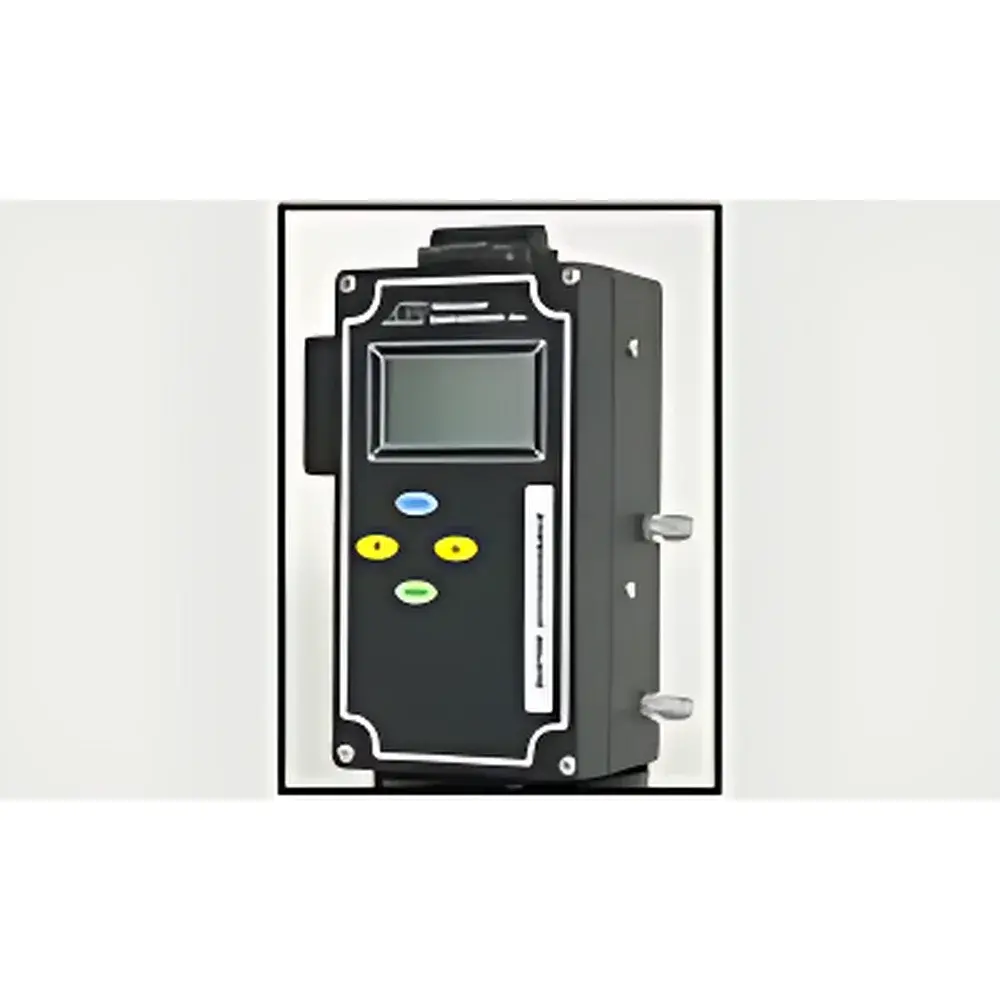
SIELINS 1500 Micro-Oxygen Analyzer
| Brand | SIELINS |
|---|---|
| Model | 1500 |
| Measurement Principle | Electrochemical Fuel Cell (GPR-12-333 & XLT-12-333) |
| Detection Range | 0–10 / 100 / 1000 ppm, 0–1% / 25% FS |
| Accuracy | <1% FS (at 25°C, 1 atm) |
| Resolution | 0.01 ppm |
| Response Time (T90) | ≤10 s |
| Linearity | >0.995 |
| Operating Temperature | 5–45°C (GPR), –20–45°C (XLT) |
| Pressure Range | 5–30 psig (inlet), ambient (outlet) |
| Flow Rate | 0.5–5 SCFH (recommended: 2 SCFH) |
| Compensation | Automatic temperature & barometric pressure compensation |
| Output Signal | 4–20 mA (isolated) |
| Enclosure Rating | NEMA 4X (aluminum-coated stainless steel) |
| Certifications | CE, ISO 9001 |
| Intrinsically Safe Option | Compatible with IS barriers for Class I, Division 1, Groups A–D hazardous areas |
| Sensor Lifetime | 24 months (GPR-12-333, zero-maintenance) |
Overview
The SIELINS 1500 Micro-Oxygen Analyzer is a high-stability, electrochemical fuel cell-based instrument engineered for continuous, low-level oxygen monitoring in inert, reducing, and corrosive gas streams. It employs the GPR-12-333 proprietary fuel cell sensor — a solid-electrolyte, diffusion-limited electrochemical transducer — which delivers exceptional long-term stability and drift-free operation without periodic electrolyte refills or mechanical maintenance. Unlike paramagnetic or zirconia-based analyzers, the 1500 leverages selective oxygen reduction kinetics at the cathode, enabling accurate quantification down to 0.01 ppm resolution across five programmable full-scale ranges (0–10 ppm, 0–100 ppm, 0–1000 ppm, 0–1% FS, and 0–25% FS). Its measurement architecture is inherently insensitive to background gas composition changes in helium, nitrogen, argon, hydrogen, CO₂ (with optional XLT-12-333 sensor), and acid gas mixtures — making it suitable for semiconductor purge gas verification, specialty gas cylinder certification, glovebox atmosphere control, and hydrogen production purity validation.
Key Features
- Zero-maintenance GPR-12-333 fuel cell sensor with guaranteed 24-month operational lifetime under typical conditions
- Five factory-configurable measurement ranges; auto-ranging or manual selection via intuitive menu-driven interface
- NEMA 4X-rated aluminum-coated stainless steel enclosure — IP66-compliant, corrosion-resistant, and suitable for outdoor or washdown environments
- Integrated real-time environmental compensation: simultaneous temperature (±0.1°C) and barometric pressure (±0.1 kPa) correction applied to raw sensor output
- Isolated 4–20 mA analog output with HART compatibility (optional); configurable alarm relays and status diagnostics
- Robust gas handling design: 1/8″ Swagelok® compression fitting inlet, pressure-regulated flow path, and built-in flow restriction for stable 2 SCFH operation
- Compliance-ready firmware architecture supporting audit trails, calibration lockout, and user-access level management per GLP/GMP guidelines
Sample Compatibility & Compliance
The 1500 is validated for use with non-condensing, dry process gases including ultra-high-purity nitrogen, helium, argon, hydrogen, and synthetic air blends. For applications involving CO₂ concentrations exceeding 0.5%, the XLT-12-333 high-concentration fuel cell sensor is required to prevent cross-sensitivity and ensure stoichiometric accuracy. The analyzer meets CE marking requirements under Directive 2014/30/EU (EMC) and 2014/35/EU (LVD), and its quality management system is certified to ISO 9001:2015. When paired with an approved intrinsically safe barrier (e.g., Pepperl+Fuchs KFD2-STC4-EX1), the system complies with ANSI/UL 913 and IEC 60079-11 for installation in Class I, Division 1, Groups A–D hazardous locations. All firmware revisions are traceable, and calibration records adhere to ISO/IEC 17025 documentation standards.
Software & Data Management
The embedded microcontroller supports local configuration via a waterproof membrane keypad and backlit LCD display (128×64 pixels). Full device diagnostics — including sensor health index, voltage stability, temperature drift history, and pressure deviation logs — are accessible through the on-screen menu. Optional PC-based configuration software (SIELINS ConfigTool v3.2+) enables remote setup, batch calibration logging, and export of time-stamped measurement data in CSV format. Audit trail functionality records all parameter changes, calibration events, and user logins with timestamps and operator IDs — satisfying FDA 21 CFR Part 11 requirements when deployed in regulated pharmaceutical or biotech environments.
Applications
- Monitoring residual O₂ in semiconductor-grade N₂ and Ar purge lines (≤1 ppm specification)
- In-line verification of hydrogen fuel purity prior to PEM electrolyzer feed (ASTM D7184 compliance support)
- Continuous atmosphere control in nitrogen-filled gloveboxes used for lithium battery electrode manufacturing
- Quality assurance testing of medical oxygen cylinders and anesthesia gas mixtures (USP <911>)
- Leak detection verification in vacuum chamber backfilling systems using tracer O₂ spikes
- Process gas certification for cryogenic air separation units and bulk gas distribution networks
FAQ
What is the recommended calibration gas concentration?
A certified standard gas containing 80% of the selected full-scale range is recommended (e.g., 8 ppm for 0–10 ppm range, 20% O₂ for 0–25% FS range).
Can the 1500 measure oxygen in CO₂-rich streams?
Yes — but only when equipped with the XLT-12-333 sensor, which is specifically designed to suppress CO₂ interference above 0.5% volume.
Is pressure compensation automatic or manual?
Fully automatic: an integrated absolute pressure transducer and RTD sensor continuously feed compensation values to the measurement algorithm.
What is the minimum detectable oxygen level with the GPR-12-333 sensor?
The lower limit of quantitation (LLOQ) is 0.5% FS, corresponding to 0.05 ppm in the 0–10 ppm range, verified per ISO 11843-1.
Does the analyzer support Modbus RTU communication?
Not natively; however, the isolated 4–20 mA output can be interfaced with third-party PLCs or DCS systems via standard current-loop converters.







