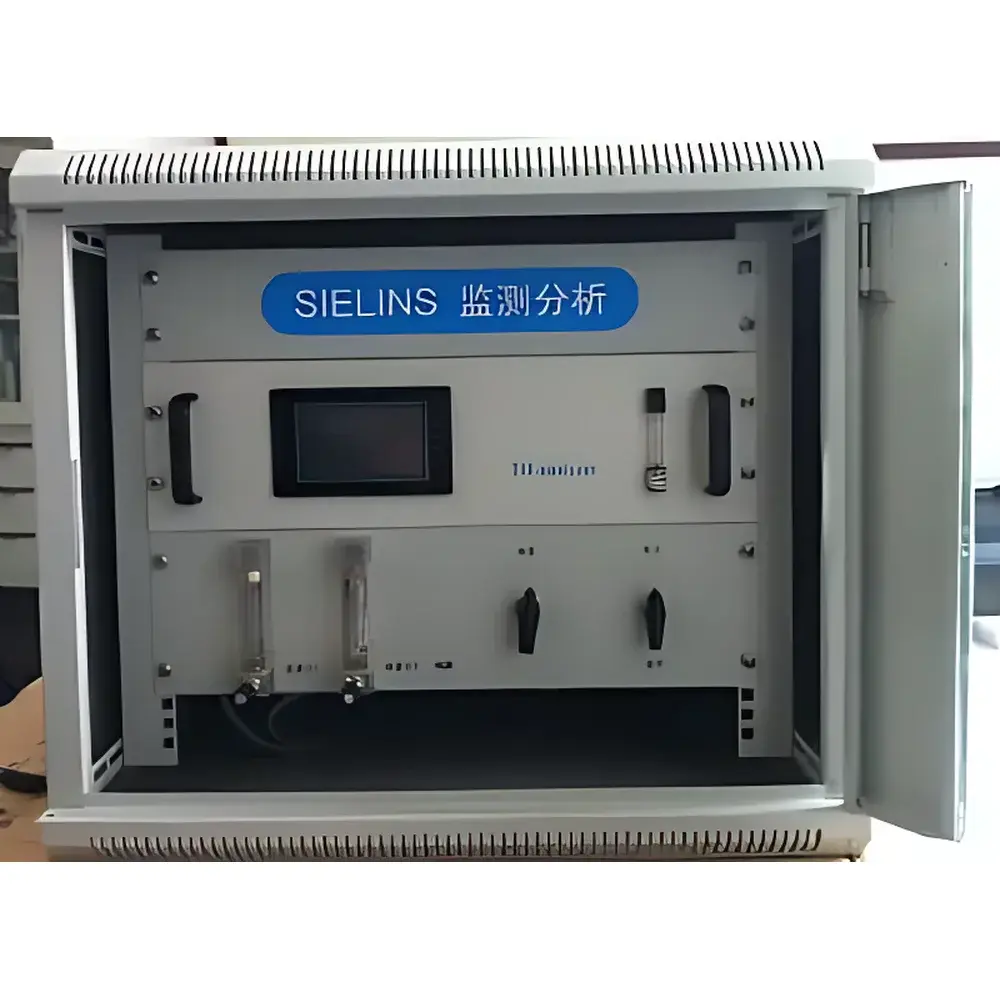
SIELINS-904 Online CO Monitoring & Sample Conditioning System
| Brand | SIELINS |
|---|---|
| Origin | Beijing, China |
| Model | SIELINS-904 |
| Power Supply | AC 220 V ±10%, 50 Hz ±1% |
| Total Power Consumption | 2000 VA |
| Probe Power | 800 VA |
| � | �热管线供电: 1500 VA |
| Compressed Air Requirement | 0.6 MPa, oil-free & dry |
| Ambient Temperature Range | −10–50 °C |
| Relative Humidity | <80% RH |
| Output Signal | Isolated 4–20 mA DC |
| Alarm Output | Dry contact (NO/NC configurable) |
| Sample Gas | Wet, dusty process gas containing CO |
| Primary Analyte | Carbon Monoxide (CO) |
| Compliance | Designed for industrial process monitoring per IEC 61511 functional safety principles (non-SIL certified), compatible with DCS/PLC integration under ISO 50001 energy management contexts |
Overview
The SIELINS-904 Online CO Monitoring & Sample Conditioning System is an integrated, fully automated gas analysis solution engineered for continuous, real-time measurement of carbon monoxide (CO) in high-moisture, high-particulate industrial process streams. Unlike conventional extractive analyzers requiring external pre-treatment, the SIELINS-904 embeds a complete, multi-stage sample conditioning architecture — including high-temperature probe filtration, electrically heated sample transport, ambient-stage coarse dehydration, and compressor-driven cryogenic condensation — all within a single, rack-mounted cabinet. The system operates on the principle of extractive sampling with active thermal management: process gas is drawn at source via a 100 °C+ heated probe to prevent water condensation and particulate agglomeration; it is then conveyed through insulated, trace-heated tubing to maintain dew point integrity; subsequently cooled to 5–8 °C in dual-stage refrigerated condensers to achieve precise dew point control (<8 °C); and finally delivered to a CO-specific sensor (e.g., electrochemical or NDIR-based, depending on configuration) for quantitative detection. This architecture ensures high reproducibility in harsh environments where conventional systems suffer from line clogging, sensor drift, or calibration instability due to uncontrolled moisture and dust ingress.
Key Features
- Integrated high-temperature probe (≥100 °C) with ceramic filter for primary particulate removal at source
- Electrically trace-heated sample transfer line (220 V AC powered, 1500 VA dedicated supply) to suppress condensation during transport
- Dual-stage dehydration: ambient-buffered sedimentation tank (L1) + dual-cavity refrigerated condenser (5–8 °C cooling)
- Automated, programmable purge cycles: internal probe blowback (via DV3), external probe cleaning (via DV4), and timed drain actuation (DV1, DV2, DV3)
- Isolated 4–20 mA analog output with HART compatibility (optional), compliant with ISA-50.00.01 signal standards
- Dry-contact alarm relay (NO/NC configurable) with user-defined CO threshold and hysteresis logic
- Manual override capability for probe blowback, condensate drainage, and sample bypass — accessible via front-panel controls
- Non-explosion-proof enclosure rated for Class 1, Division 2 ambient conditions (IEC 60079-0 general requirements)
Sample Compatibility & Compliance
The SIELINS-904 is validated for continuous monitoring of CO in wet, dusty process gases derived from coal gasification, syngas production, coke oven off-gas, and waste incineration flue streams. It accommodates inlet gas temperatures up to 300 °C (probe-limited), particulate loading ≤100 mg/Nm³, and dew points up to 120 °C (pre-conditioning). All wetted materials comply with ASTM A269 TP316L stainless steel specifications for corrosion resistance. While the system itself is not SIL-certified, its architecture supports integration into safety instrumented systems (SIS) when deployed with external voting logic per IEC 61511. Data logging and alarm events adhere to GLP-aligned timestamping conventions. The 4–20 mA output meets EMC immunity requirements per IEC 61326-1 (industrial environment), and power inputs conform to IEC 61000-4-5 surge immunity Level 3.
Software & Data Management
The SIELINS-904 operates without embedded firmware-based HMI; instead, it delivers raw and processed data via hardwired analog and discrete I/O channels optimized for direct integration into distributed control systems (DCS), programmable logic controllers (PLC), or SCADA platforms. Optional Modbus RTU (RS-485) interface enables remote parameter readout (CO concentration, probe temperature, condensate level status, alarm state) and limited setpoint adjustment. All alarm events — including high-CO trip, condensate overflow, heater fault, and pressure loss — generate time-stamped digital pulses traceable for audit purposes. While the base unit does not include FDA 21 CFR Part 11-compliant electronic signatures or audit trails, it supports third-party historian integration (e.g., OSIsoft PI, Emerson DeltaV Datalogger) for full GMP/GLP data governance when deployed with validated middleware.
Applications
- Real-time CO monitoring in coal-fired boiler flue gas for combustion efficiency optimization and NOx precursor control
- Syngas quality assurance in Fischer–Tropsch and methanol synthesis loops, where CO concentration directly impacts catalyst lifetime
- Off-gas safety surveillance in coke oven batteries and blast furnace stoves, meeting OSHA PEL (50 ppm TWA) and ACGIH TLV compliance thresholds
- Waste-to-energy plant emission control, supporting continuous emissions monitoring system (CEMS) redundancy and regulatory reporting under EU Directive 2010/75/EU (IED)
- Hydrogen production facilities (steam methane reforming), where CO slip detection prevents downstream PEM electrolyzer poisoning
FAQ
What is the maximum allowable particulate load for reliable operation?
The heated probe filter is rated for continuous exposure to ≤100 mg/Nm³ total suspended particulates. For higher loads (>200 mg/Nm³), upstream cyclonic pre-separation is recommended.
Can the system operate in ambient temperatures below 0 °C?
Yes — the cabinet includes internal thermostatic heating to maintain internal electronics above 5 °C. However, external sample lines require additional insulation beyond standard heat tracing in sub-zero environments.
Is compressed air used only for probe blowback?
Compressed air serves three functions: (1) probe internal/external purging, (2) actuation of pneumatic ball valves (SV1), and (3) optional zero-gas dilution if integrated with calibration manifold (not included standard).
Does the system support automatic zero/span calibration?
No — the base SIELINS-904 lacks integrated calibration gas manifolds. Manual calibration requires external zero air (CO-free) and span gas (traceable NIST-certified CO in N₂) introduced via the sample inlet test port.
What maintenance intervals are recommended for the refrigerated condenser?
Compressor oil and refrigerant charge require verification every 24 months; condenser coil cleaning and desiccant replacement (if installed downstream) are advised quarterly under high-humidity operation.
Related Products