
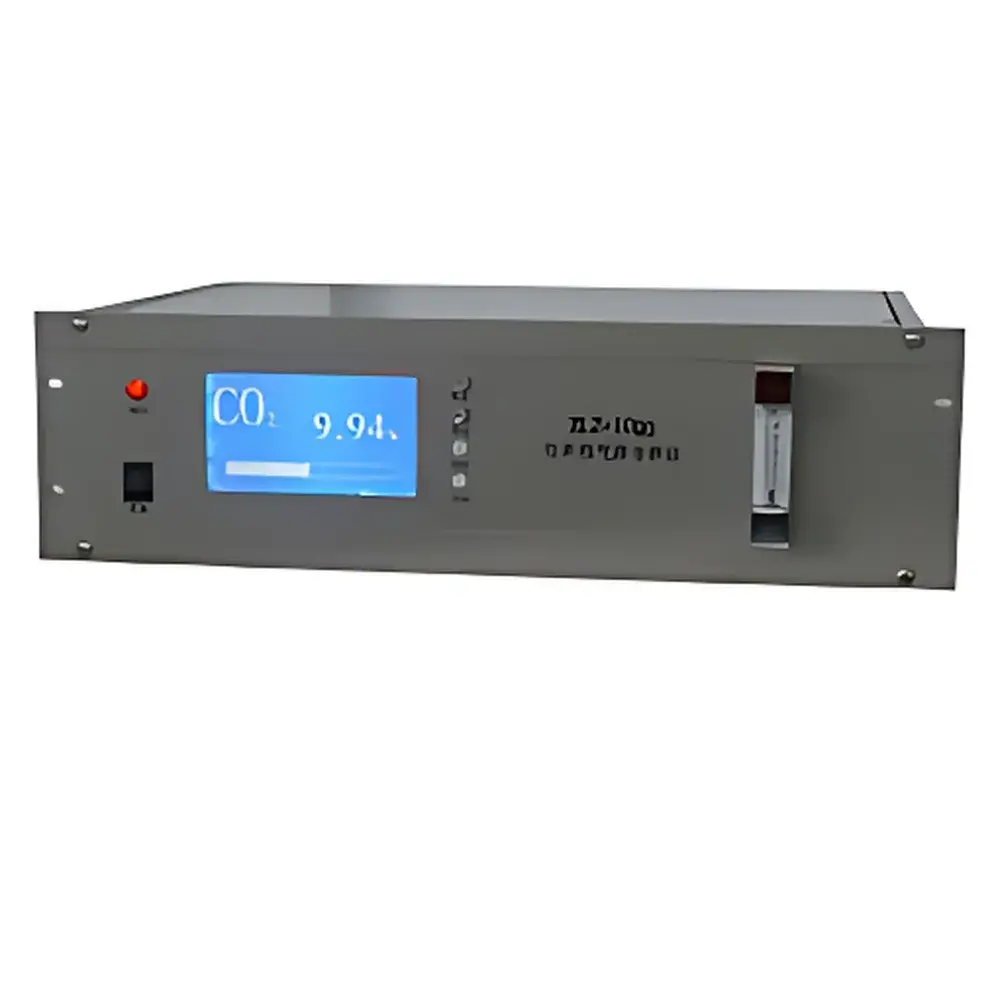
SIELINS XLZ-1090GXH Non-Dispersive Infrared (NDIR) Sulfur Dioxide Analyzer
| Brand | SIELINS |
|---|---|
| Model | XLZ-1090GXH |
| Detection Principle | Non-Dispersive Infrared (NDIR) Absorption |
| Target Gas | SO₂ |
| Measurement Range | 0–5000 ppm |
| Resolution | 1 ppm |
| Accuracy | ±1 ppm |
| Response Time (T₉₀) | ≤15 s |
| Zero Drift | ≤±1% FS / 48 h |
| Span Drift | ≤±1% FS / 48 h |
| Linearity Error | ≤±1% FS |
| Repeatability | ≤1% |
| Sample Flow Rate | 0.5–3 L/min |
| Operating Temperature | 0–40 °C |
| Relative Humidity | ≤90% RH |
| Power Supply | 220 V ±10%, 50 ±0.5 Hz, 150 W |
| Analog Outputs | 4–20 mA (600 Ω max load), 0–20 mA, 0–10 mV, 1–5 V |
| Display | Digital LCD |
Overview
The SIELINS XLZ-1090GXH is a fixed-mount, continuous-emission monitoring (CEM)-grade non-dispersive infrared (NDIR) sulfur dioxide (SO₂) analyzer engineered for high-reliability ambient air quality surveillance and industrial process gas analysis. It operates on the fundamental spectroscopic principle that SO₂ exhibits strong, characteristic absorption bands in the mid-infrared region—specifically near 7.3 µm—enabling selective, interference-resistant quantification without optical filters or monochromators. The instrument employs a single broadband infrared source, a dual-compartment single-tube optical cell (with reference and measurement channels separated by an internal partition), and a thermopile or pyroelectric detector optimized for SO₂ spectral response. This robust NDIR architecture eliminates moving parts and wavelength calibration drift, ensuring long-term stability and minimal maintenance under field-deployed conditions. Designed for unattended 24/7 operation, the XLZ-1090GXH meets the physical and functional prerequisites for integration into regulatory-compliant air quality monitoring networks—including those aligned with China’s HJ 654-2013 standard for SO₂ analyzers—and serves as a core component in both environmental station networks and industrial stack emission control systems.
Key Features
- True NDIR optical design with single-source, dual-channel (reference/measurement) gas cell—no dispersive elements, no mechanical choppers
- Digital signal processing engine with real-time baseline correction and temperature-compensated gain stabilization
- High-contrast backlit LCD interface supporting local parameter configuration, real-time concentration display, and status diagnostics
- Modular analog output architecture: configurable 4–20 mA (HART-compatible), 0–20 mA, 0–10 mV, or 1–5 V outputs with load-independent linearity up to 600 Ω
- Integrated flow sensor and pressure-compensated sampling path to maintain consistent residence time and minimize cross-sensitivity to flow fluctuations
- Robust mechanical housing rated IP54 for indoor and sheltered outdoor deployment; conformal-coated PCBs for humidity resilience
- Zero and span verification capability via external gas ports—supports periodic automated or manual calibration protocols
Sample Compatibility & Compliance
The XLZ-1090GXH is validated for direct analysis of SO₂ in complex multi-component gas matrices—including flue gas (post-desulfurization), ambient urban air, biogas streams, and laboratory combustion exhaust—without requiring catalytic scrubbers or chemical conversion stages. Its NDIR selectivity inherently suppresses interference from CO₂, H₂O vapor (within specified RH limits), CH₄, and NO, provided water condensation is prevented upstream. The analyzer complies with key metrological and operational benchmarks: repeatability ≤1% FS, zero and span drift ≤±1% FS over 48 hours, and linearity error ≤±1% FS across full scale. While not certified to EN 15267 or EPA PS-1/PS-2 out-of-the-box, its performance envelope aligns with the technical requirements for Class I analyzers per ISO 7205 and supports data integrity frameworks compatible with GLP-aligned QA/QC procedures. Optional data logging modules enable audit-ready timestamped records suitable for regulatory reporting.
Software & Data Management
The device operates autonomously without host PC dependency but supports optional RS-485 Modbus RTU or RS-232 ASCII protocol for integration into SCADA, DCS, or centralized EMS platforms. Firmware includes configurable alarm thresholds (high/low concentration, flow fault, temperature out-of-range), event-triggered data snapshots, and diagnostic logs (e.g., detector voltage drift, source intensity decay). All analog outputs are digitally trimmed and calibrated in firmware, with calibration coefficients stored in non-volatile memory. For laboratories requiring 21 CFR Part 11 compliance, third-party middleware solutions can be deployed to add electronic signatures, audit trails, and user access controls—though native instrument firmware does not implement cryptographic authentication or role-based permissions.
Applications
- Ambient air quality monitoring stations (AQS) measuring SO₂ against WHO and national limit values (e.g., China’s GB 3095-2012, EU Directive 2008/50/EC)
- Continuous emissions monitoring systems (CEMS) for coal-fired power plants, waste incinerators, and sulfuric acid production facilities
- Process control in petrochemical refineries—monitoring SO₂ breakthrough in Claus unit tail gas or amine scrubber effluent
- Indoor air quality assessment in industrial workspaces subject to occupational exposure limits (e.g., OSHA PEL: 5 ppm TWA)
- Research applications including atmospheric chemistry simulation chambers, combustion kinetics studies, and catalyst deactivation testing
- Calibration transfer and field validation of portable electrochemical SO₂ sensors
FAQ
What gases can interfere with SO₂ measurement on this analyzer?
Water vapor at saturation levels may cause optical scattering; however, the instrument’s built-in compensation algorithms mitigate low-level humidity effects up to 90% RH. Significant CO₂ concentrations (>10%) require optional CO₂ subtraction firmware—contact technical support for configuration options.
Is the XLZ-1090GXH suitable for stack gas analysis at elevated temperatures?
No—the analyzer is designed for conditioned sample gas at 0–40 °C. Hot/wet stack extraction requires external heated sample line, particulate filtration, and condensate removal prior to inlet.
Can it be calibrated using certified SO₂ standard gas?
Yes—calibration is performed using traceable NIST- or CNAS-certified SO₂-in-N₂ standards (e.g., 100 ppm, 1000 ppm) introduced via the dedicated calibration port; full two-point (zero/span) calibration is recommended every 7 days for CEMS-grade operation.
Does the device support automatic zero calibration?
It supports manual zero calibration using zero air (SO₂-free compressed air or nitrogen); fully automated zero cycles require external solenoid valve integration, which is available as an OEM option.
What maintenance intervals are recommended?
Optical window cleaning every 3 months in dusty environments; annual verification of detector responsivity and source output intensity using factory service tools; no routine replacement of IR source or detector under normal operating conditions (rated lifetime >20,000 hours).
Related Products







