
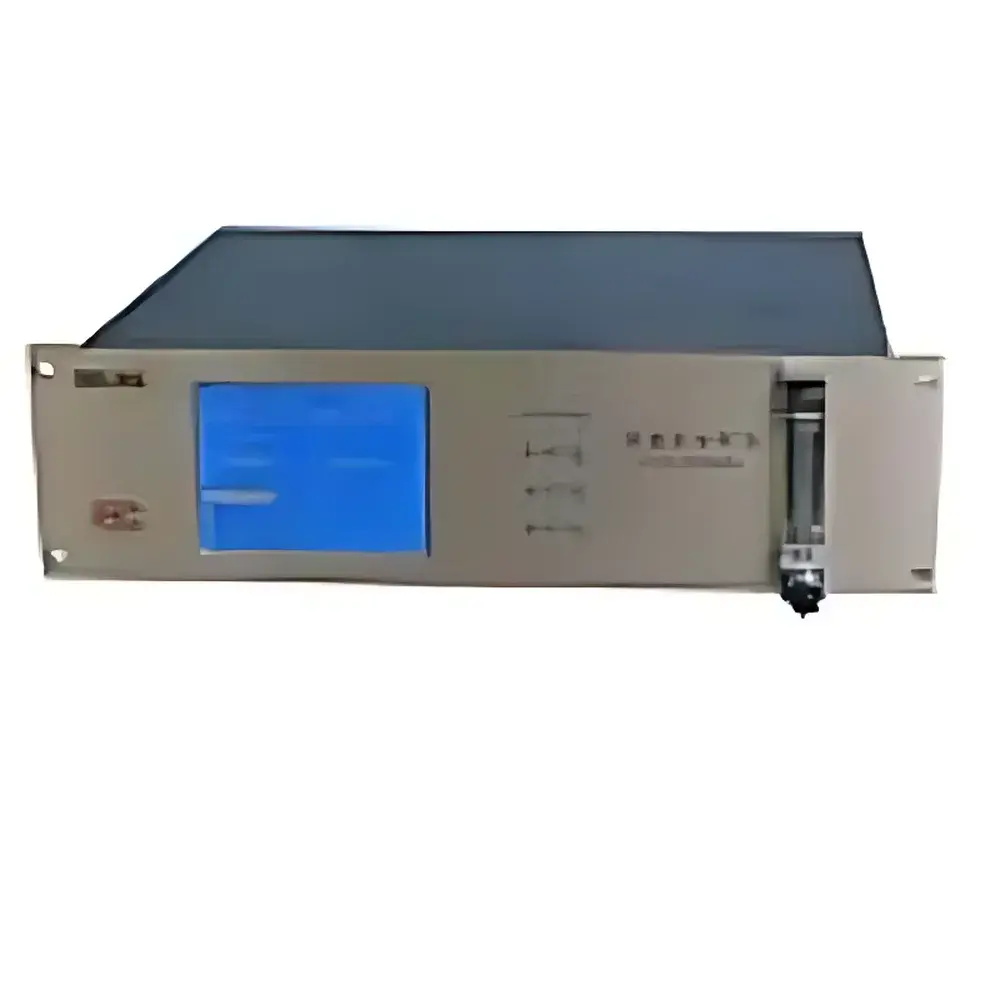
SIELINS XLZ-1090GXH Multi-Gas Infrared Analyzer for Biogas Composition Monitoring
| Brand | SIELINS |
|---|---|
| Model | XLZ-1090GXH |
| Type | Online Fixed-Mount Gas Analyzer |
| Measurement Principle | NDIR (Non-Dispersive Infrared) |
| Target Gases | CH₄, CO₂, O₂, CO, H₂S, SO₂, NH₃ |
| Detection Range | CH₄: 0–100% vol |
| CO₂ | 0–50% vol |
| O₂ | 0–20% vol |
| H₂S | 0–1000 ppm |
| Minimum Detectable Range | 0–50 ppm |
| Resolution | CH₄/O₂/CO₂: 0.1% vol |
| H₂S | 1 ppm |
| Repeatability | ≤1% FS |
| Linearity Error | ≤±1% FS |
| Zero Drift | ≤±1% FS / 48 h |
| Span Drift | ≤±1% FS / 48 h |
| Response Time (T₉₀) | ≤10 s |
| Warm-up Time | 15 min |
| Output Signals | Isolated 4–20 mA (default), 0–5 V DC, RS232 serial interface |
| Power Supply | AC 220 V ±10% / 50 Hz or DC 12 V |
| Enclosure | 19″ rack-mount (standard industrial chassis) |
| Compliance | Designed for continuous emission monitoring (CEMS) and process gas analysis per ISO 14644-1 cleanroom air guidance, ASTM D1945 & D1946 for gas composition, and compatible with GLP/GMP data integrity requirements via optional audit-trail-enabled software |
Overview
The SIELINS XLZ-1090GXH is a fixed-installation, multi-component infrared gas analyzer engineered for continuous, real-time quantification of key biogas constituents—including methane (CH₄), carbon dioxide (CO₂), oxygen (O₂), hydrogen sulfide (H₂S), carbon monoxide (CO), sulfur dioxide (SO₂), and ammonia (NH₃)—within complex gas matrices. It operates on the principle of Non-Dispersive Infrared (NDIR) spectroscopy: a broadband infrared source emits radiation through a dual-compartment measurement cell (reference and sample), where target gases absorb specific wavelengths proportional to their concentration. Advanced pyroelectric or photonic detectors capture differential absorption signals, which are digitally processed using high-stability algorithms to deliver calibrated concentration values. Unlike tunable diode laser (TDLAS) or electrochemical systems, the XLZ-1090GXH leverages single-source, split-cell architecture with precision optical filtering—ensuring robustness against vibration, particulate interference, and ambient temperature fluctuations common in field-deployed biogas upgrading, landfill gas recovery, and anaerobic digestion facilities.
Key Features
- Simultaneous NDIR-based detection of up to seven gases in a single instrument platform, eliminating need for multiple analyzers or external gas conditioning modules
- Dual-range auto-switching capability with user-definable intermediate range thresholds—enabling accurate measurement across low-concentration trace contaminants (e.g., H₂S at 1 ppm) and high-volume bulk components (e.g., CH₄ up to 100% vol)
- Industrial-grade 19″ rack-mount chassis conforming to IEC 60297-3-100; designed for integration into PLC-controlled skids, CEMS cabinets, or centralized control rooms
- Backlit monochrome LCD with full Chinese-language menu navigation (English firmware option available); includes contextual operation prompts and guided calibration workflows
- Isolated analog outputs (4–20 mA and 0–5 V DC, both configurable) compliant with ISA-50.00.01 signal standards; RS232 interface supports Modbus RTU protocol for DCS/SCADA connectivity
- Digital zero/span calibration routines with manual and automatic modes; built-in fault diagnostics with discrete relay outputs for alarm, calibration status, and system error reporting
Sample Compatibility & Compliance
The XLZ-1090GXH accepts conditioned sample gas streams within standard operating conditions: 0–45 °C ambient temperature, <90% RH non-condensing, and inlet pressure of 100–120 kPa absolute. Sample gas must be filtered to ≤1 µm particulate size and dried to dew point ≤−20 °C to prevent optical window fouling or condensation in the measurement cell. The analyzer meets electromagnetic compatibility (EMC) requirements per IEC 61326-1 for industrial environments and is suitable for installation in Zone 2 hazardous areas when paired with appropriate barrier systems (ATEX/IECEx certification not inherent but achievable via external safety barriers). Its measurement methodology aligns with ASTM D1945 (Standard Test Method for Analysis of Natural Gas by Gas Chromatography) and ASTM D1946 (Standard Practice for Analysis of Reformed Gas) for comparative validation. Data handling supports 21 CFR Part 11 readiness when used with validated third-party data acquisition software featuring electronic signatures and audit trails.
Software & Data Management
While the XLZ-1090GXH operates autonomously via front-panel controls, optional PC-based data acquisition software enables long-term trend logging, report generation (PDF/CSV), and remote configuration. The software implements time-stamped event logging for all calibration actions, alarm triggers, and output changes—supporting GLP-compliant record retention. Raw sensor outputs and processed concentration values are timestamped with millisecond resolution and synchronized to system clock (NTP-compatible via Ethernet gateway add-on). All configuration parameters—including span gas assignments, alarm thresholds, and linearization coefficients—are stored in non-volatile memory with checksum verification. Firmware updates are performed via secure UART or RS232, requiring physical access and authenticated credentials to prevent unauthorized modification.
Applications
- Continuous monitoring of raw and upgraded biogas in anaerobic digesters, landfill gas collection systems, and wastewater treatment plants—ensuring compliance with EN 16723-1 (biomethane quality specifications) and local grid injection standards
- Process control in biogas-to-energy facilities, where real-time CH₄/CO₂ ratio informs combustion optimization and engine load management
- Emission source testing in municipal solid waste incinerators and cement kilns, supporting EPA Method 3A and ISO 10849 for CO/CO₂/SO₂ quantification
- Indoor air quality (IAQ) surveillance in agricultural biogas storage barns and manure-handling facilities—monitoring H₂S exposure risks per OSHA PEL and ACGIH TLV guidelines
- Research-grade gas composition profiling during laboratory-scale digestion experiments, syngas fermentation studies, and catalyst performance evaluation under varying substrate loads
FAQ
What gases can the XLZ-1090GXH measure simultaneously?
The analyzer is configured to measure CH₄, CO₂, O₂, and H₂S as standard. Additional channels for CO, SO₂, and NH₃ require factory configuration and dedicated optical filters—subject to cross-sensitivity validation per ISO 21258.
Is the instrument certified for use in explosive atmospheres?
The base unit is not intrinsically safe; however, it may be installed in Zone 2 classified areas when connected via approved galvanic isolators and housed in explosion-proof enclosures meeting IEC 60079-0 and IEC 60079-15.
Can the device perform automatic zero calibration without external gas?
Yes—using internal reference cells and temperature-compensated baseline correction algorithms—but periodic verification with certified span gases (e.g., 2% CH₄ in N₂) is required per ISO 13571 for measurement traceability.
What maintenance intervals are recommended for field operation?
Optical windows should be inspected and cleaned every 90 days in high-dust environments; detector and source lifetime exceeds 5 years under typical biogas sampling conditions (per manufacturer MTBF data).
Does the analyzer support MODBUS TCP or only RS232?
RS232 is native; MODBUS TCP requires an external protocol converter or optional Ethernet communication module (sold separately).
Related Products







