
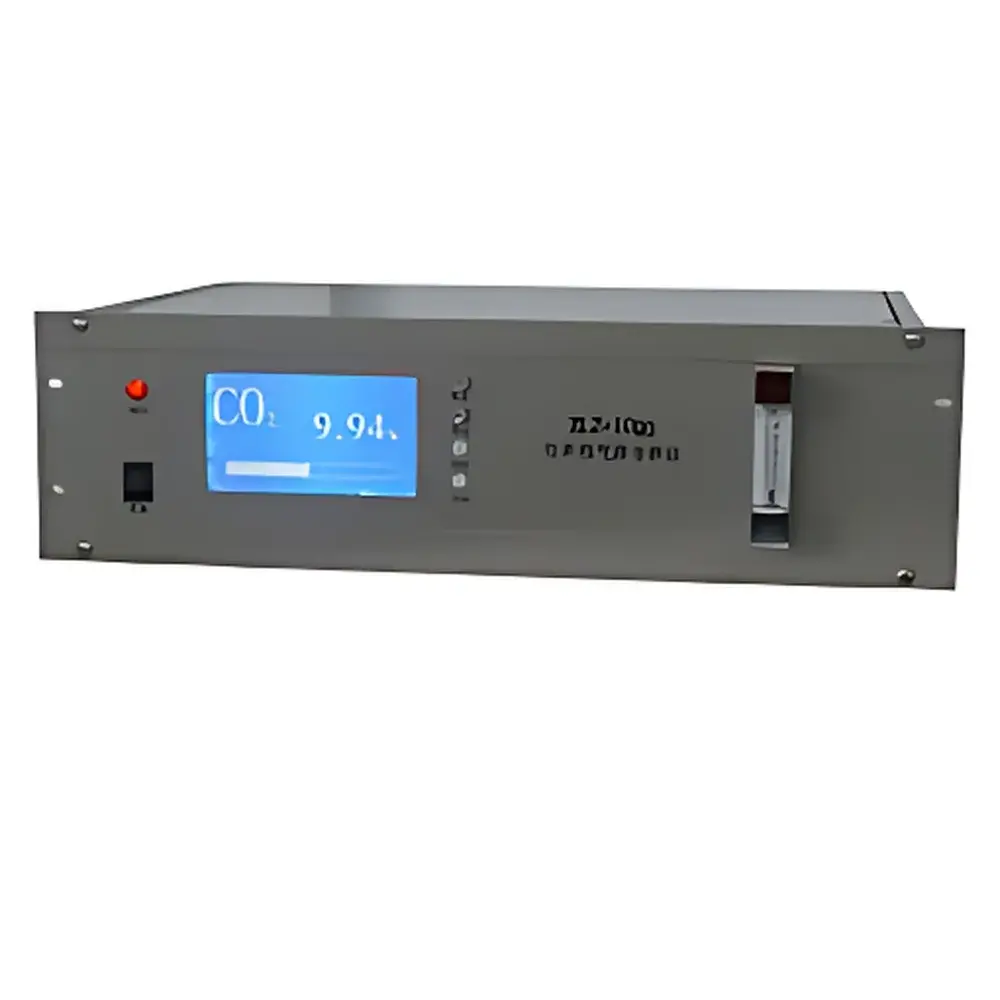
SIELINS XLZ-1090GXH NDIR Carbon Monoxide Analyzer
| Brand | SIELINS |
|---|---|
| Origin | Beijing, China |
| Model | XLZ-1090GXH |
| Type | Online Fixed-Mount Gas Analyzer |
| Detection Principle | Non-Dispersive Infrared (NDIR) |
| Target Gas | CO (single-component) |
| Measurement Range | 0–50 ppm (minimum span) |
| Repeatability | ≤1% of full scale |
| Resolution | 1 ppm (trace level), ≤0.01% v/v (high-concentration mode) |
| Response Time | T90 ≤15 s |
| Zero Drift | ≤±1% FS / 48 h |
| Span Drift | ≤±1% FS / 48 h |
| Linearity Error | ≤±1% FS |
| Sample Flow Rate | 0.5–3 L/min |
| Operating Temperature | 0–40 °C |
| Relative Humidity | ≤90% RH (non-condensing) |
| Power Supply | 220 V ±10%, 50 ±0.5 Hz, 150 W |
| Analog Outputs | 4–20 mA, 0–20 mA, 0–10 mV, 1–5 V (configurable, load-independent up to 600 Ω) |
| Display | Digital LCD with real-time concentration readout |
Overview
The SIELINS XLZ-1090GXH is a fixed online non-dispersive infrared (NDIR) carbon monoxide (CO) analyzer engineered for continuous, selective, and stable quantification of CO in complex gas matrices. It operates on the fundamental spectroscopic principle that CO exhibits characteristic absorption bands in the mid-infrared region—specifically near 4.6 µm—where interference from common background gases (e.g., CO₂, H₂O, CH₄, N₂, O₂) is minimized. Unlike dispersive systems requiring optical gratings or filters, this instrument employs a single broadband infrared source, a dual-compartment (half-cell) measurement chamber, and a high-stability pyroelectric or micro-machined thermopile detector optimized for CO-specific signal discrimination. The optical path design ensures minimal cross-sensitivity and robust immunity to vibration and thermal gradient effects. Signal processing leverages digital filtering, temperature-compensated baseline correction, and real-time drift compensation algorithms—enabling reliable operation under industrial ambient conditions without frequent recalibration.
Key Features
- True NDIR architecture with single-beam, dual-compartment gas cell for inherent reference stability and reduced optical misalignment risk
- High-selectivity detection at 4.6 µm using narrowband spectral filtering and matched detector responsivity
- Digital signal processing engine with auto-zero tracking and span validation logic compliant with ISO 12039 and EN 15267-3 functional requirements
- Wide dynamic range: configurable spans from 0–50 ppm (for ambient air quality monitoring) up to 0–100% v/v (for industrial process safety applications)
- Low-power, fan-cooled thermal management ensuring consistent detector operating temperature across 0–40 °C ambient
- Modular analog output interface supporting 4–20 mA current loop (HART-compatible), voltage outputs (1–5 V), and optional RS-485 Modbus RTU for integration into SCADA or DCS platforms
- Backlit LCD display with dual-line readout: real-time CO concentration + status indicators (flow OK, zero/scale alarm, sensor health)
Sample Compatibility & Compliance
The XLZ-1090GXH is validated for use with dry or moderately humid sample streams (≤90% RH, non-condensing). For high-moisture or particulate-laden applications (e.g., flue gas, biogas), an external conditioned sampling system—including particulate filter, moisture trap, and flow regulator—is required upstream. The analyzer complies with electromagnetic compatibility standards per IEC 61326-1 (industrial environment) and meets safety requirements per IEC 61010-1. While not intrinsically safe certified, it is suitable for Zone 2/Class I Div 2 environments when installed with appropriate barrier systems. Its performance characteristics align with EPA Method 10 (CO determination in stationary sources) and supports data integrity workflows compatible with GLP and ISO/IEC 17025 laboratory accreditation frameworks.
Software & Data Management
The device includes embedded firmware with non-volatile memory for storing calibration history, zero/span events, and diagnostic logs (e.g., detector signal amplitude, chamber temperature, flow rate). Optional PC-based configuration software enables remote setup of alarm thresholds, output scaling, and communication parameters via USB-to-RS485 adapter. All analog outputs are traceable to NIST-traceable calibration gases (certified CO/N₂ mixtures), and the unit supports periodic verification per ASTM D6522 or ISO 4037-3 protocols. Audit trail functionality records user-initiated actions (e.g., manual zero, span adjustment) with timestamp and operator ID—meeting basic FDA 21 CFR Part 11 record-keeping expectations when deployed in regulated QA/QC environments.
Applications
- Ambient air quality monitoring networks (urban, roadside, landfill perimeter)
- Continuous emissions monitoring systems (CEMS) for combustion sources: coal-fired boilers, incinerators, cement kilns
- Industrial hygiene surveillance in garages, tunnels, parking structures, and confined workspaces
- Process control in syngas production, methanol synthesis, and hydrogen purification units where CO is a critical impurity
- Research-grade combustion analysis in engine test cells and furnace laboratories
- Indoor air quality (IAQ) compliance verification in commercial buildings and healthcare facilities per ASHRAE Standard 62.1
FAQ
What gases can the XLZ-1090GXH measure simultaneously?
It is configured for single-component analysis—primarily CO—but can be factory-calibrated for CO₂, SO₂, CH₄, or NH₃ upon order. Multi-gas capability requires separate dedicated analyzers or a multi-channel platform.
Is field calibration possible without specialized equipment?
Yes—zero calibration uses certified zero air; span calibration requires a certified CO standard gas cylinder (e.g., 25 ppm CO in N₂). Both procedures are guided by on-screen prompts and require no disassembly.
Does the analyzer require regular consumables?
No consumables are used. The NDIR light source has a typical lifetime exceeding 5 years under continuous operation. Only routine maintenance includes periodic optical window cleaning and inlet filter replacement every 6–12 months depending on sample cleanliness.
Can it be integrated into a building management system (BMS)?
Yes—via its 4–20 mA output or Modbus RTU interface. Configuration tools support BACnet MS/TP gateway mapping for seamless integration into legacy and modern BMS architectures.
What is the recommended calibration frequency for regulatory compliance?
For EPA-compliant CEMS applications, daily automatic zero checks and weekly span validations are recommended. For occupational health monitoring, quarterly full calibration is sufficient per OSHA 1910.1200 guidelines.
Related Products







