
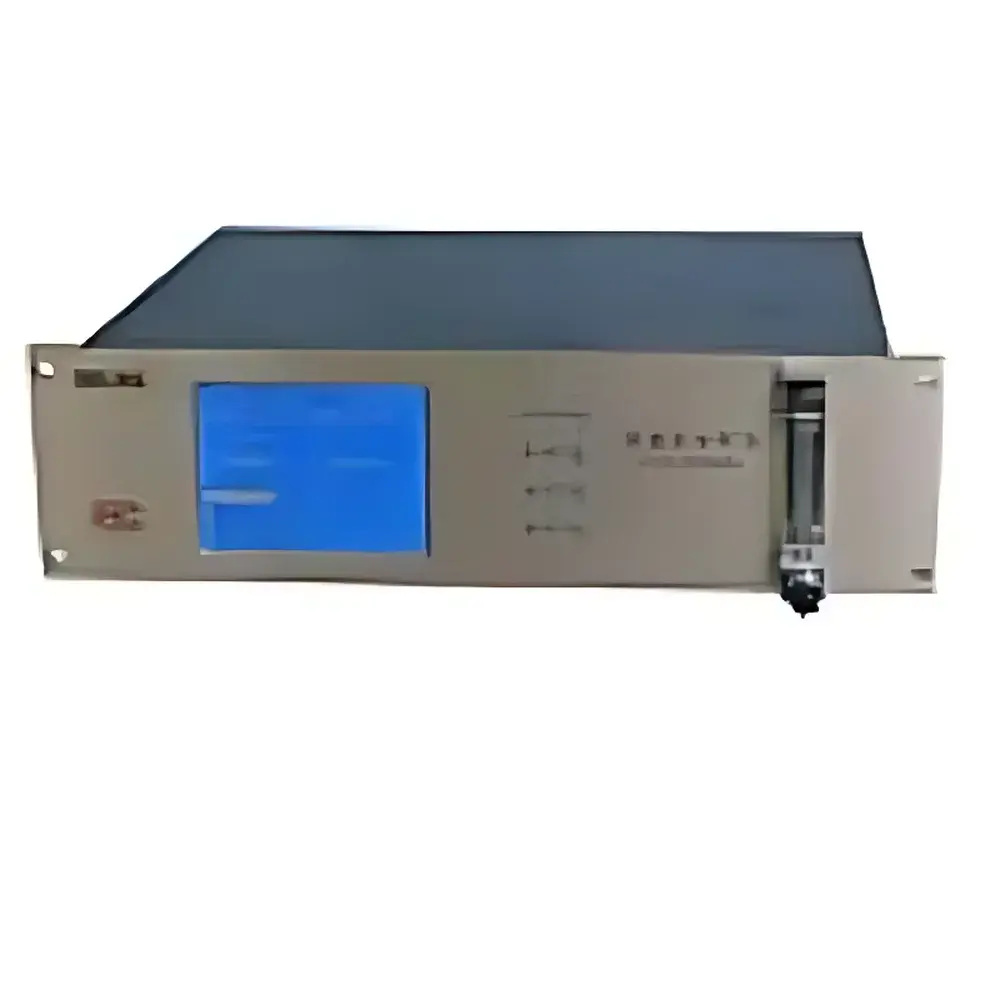
SIELINS XLZ-1090GXH Online NDIR Methane (CH₄) Analyzer
| Brand | SIELINS |
|---|---|
| Model | XLZ-1090GXH |
| Type | Online Gas Analyzer |
| Detection Principle | Non-Dispersive Infrared (NDIR) |
| Measurement Target | Single-component CH₄ |
| Range | 0–50 ppm (standard minimum), up to 0–100% vol (configurable) |
| Repeatability | ≤1% of full scale |
| Resolution | 0.1 ppm |
| Response Time (T₉₀) | ≤20 s |
| Zero Drift | ≤±1% FS/48 h (high-concentration mode) |
| Span Drift | ≤±1% FS/48 h (high-concentration mode) |
| Linearity Error | ≤±2% FS |
| Display | Backlit LCD with Chinese menu interface |
| Output Signals | Isolated 4–20 mA (default), 0–20 mA, 0–5 V, 1–5 V (selectable) |
| load | ≤400 Ω for current, ≥250 Ω for voltage |
| Communication | RS232 standard |
| Housing | 19" rack-mount chassis (483 mm W × 177 mm H × 300 mm D) |
| Compliance | Designed for continuous emission monitoring (CEM), industrial process control, and ambient air quality applications per ISO 12039, ASTM D6522, and EN 15267-3 guidelines |
Overview
The SIELINS XLZ-1090GXH Online NDIR Methane (CH₄) Analyzer is a fixed-installation, single-component gas analyzer engineered for continuous, real-time quantification of methane concentration in complex gas matrices. It operates on the principle of non-dispersive infrared (NDIR) absorption spectroscopy—leveraging the characteristic vibrational absorption band of CH₄ near 3.3 µm. The instrument employs a dual-beam optical architecture featuring a single infrared source, a split-path measurement/reference gas cell, and a high-stability pyroelectric detector. This design eliminates interference from dust, humidity fluctuations, and background gas absorption through differential signal processing and temperature-compensated signal conditioning. Unlike filter-wheel or tunable-laser systems, the XLZ-1090GXH delivers robust performance without moving parts or consumables, making it suitable for unattended operation in harsh industrial and environmental monitoring environments.
Key Features
- Rack-mount 19″ chassis (483 mm × 177 mm × 300 mm) compatible with standard control cabinets and CEMS enclosures
- High-resolution backlit LCD display with intuitive Chinese-language menu navigation and context-sensitive operation prompts
- Dual-mode calibration support: manual or automated zero/span adjustment; optional mid-range point verification for extended linearity validation
- Fully digital signal processing chain—including 24-bit ADC, adaptive baseline correction, and real-time drift compensation algorithms
- Configurable analog outputs: isolated 4–20 mA (default), 0–20 mA, 0–5 V, or 1–5 V, compliant with IEC 61000-6-2/6-4 EMC standards
- Standard RS232 serial interface supporting Modbus RTU protocol for integration into SCADA, DCS, or PLC-based control systems
- Optimized thermal management ensuring stable optical path alignment across ambient temperatures from –10 °C to +50 °C
Sample Compatibility & Compliance
The XLZ-1090GXH is designed for direct sampling of dry or conditioned gas streams with particulate filtration (≤1 µm) and moisture removal (dew point < 5 °C). It accommodates inlet pressures from 70–110 kPa and flow rates of 0.5–2.0 L/min. The analyzer meets functional requirements for continuous emissions monitoring (CEMS) under China’s HJ 75–2017 and HJ 76–2017 technical specifications. Its metrological performance aligns with international reference methods including ISO 12039 (stationary source emissions — determination of methane and other volatile organic compounds), ASTM D6522 (standard test method for determination of methane in ambient air by gas chromatography), and EN 15267-3 (performance certification of automated measuring systems). While not intrinsically safe, the unit may be deployed in Zone 2 classified areas when installed with appropriate barrier systems and housed in explosion-proof enclosures per ATEX Directive 2014/34/EU.
Software & Data Management
Data logging and system diagnostics are managed via embedded firmware supporting time-stamped event records—including calibration events, alarm triggers, power cycles, and sensor fault codes. The RS232 interface enables bidirectional communication for remote configuration, real-time data polling, and firmware updates. Optional PC-based software (provided separately) supports historical trend visualization, compliance reporting (e.g., 15-min average values, daily uptime metrics), and audit-trail generation compliant with GLP/GMP principles. All output signals include hardware-level isolation (>1500 VDC) to prevent ground-loop interference—a critical requirement for integration into distributed control architectures in petrochemical and power-generation facilities.
Applications
- Continuous monitoring of CH₄ emissions from municipal landfills, wastewater treatment plants, and biogas upgrading units
- Process gas analysis in natural gas transmission stations, LNG terminals, and refinery flare stacks
- Leak detection and repair (LDAR) programs in upstream oil & gas operations
- Ambient air quality monitoring networks for urban and rural background stations (in accordance with WHO and EU Air Quality Directives)
- Control feedback for combustion optimization in industrial boilers and incinerators
- Research-grade CH₄ quantification in agricultural soil flux chambers and controlled-environment laboratories
FAQ
What is the recommended sample conditioning system for humid or particulate-laden gas streams?
A heated sample line (maintained at >60 °C), stainless-steel particulate filter (0.3 µm absolute rating), and Nafion™-based permeation dryer are strongly advised to prevent condensation and optical contamination.
Can the XLZ-1090GXH measure CH₄ in the presence of CO₂ or water vapor?
Yes—the NDIR optical filter and dual-beam compensation minimize cross-sensitivity to CO₂ (absorption at 4.26 µm) and H₂O (broadband IR absorption); typical interferences are <±0.5% FS for CO₂ up to 10% v/v and <±0.3% FS for H₂O up to 2% v/v.
Is the instrument certified for use in safety-critical applications such as explosion hazard zones?
The base unit is not ATEX or IECEx certified; however, it may be integrated into certified systems using approved intrinsic safety barriers and explosion-proof housings per local regulatory requirements.
How often should zero and span calibration be performed?
For regulatory compliance (e.g., EPA Method 21 or HJ 75–2017), daily automatic zero checks and weekly multi-point span verification are recommended; field calibration frequency may be extended to monthly under stable operating conditions with documented drift history.
Does the analyzer support remote diagnostics or predictive maintenance alerts?
Yes—embedded self-diagnostics monitor detector signal-to-noise ratio, lamp intensity decay, and temperature stability; abnormal trends trigger configurable relay outputs and log entries for proactive service intervention.







