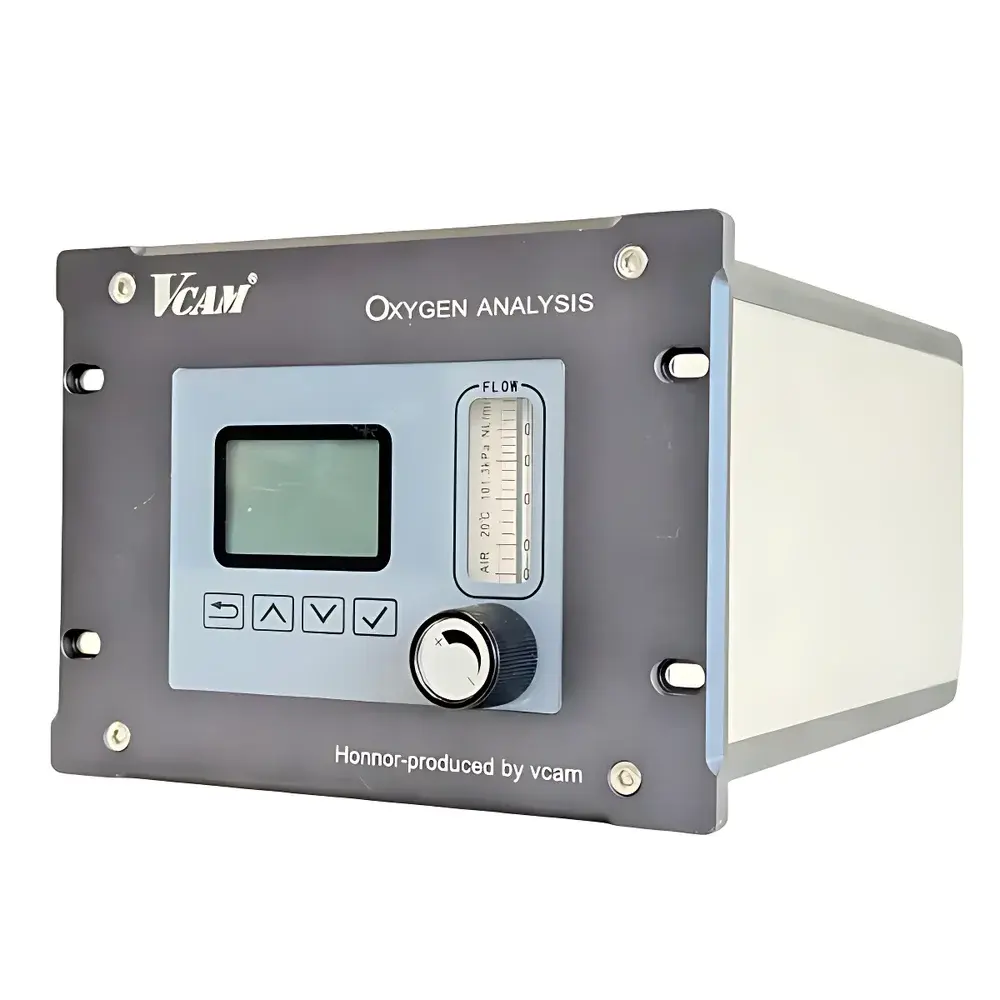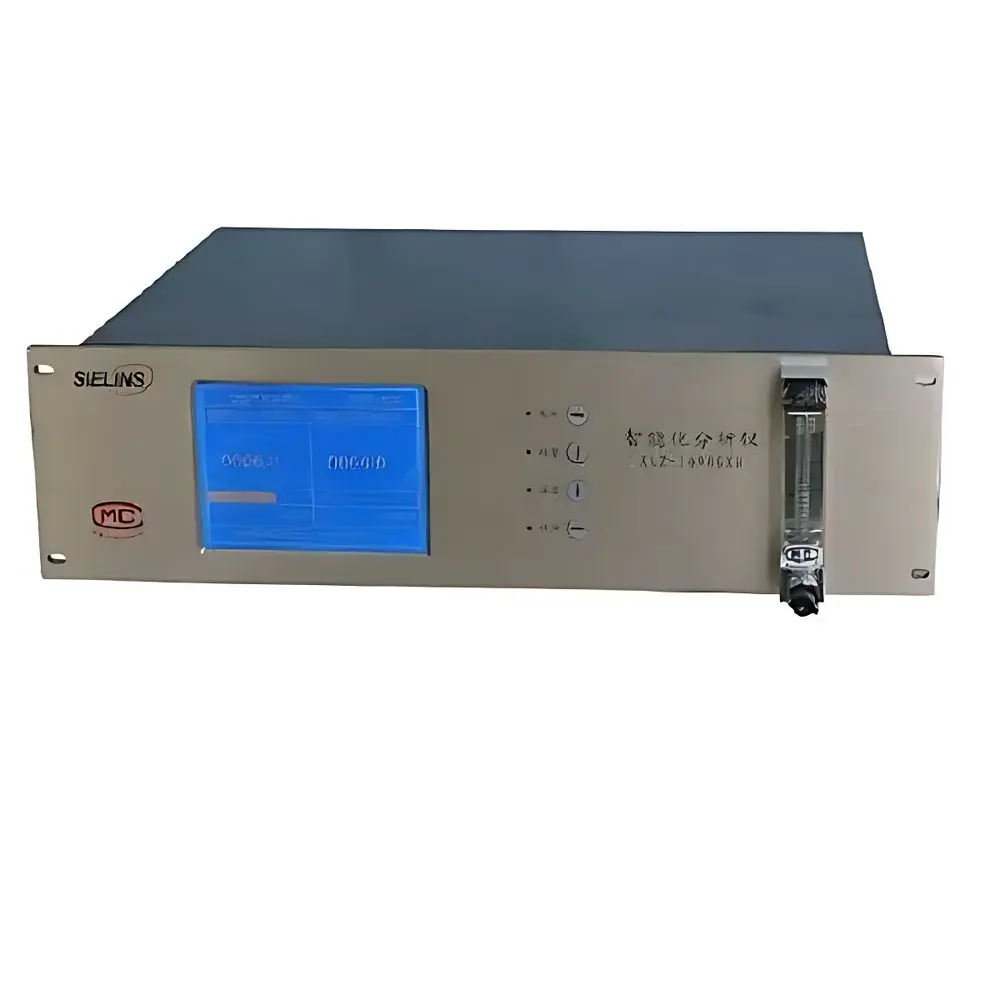
SIELINS XLZ-1090JRD Thermal Conductivity Hydrogen Analyzer
| Brand | SIELINS |
|---|---|
| Model | XLZ-1090JRD |
| Measurement Principle | Thermal Conductivity Detection |
| Measurement Range | 0–100% H₂ (selectable sub-ranges: 0–1%, 0–10%, 35–75%, 40–80%, 75–100%, 80–100%) |
| Zero Drift | ±1% FS |
| Span Drift | ±1% FS |
| Linearity Error | ±1% FS |
| Repeatability | ≤0.5% FS |
| Response Time (T₉₀) | ≤25 s |
| Power Consumption | <80 W (including heater) |
| Supply Voltage | (220 ± 22) VAC, (50 ± 0.5) Hz |
| Operating Temperature | 5–40 °C |
| Relative Humidity | ≤80% RH |
| Enclosure | 19" rack-mount chassis (standard industrial format) |
| Output Signals | Isolated 4–20 mA (default), 0–20 mA, 0–5 V, 1–5 V (load-dependent) |
| Communication Interface | RS232 (ASCII protocol) |
| Weight | ~10 kg |
| Environmental Constraints | Non-corrosive atmosphere |
Overview
The SIELINS XLZ-1090JRD Thermal Conductivity Hydrogen Analyzer is a fixed-mount, continuous-duty process analyzer engineered for real-time quantification of hydrogen concentration in binary or multi-component gas streams. It operates on the fundamental physical principle of differential thermal conductivity: hydrogen exhibits a thermal conductivity approximately seven times greater than that of nitrogen and over six times greater than air, enabling highly selective detection without chemical reaction or consumables. This makes the XLZ-1090JRD particularly suited for safety-critical and process-optimization applications where catalytic or electrochemical sensors may suffer from poisoning, drift, or limited lifetime. The instrument is designed for integration into distributed control systems (DCS), programmable logic controllers (PLC), and centralized monitoring architectures across energy, chemical, nuclear, and power generation facilities.
Key Features
- Rack-mount 19″ industrial chassis compliant with IEC 60297-3-100, facilitating seamless integration into control cabinets and analyzer shelters.
- High-stability dual-sensor thermal conductivity cell with temperature-controlled reference and measurement arms, minimizing ambient-induced drift.
- Full digital signal processing architecture with auto-zero and auto-span calibration routines—supporting both manual initiation and scheduled automated calibration sequences.
- Dual-range capability with automatic switching logic to maintain optimal signal-to-noise ratio across wide dynamic concentration spans (e.g., trace-level leak detection and high-purity verification).
- Isolated analog outputs (4–20 mA and 1–5 V default) with configurable fault signaling—each output electrically isolated per IEC 61000-4-5 surge immunity standards.
- RS232 serial interface supporting ASCII-based command-response protocol for remote configuration, data logging, and diagnostic interrogation via host PC or SCADA system.
- Backlit graphical LCD with intuitive Chinese-language menu navigation, contextual operation prompts, and real-time status indicators for calibration, alarm, and sensor health.
Sample Compatibility & Compliance
The XLZ-1090JRD is validated for use with dry, non-corrosive gas matrices including N₂, Ar, CO₂, CH₄, and air-based mixtures. Sample conditioning (filtration, pressure regulation, and moisture removal) is required upstream when analyzing process streams containing particulates, condensables, or acidic components. While not intrinsically safe certified, the analyzer meets EMC Directive 2014/30/EU and Low Voltage Directive 2014/35/EU for CE marking. Its design aligns with functional safety expectations for SIL 1-rated monitoring loops per IEC 61508 when deployed with appropriate system-level redundancy and validation. For nuclear applications, it supports ASME NQA-1 compliance documentation packages upon request, and its response time and repeatability meet typical requirements for hydrogen concentration surveillance in containment atmospheres per IEEE 383 and EPRI TR-102323 guidelines.
Software & Data Management
The analyzer does not include embedded firmware-based data storage but provides real-time analog and serial telemetry compatible with industry-standard historian platforms (e.g., OSIsoft PI System, Emerson DeltaV DCS, Siemens Desigo CC). RS232 communication supports polling at user-defined intervals (1–60 s), returning calibrated %H₂ values alongside diagnostic flags (e.g., sensor fault, heater timeout, zero deviation alert). Configuration parameters—including range selection, output scaling, alarm thresholds, and calibration gas values—are retained in non-volatile memory with battery-backed SRAM. Audit trail functionality is implemented at the system level through external DCS logging; while the device itself does not provide FDA 21 CFR Part 11-compliant electronic signatures, its deterministic output behavior and traceable calibration records support GLP/GMP-aligned validation protocols when integrated into qualified infrastructure.
Applications
- Ammonia synthesis loop monitoring in nitrogen–hydrogen feed gas, ensuring stoichiometric ratio control and catalyst protection.
- Hydrogen coolant purity assurance in turbine generators and synchronous condensers, preventing explosive mixtures and optimizing heat transfer efficiency.
- Containment atmosphere surveillance in pressurized water reactors (PWRs) and boiling water reactors (BWRs), detecting post-accident hydrogen accumulation per severe accident management guidelines (SAMGs).
- Hydrogen purity certification in on-site electrolysis or PSA-based hydrogen production units, meeting ISO 8573-1 Class 2 or CGA G-5.1 Grade A specifications.
- Combustion gas analysis in research-scale burners and flame stability studies, where rapid thermal conductivity response enables transient H₂ profiling.
FAQ
What gases can interfere with hydrogen measurement using this analyzer?
Interference occurs primarily from gases with thermal conductivities close to hydrogen—such as helium (He) and methane (CH₄)—if present above 0.5% v/v in the sample matrix. Nitrogen, argon, carbon dioxide, and oxygen exhibit sufficiently distinct thermal conductivities and do not cause significant cross-sensitivity under normal operating conditions.
Is sample conditioning required before installation?
Yes. Inlet gas must be filtered to ≤1 µm, dried to a dew point below −20 °C, and regulated to 100–150 kPa absolute. Condensate traps, coalescing filters, and pressure-reducing regulators are mandatory for long-term reliability.
Can the XLZ-1090JRD be used in hazardous areas?
No. It is rated for general-purpose indoor or sheltered outdoor environments (IP54 enclosure). Explosion-proof variants require third-party certification and mechanical redesign—not supported by standard configuration.
How often should calibration be performed?
Initial calibration is recommended at commissioning using certified H₂/N₂ standard gases. Subsequent verification frequency depends on application criticality: quarterly for non-safety systems; monthly for nuclear or hydrogen safety monitoring; and after any maintenance event affecting flow path integrity.
Does the analyzer support Modbus RTU or Ethernet/IP protocols?
No. Native communication is limited to RS232 ASCII. Protocol conversion to Modbus RTU or EtherNet/IP requires an external industrial protocol gateway configured as a transparent serial bridge.