
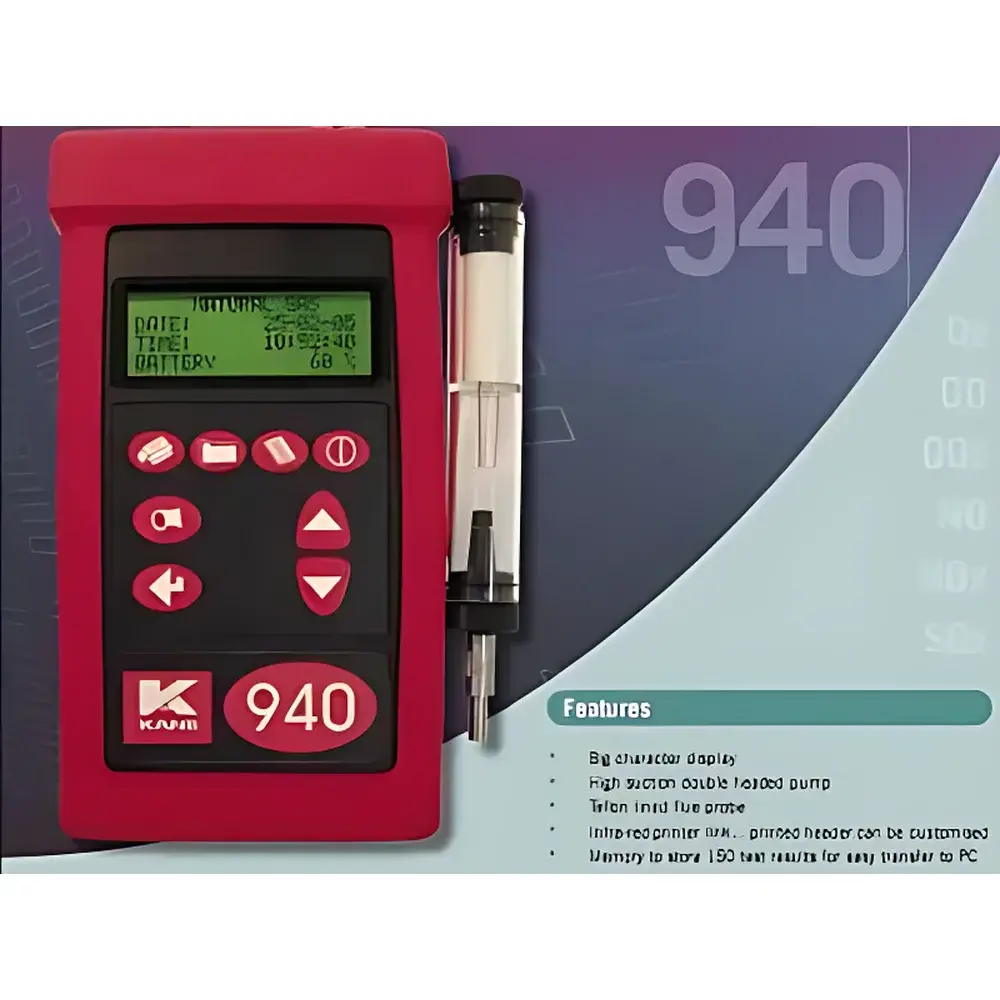
SIELINS XLZ-940 Flue Gas Analyzer
| Brand | SIELINS |
|---|---|
| Origin | Beijing, China |
| Model | XLZ-940 |
| Price Range | USD 7,000–14,000 (FOB) |
| Instrument Type | Portable Multi-Gas Flue Gas Analyzer |
| Accuracy | ≤ ±5% FS (SO₂, CO, NO, NO₂, CO₂) |
| Repeatability | ≤ 1% RSD |
| Response Time | < 3 s (T₉₀) |
| Stability | Long-term baseline drift < 2% FS/week |
| Measured Gases | O₂, SO₂, CO, NO, NO₂, CO₂ (calculated), flue gas temperature, ambient temperature, differential pressure |
| Sensor Configuration | Interchangeable electrochemical sensors (1–3 toxic gases selectable) |
| Operating Temperature | 0–50 °C |
| Battery Life | Up to 8 h continuous operation (rechargeable Li-ion) |
| Data Storage | 150 measurement sets with timestamp, location tag (optional), and calculated parameters |
Overview
The SIELINS XLZ-940 Flue Gas Analyzer is a portable, microprocessor-controlled emission monitoring instrument engineered for precision combustion efficiency assessment and regulatory-compliant flue gas analysis in industrial boiler systems, thermal power plants, waste incineration facilities, and HVAC commissioning environments. It operates on the principle of selective electrochemical detection for toxic gases (SO₂, CO, NO, NO₂) and paramagnetic or zirconia-based sensing for oxygen, combined with thermocouple-based temperature measurement and piezoresistive differential pressure transduction. All raw sensor outputs are digitally conditioned, temperature-compensated, and linearized in real time using factory-calibrated algorithms traceable to NIST-certified reference standards. The device complies with fundamental performance requirements outlined in EN 15267-3 (performance certification of automated measuring systems), ISO 12039 (determination of SO₂ and NOₓ in flue gases), and supports data integrity practices aligned with ISO/IEC 17025 quality management frameworks.
Key Features
- Integrated dual-sensor probe with PTFE-lined sampling tube to minimize adsorption losses of SO₂ and NOₓ—critical for low-concentration accuracy and repeatability
- High-efficiency internal diaphragm pump capable of sustaining stable flow at suction pressures up to −150 mbar, enabling reliable sampling from high-resistance ducts and economizers
- Simultaneous real-time display of up to eight parameters: O₂ (% vol), flue gas temperature (°C/°F), ambient temperature, ΔP (mbar), and three user-selected gas concentrations (e.g., CO, NO₂, SO₂)
- Onboard calculation engine compliant with DIN 1343 and VDI 2066 for derived combustion metrics: CO₂ (% vol), excess air ratio (λ), combustion efficiency (%), CO/CO₂ ratio, flue gas loss (%), net temperature difference (ΔTnet), and toxicity index (PI)
- Optimized thermal management architecture ensures sensor stability across ambient conditions from 0 °C to 50 °C without active oven control
- Infrared communication interface (IRDA 1.1) for wireless printing via optional KMIRP handheld thermal printer; supports customizable report templates including header fields, unit preferences, and compliance annotations
Sample Compatibility & Compliance
The XLZ-940 is validated for use with dry or moderately humid flue gases containing particulate matter up to 5 g/m³ (with optional KMCPP1 front-end filter). It accommodates standard fuel types—including natural gas, LPG, light oil, bituminous coal, anthracite, and coke—via built-in fuel-specific stoichiometric databases. All electrochemical sensors meet IEC 60079-29-1 explosion protection guidelines for non-hazardous area deployment. While not intrinsically safe, the analyzer conforms to EMC Directive 2014/30/EU and Low Voltage Directive 2014/35/EU. Measurement uncertainty budgets are documented per ISO/IEC Guide 98-3 (GUM), with expanded uncertainties (k=2) reported for each gas channel in the calibration certificate supplied with each unit.
Software & Data Management
Data logging is performed autonomously at user-defined intervals (1–60 s), storing 150 complete measurement records with UTC timestamps, sensor status flags, and calculated parameters. Export is supported via IRDA to PC using bundled Windows-compatible software (XLZ-Link v3.2), which generates CSV and PDF reports compliant with GLP documentation requirements—including operator ID, calibration history, and audit trail of all parameter edits. The software enforces electronic signature capture prior to report finalization and maintains version-controlled firmware update logs. No cloud connectivity is embedded; all data remains under full end-user control—consistent with GDPR and HIPAA-aligned data sovereignty policies.
Applications
- Routine stack testing for EPA Method 7E (SO₂), Method 10 (CO), and Method 7 (NOₓ) pre-screening
- Boiler tuning and optimization per ASME PTC 4 and EN 12952-15 energy performance verification
- Pre-commissioning checks of SCR/SNCR denitrification systems and FGD scrubber bypass validation
- Educational laboratory use in environmental engineering curricula for hands-on emissions metrology training
- Third-party verification audits supporting ISO 50001 energy management system certification
FAQ
What calibration standards are required for field verification?
Certified span gases traceable to NIST or UKAS—typically 500 ppm CO in N₂, 200 ppm NO in air, and 100 ppm SO₂ in N₂—are recommended for quarterly bump tests. Zero air must be oil-free and filtered to < 0.01 µm.
Can the XLZ-940 be used for continuous emissions monitoring (CEMS)?
No—it is designed for periodic grab sampling and manual survey applications, not unattended 24/7 operation. For CEMS, refer to SIELINS’s fixed-mount FG-3000 series with 4–20 mA analog outputs and Modbus TCP support.
Is sensor cross-sensitivity compensated in firmware?
Yes. Factory-loaded interference correction matrices mitigate CO-induced NO₂ signal offset and humidity-dependent SO₂ drift, validated per ISO 12039 Annex B protocols.
How is traceability maintained during battery-powered operation?
Internal RTC (real-time clock) retains UTC time within ±2 s/month drift. All stored records include GPS-optional geotags when paired with external Bluetooth GNSS modules (not included).
What maintenance intervals are specified for the internal pump and filters?
The diaphragm pump requires replacement every 12 months or after 2,000 operating hours. The standard particulate filter (KMC-LP20) should be inspected before each use and replaced if visibly soiled or after 50 hours of high-dust sampling.







