
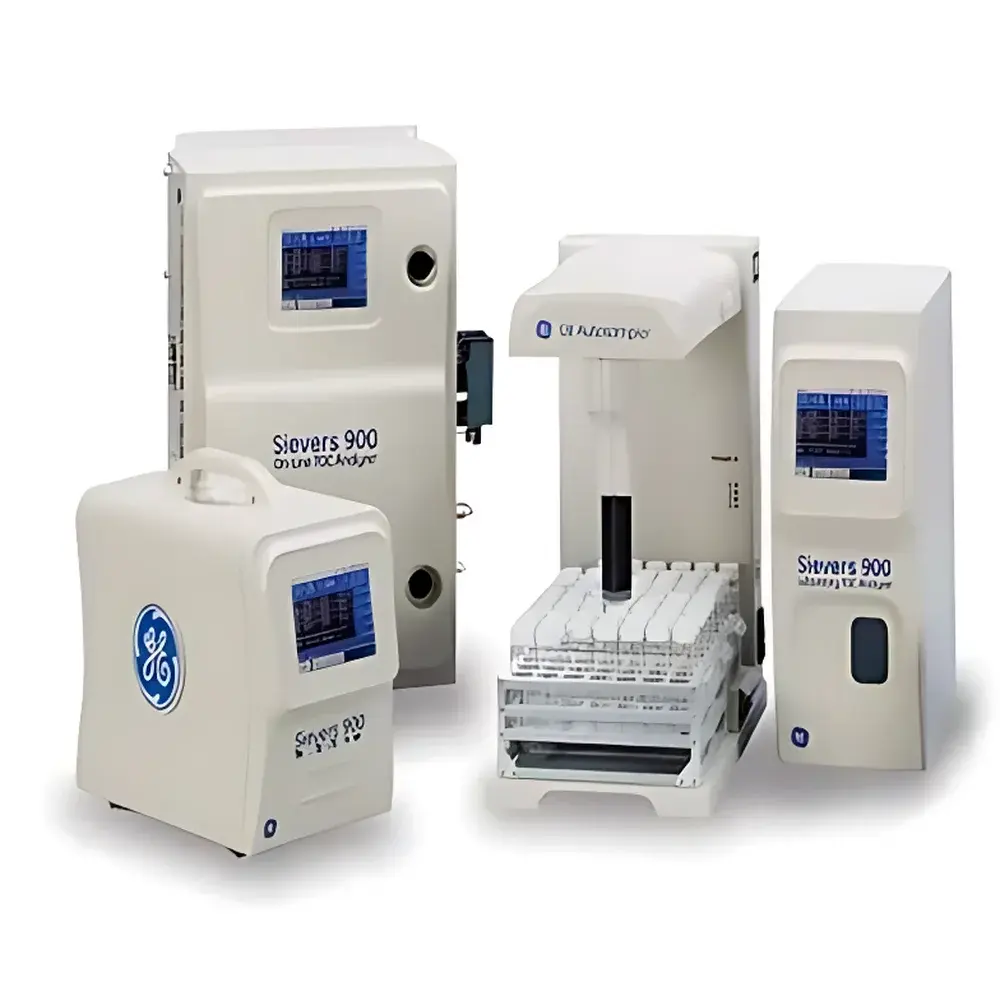
Sievers 900 Total Organic Carbon Analyzer
| Brand | Sievers (Veolia) |
|---|---|
| Origin | USA |
| Model | Sievers 900 |
| Detection Range | 0.03 ppb to 50 ppm |
| Accuracy | ±2% |
| Precision | <1% RSD |
| Oxidation Method | UV/Persulfate |
| Detection Method | Membrane Conductivity |
| Sample Pressure | up to 250 psi |
| Flow Rate | 30–300 mL/min |
| Sample Temperature | 1–95 °C |
| Analysis Time | 4 min (standard), 4 s (rapid module) |
| IP Rating | IP65 |
| Compliance | US EPA Method 5310C, US EPA 415.3, ASTM D7573 |
Overview
The Sievers 900 Total Organic Carbon (TOC) Analyzer is an industrial-grade, online analytical instrument engineered for continuous, real-time TOC monitoring across the full spectrum of water quality applications—from municipal drinking water and wastewater effluent to pharmaceutical-grade purified water (PW) and ultra-pure water (UPW). It employs a validated two-stage measurement principle: first, complete oxidation of non-purgeable organic carbon (NPOC) using high-intensity 185/254 nm UV lamps combined with sodium persulfate under acidic conditions; second, highly selective quantification via Sievers’ proprietary membrane conductivity detection technology. This approach eliminates interferences from inorganic carbon species, chloride, and ionic background, delivering trace-level sensitivity (detection limit: 0.03 ppb C) and exceptional long-term calibration stability (12-month calibration interval certified per ASTM D7573). Designed for unattended operation in demanding production environments, the analyzer features wall-mountable housing rated IP65—ensuring dust-tight and water-jet resistant performance in utility corridors, cleanroom support areas, and outdoor water treatment skids.
Key Features
- Modular architecture with field-replaceable UV lamp, reagent cartridge, and conductivity cell—enabling rapid service without system downtime
- Zero-consumables design: no external gas supply (e.g., zero air or oxygen), no liquid acid or base reagents required beyond factory-loaded persulfate cartridges
- Intuitive 7-inch color touchscreen interface with multilingual (English/Chinese) menus, real-time trend graphs, and configurable alarm thresholds
- Automated daily system suitability testing (SST), multi-point calibration verification, and electronic audit trail compliant with FDA 21 CFR Part 11 requirements
- Integrated Rapid Module option reduces analysis cycle time to 4 seconds for high-frequency process control loops
- Full IQ/OQ/PQ documentation package available—including installation qualification protocols, operational test scripts, and performance qualification reports aligned with GMP Annex 1 and USP
- Support for both continuous flow mode and discrete sampling via optional Integrated Online Sampling (IOS) System™ with programmable sample hold and purge cycles
Sample Compatibility & Compliance
The Sievers 900 accepts liquid samples across a broad physicochemical envelope: inlet pressure up to 250 psi, flow rates adjustable between 30–300 mL/min, and temperature tolerance from 1 °C to 95 °C—making it suitable for hot condensate return lines, reverse osmosis permeate streams, and chilled water distribution systems. Its oxidation efficiency has been verified against recalcitrant compounds including ethylene glycol, sucrose, and humic acid per US EPA Method 5310C and ASTM D7573. Regulatory compliance extends to ISO 9001-certified manufacturing, CE marking for EMC and LVD directives, and full alignment with pharmaceutical water guidance documents including EU GMP Annex 1, WHO TRS 970, and JP 17 General Chapter 2.2.48. Data integrity is enforced through role-based user access control, immutable electronic records, and timestamped calibration logs with digital signature capability.
Software & Data Management
The embedded firmware supports native Modbus TCP/IP, EtherNet/IP, and 4–20 mA analog output for seamless integration into DCS, SCADA, and MES platforms. Optional Sievers Insight™ PC software provides advanced data visualization, automated report generation (PDF/CSV), and historical comparison tools with statistical process control (SPC) charting. All measurement data—including raw conductivity signals, oxidation efficiency metrics, and diagnostic event logs—are stored locally on encrypted internal flash memory with configurable retention policies (default: 90 days). Remote diagnostics via secure TLS-encrypted web interface allow authorized technicians to perform health checks, firmware updates, and parameter adjustments without physical site access—reducing mean time to repair (MTTR) by >65% versus legacy TOC platforms.
Applications
- Pharmaceutical water systems: PW, WFI, and UPW monitoring per USP , EP 2.2.44, and JP 17
- Power generation: boiler feedwater and condensate TOC surveillance to prevent turbine deposit formation
- Microelectronics: UPW loop monitoring for semiconductor fab ultrapure water specifications (SEMI F63)
- Municipal utilities: compliance reporting for disinfection by-product precursor control (DBP precursors)
- Biotechnology: cell culture media preparation and buffer storage tank validation
- Environmental laboratories: accredited analysis of surface water, groundwater, and treated effluent per US EPA 415.3
FAQ
Does the Sievers 900 require daily manual calibration?
No. The analyzer performs automated daily system suitability tests and supports a certified 12-month calibration interval when operated within specified environmental and sample conditions.
Can the instrument measure TOC in high-salinity or chlorinated water?
Yes. The membrane conductivity detector selectively measures CO₂-derived conductivity while rejecting chloride and other ionic interferences—validated for seawater-influenced brackish sources and chloraminated municipal supplies.
Is IQ/OQ/PQ documentation included with the purchase?
Standard delivery includes factory-verified IQ/OQ templates. Full PQ execution, site-specific protocol customization, and regulatory submission support are available as optional professional services.
What maintenance is required annually?
Preventive maintenance requires approximately two hours per year—primarily consisting of UV lamp replacement, membrane cell inspection, and flow path verification using NIST-traceable standards.
How does the Rapid Module differ from standard analysis mode?
The Rapid Module uses optimized UV exposure and shortened reaction dwell time to deliver repeatable 4-second measurements ideal for closed-loop feedback control in high-throughput purification systems.







