
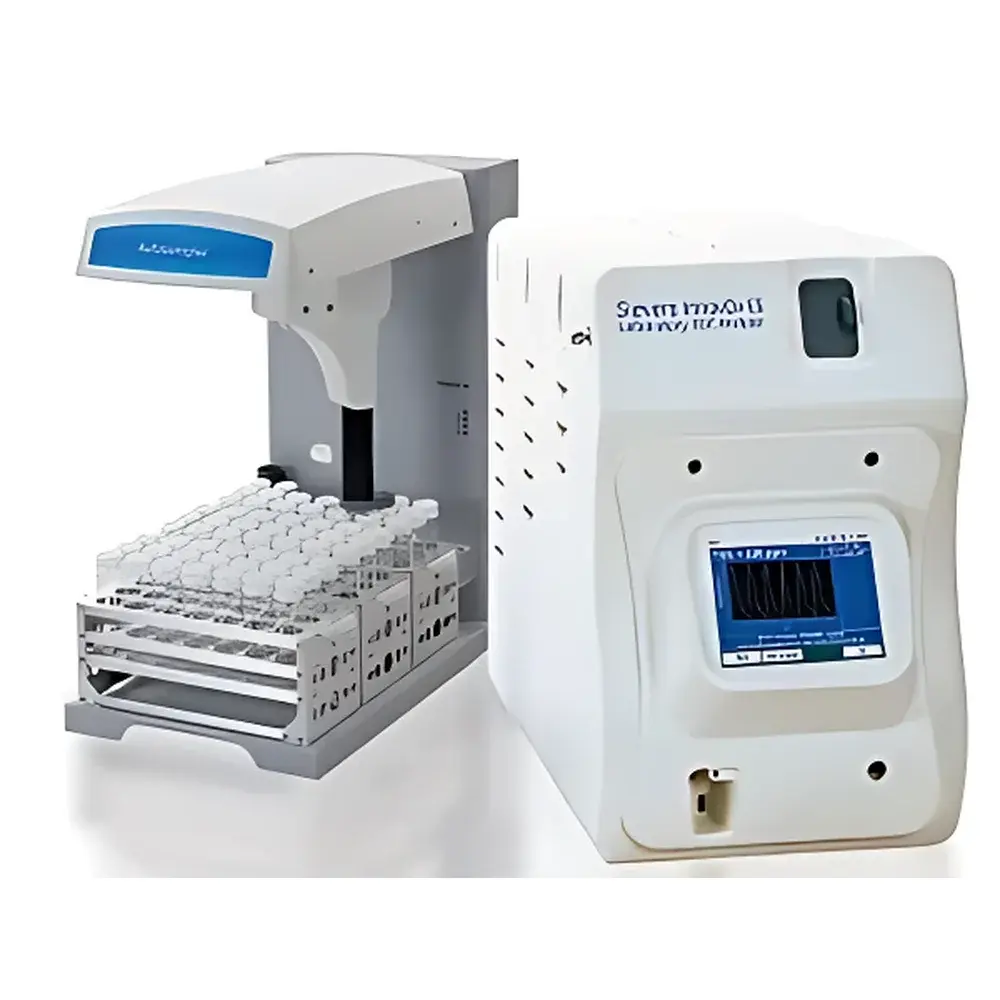
Sievers InnovOx Lab Total Organic Carbon Analyzer
| Brand | Sievers (Veolia) |
|---|---|
| Origin | USA |
| Manufacturer Status | Authorized Distributor |
| Product Category | Imported Instrument |
| Model | Sievers InnovOx Lab |
| Instrument Type | Laboratory TOC Analyzer |
| Detection Principle | Non-Dispersive Infrared (NDIR) Absorption |
| Oxidation Method | Supercritical Water Oxidation (SCWO) |
| Measurement Range | 0.05 ppm – 50,000 ppm TOC |
| Accuracy | ±3% |
| Resolution | 0.05 ppm |
| Detection Limit | 0.05 ppm |
| Repeatability | RSD ≤ 1.5% |
Overview
The Sievers InnovOx Lab Total Organic Carbon Analyzer is a laboratory-grade instrument engineered for precise, robust, and interference-resistant quantification of total organic carbon in challenging aqueous matrices. It employs supercritical water oxidation (SCWO) — a high-temperature, high-pressure oxidation technique operating above the critical point of water (374 °C, 22.1 MPa) — to achieve near-complete mineralization of recalcitrant organic compounds, including humic substances, polymers, and halogenated organics. Coupled with non-dispersive infrared (NDIR) detection, the system delivers highly reproducible CO₂ measurement without moving optical components, ensuring long-term stability and minimal drift. Designed specifically for high-salinity, high-turbidity, and high-suspended-solids samples — such as seawater, brine, industrial wastewater, and anaerobic digester effluents — the InnovOx Lab meets stringent regulatory requirements for environmental compliance, process validation, and discharge monitoring.
Key Features
- Supercritical water oxidation (SCWO) technology enabling >98% TOC recovery across complex, saline, and particulate-laden samples
- NDIR-based CO₂ detection with no moving parts, eliminating calibration drift and mechanical wear
- Dynamic measurement range from 0.05 ppm to 50,000 ppm TOC — covering ultra-trace to concentrated industrial streams
- Integrated autosampler with stirring and rinse station for batch analysis of up to 60 samples per run
- High-temperature online option supporting direct analysis of samples up to 85 °C without pre-cooling
- Flexible measurement modes: TOC (TC – IC), NPOC, and TC/IC standalone — configurable per method or sample matrix
- Robust architecture with corrosion-resistant fluidic pathways optimized for chloride-rich environments (up to saturation)
Sample Compatibility & Compliance
The InnovOx Lab is validated for use with high-salinity waters (e.g., seawater, produced water, reverse osmosis concentrate), wastewater containing suspended solids (>100 mg/L), and samples with high concentrations of halides, sulfides, or surfactants. Its SCWO oxidation chamber tolerates particulates up to 100 µm without clogging, and its acid-digestion-free design avoids chloride interference common in persulfate-based systems. The analyzer complies with multiple international standard methods, including U.S. EPA Methods 415.1, 415.3, and 9060A for drinking water, surface water, groundwater, seawater, and wastewater; and CEN EN 1484 for routine environmental monitoring. Data integrity features support GLP/GMP-aligned workflows, including full audit trails, user access controls, and electronic signature capability compliant with FDA 21 CFR Part 11.
Software & Data Management
The InnovOx Lab operates via Sievers’ proprietary TOC Software v5.x, a Windows-based platform supporting method development, calibration management, QC tracking, and automated report generation. All analytical parameters — including oxidation temperature, gas flow rates, integration windows, and blank subtraction protocols — are fully configurable and stored with metadata. Raw chromatograms, calibration curves, and system suitability data are archived in secure, timestamped files. The software supports LIMS integration via ASTM E1384-compliant export formats (CSV, XML) and includes built-in tools for trending, outlier detection, and statistical process control (SPC). Audit logs record all user actions, parameter changes, and instrument events with immutable timestamps.
Applications
- Optimization of biological wastewater treatment processes through real-time TOC profiling of influent, effluent, and sludge supernatant
- Regulatory compliance monitoring for NPDES and ISO 14001 wastewater discharge permits
- Correlation studies between TOC, COD, and BOD to improve predictive modeling and reduce lab testing burden
- Detection of steam condensate contamination in pharmaceutical and power generation facilities
- Monitoring of cooling tower water for microbial growth indicators and biocide efficacy
- Characterization of high-salinity industrial effluents — including oil & gas produced water, desalination brine, and food processing wastewater
- Method validation and reference analysis in accredited environmental testing laboratories
FAQ
Does the InnovOx Lab require acid pretreatment for inorganic carbon removal?
No — it uses physical sparging and selective oxidation to isolate TOC without manual acid addition or catalysts.
Can the system analyze samples with >10% NaCl concentration?
Yes — SCWO oxidation remains effective and stable in saturated brine solutions, with no degradation in accuracy or carryover.
Is calibration traceable to NIST-certified standards?
Yes — calibration verification is supported using NIST-traceable potassium hydrogen phthalate (KHP) and sodium benzoate standards.
What maintenance intervals are recommended for routine operation?
Routine maintenance includes quarterly inspection of the oxidation reactor seal and annual replacement of the NDIR detector desiccant cartridge; no daily consumables are required.
How does the InnovOx Lab handle samples containing volatile organic compounds (VOCs)?
VOCs are retained during sparging and fully oxidized in the SCWO chamber, ensuring complete TOC recovery without loss or underestimation.







