
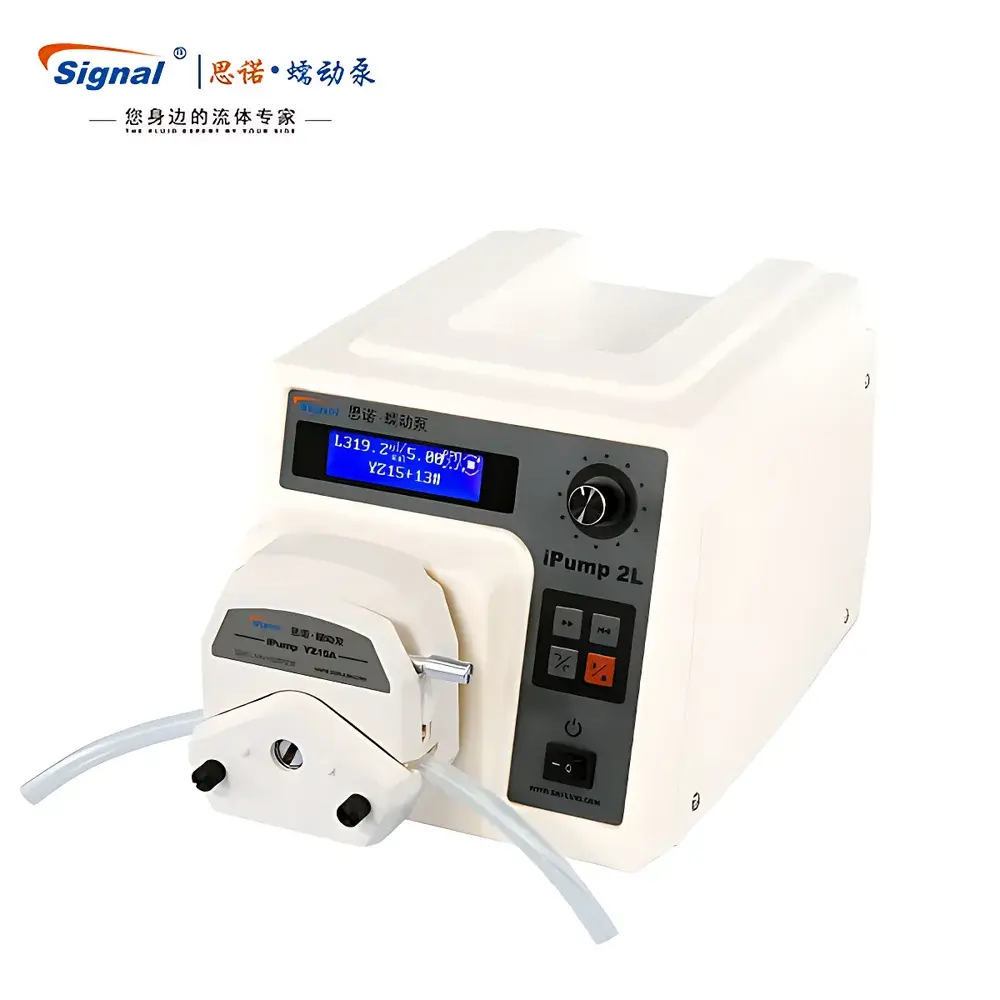
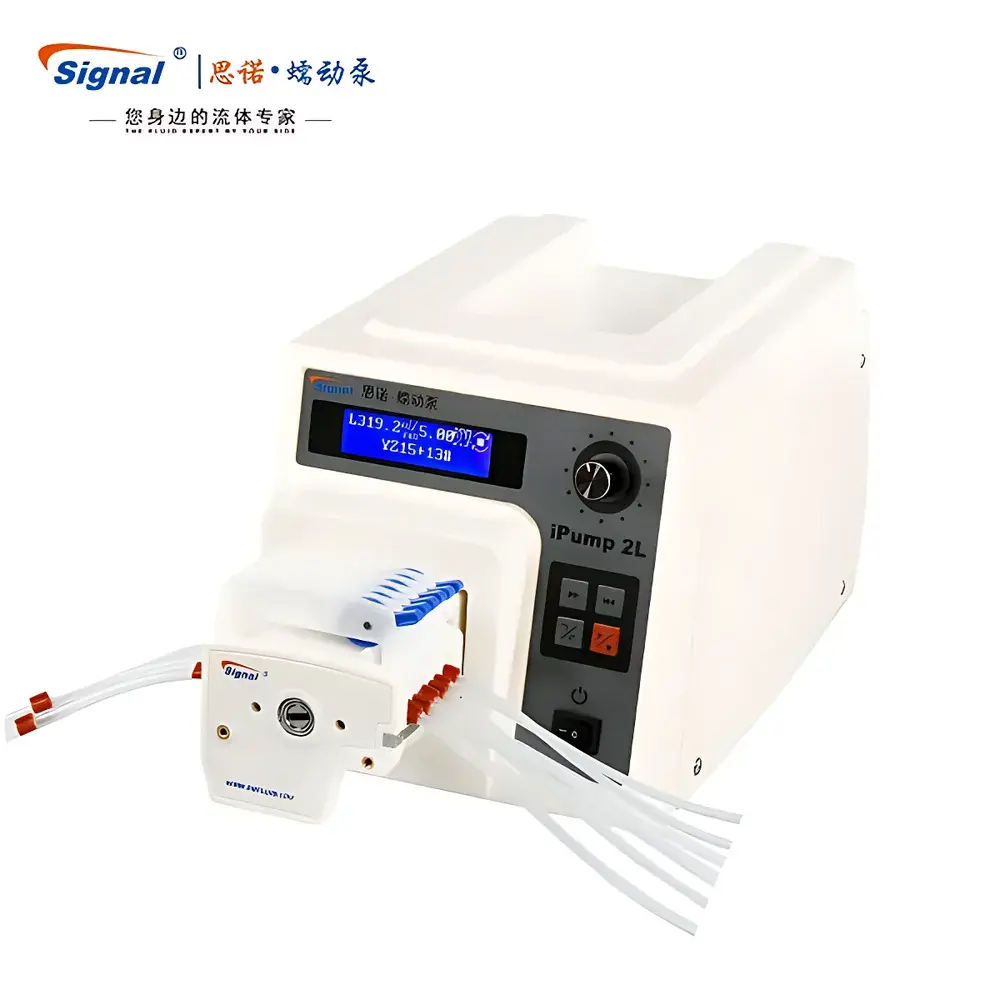
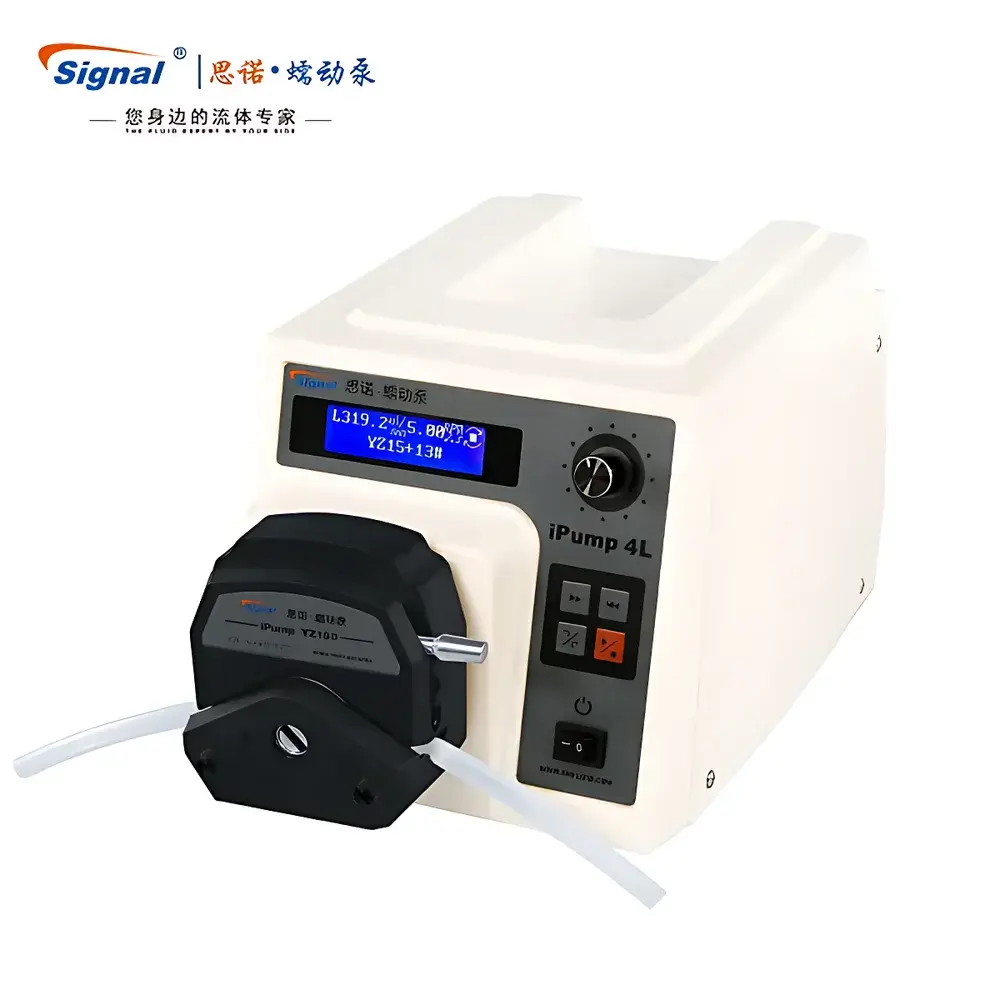
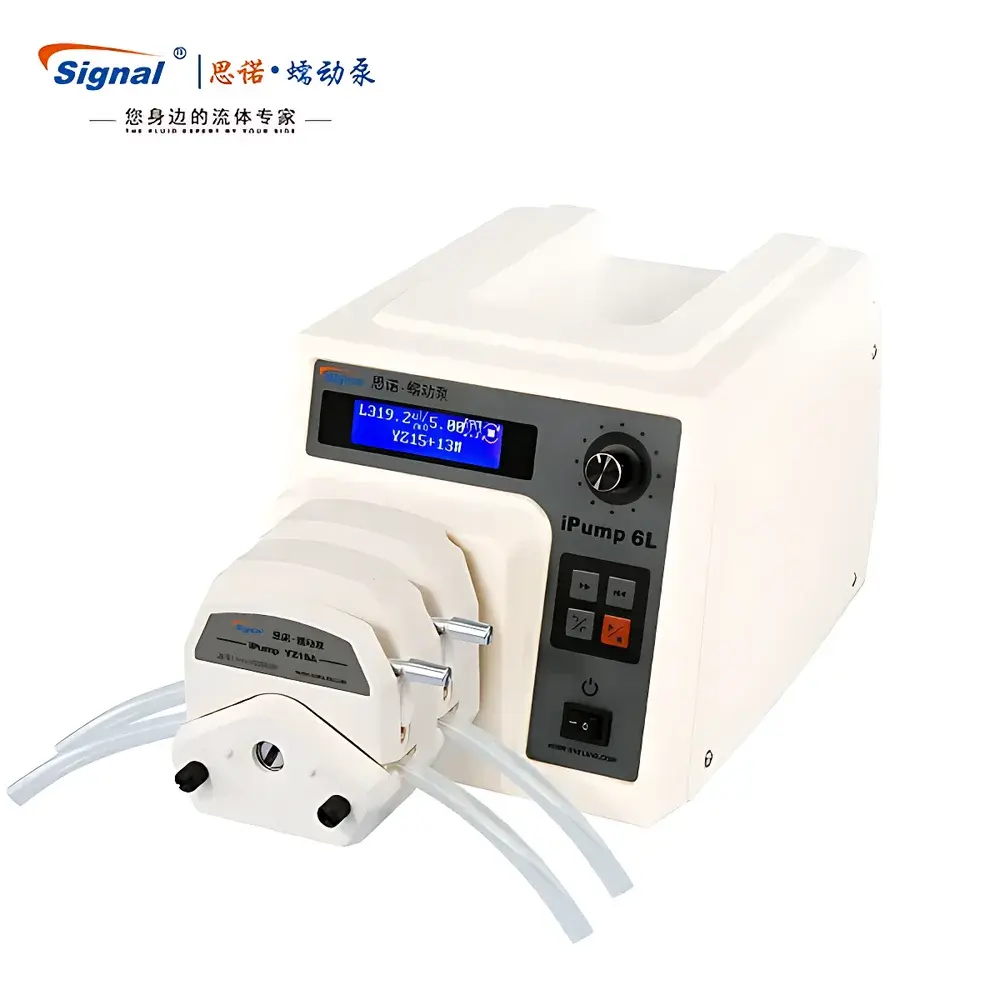
Signal iPump2L / iPump4L / iPump6L Precision Peristaltic Pump Series
| Brand | Signal |
|---|---|
| Origin | Hebei, China |
| Model | iPump2L / iPump4L / iPump6L |
| Flow Rate Range | 0.0006–2416 mL/min |
| Speed Range | 0.01–600 RPM |
| Accuracy | ±0.5% |
| Display | 128×32 Graphic LCD |
| Control Interface | Rotary Encoder + Membrane Keypad |
| External Control Options | 0–5 V, 0–10 V, 4–20 mA, 0–10 kHz (optical isolation) |
| Communication | RS485 with Modbus RTU protocol (optional) |
| Protection Rating | IP31 |
| Power Supply | AC 90–260 V, 50/60 Hz |
| Operating Environment | 0–40 °C, <80% RH non-condensing |
| Dimensions (L×W×H) | 291 × 208 × 180 mm (driver only) |
| Weight | 3.8 kg (iPump2L), 50 W max |
Overview
The Signal iPump2L / iPump4L / iPump6L series are microprocessor-controlled, high-precision peristaltic pumps engineered for continuous, repeatable fluid delivery in laboratory, pilot-scale, and industrial process environments. Based on the fundamental principle of positive displacement via occlusion—where rotating rollers compress elastomeric tubing to generate discrete fluid “pillows” per revolution—the system delivers flow rates strictly proportional to rotational speed, tube inner diameter, and roller geometry. This mechanical isolation between drive mechanism and fluid path ensures contamination-free transfer of sensitive, abrasive, or shear-sensitive media without valves, seals, or wetted metal components. The architecture adheres to core design tenets of analytical instrumentation: traceable calibration, deterministic flow behavior, and long-term operational stability under variable load conditions.
Key Features
- Three scalable driver models (iPump2L, iPump4L, iPump6L) supporting maximum speeds of 200, 400, and 600 RPM respectively—enabling broad dynamic range coverage from nanoliter-per-minute dosing to high-throughput recirculation.
- High-resolution speed control: 0.01 RPM resolution below 10 RPM; 0.1 RPM below 100 RPM; 1 RPM above 100 RPM—ensuring fine-grained adjustment for low-flow applications such as reagent addition in HPLC sample loops or cell culture media perfusion.
- Simultaneous dual-parameter display (flow rate and rotational speed) on a 128×32 monochrome graphic LCD—providing real-time verification without mode switching.
- Integrated auto-calibration function: users input a measured volume over a defined time interval, and the firmware computes and stores a correction factor for volumetric accuracy within ±0.5% of setpoint across the full operating range.
- Industrial-grade electronics: all PCBs conformally coated with tri-proof (moisture-, dust-, and corrosion-resistant) lacquer; optical isolation on all external I/O lines (0–5 V, 0–10 V, 4–20 mA, 0–10 kHz); robust AC input stage supporting universal 90–260 V, 50/60 Hz operation.
- Full bidirectional control with programmable timing (0.1 s to 99 h), power-loss memory retention, and dedicated “full-speed” override for rapid line priming or drainage.
Sample Compatibility & Compliance
The iPump series is compatible with a wide selection of chemically resistant tubing materials—including silicone (standard), Viton®, Tygon®, PharMed® BPT, and C-Flex®—allowing adaptation to aggressive solvents, biological buffers, and food-grade formulations. Each pump head (DG-1, YZ15, YZ25) is designed for specific roller counts (3, 6, or 10), channel configurations (1–6 channels), and tubing diameters (ID 0.13–2.4 mm), enabling precise matching to application viscosity, pressure head, and required pulsation profile. While not certified to ISO 8573 or ASME BPE, the system meets general-purpose requirements for GLP-compliant laboratories when operated within specified ambient conditions (0–40 °C, <80% RH). Its modular design supports integration into FDA 21 CFR Part 11–aligned workflows when paired with validated SCADA or LIMS systems using the optional RS485/Modbus interface.
Software & Data Management
Although the base unit operates as a standalone instrument, optional communication modules enable remote monitoring and control via standard Modbus RTU over RS485. This allows seamless integration into centralized automation platforms—supporting functions including start/stop command, direction reversal, speed ramping, and real-time flow feedback. All digital I/O signals (including pulse output at 0–10 kHz proportional to flow rate and open-collector status outputs) are galvanically isolated to prevent ground-loop interference in multi-instrument setups. Audit trails for parameter changes, runtime logging, and calibration events can be implemented externally through host software, satisfying basic data integrity requirements under ALCOA+ principles when configured with appropriate electronic signature protocols.
Applications
- Pharmaceutical R&D: Accurate metering of APIs, excipients, or dissolution media in automated dissolution testers (compliant with USP pumping criteria).
- Food & Beverage QA/QC: Controlled addition of colorants, preservatives, or flavor concentrates during batch homogenization or inline blending.
- Environmental Testing: Continuous sampling and dosing in wastewater nutrient removal studies, where chemical compatibility and low maintenance are critical.
- Academic Research: Fluid handling in microfluidic perfusion systems, bioreactor feed control, and electrochemical cell electrolyte circulation—particularly where sterility and material inertness are mandatory.
- Chemical Synthesis: Reagent delivery in flow chemistry reactors requiring precise stoichiometric ratios and pulse-free flow profiles achievable via multi-roller pump heads.
FAQ
What tubing materials are recommended for high-temperature or solvent-resistant applications?
Viton® and C-Flex® tubing are preferred for elevated temperature stability (>100 °C intermittent) and resistance to hydrocarbons, ketones, and chlorinated solvents. Silicone remains optimal for aqueous biologics and low-shear applications.
Can the pump be integrated into a PLC-controlled manufacturing line?
Yes—via the opto-isolated analog (0–10 V) or digital (Modbus RTU over RS485) interfaces. All control signals comply with industrial noise immunity standards for factory-floor deployment.
Is flow rate linearly proportional to RPM across the entire speed range?
Linearity holds within ±0.5% under steady-state conditions with constant backpressure (10,000 cP) due to tubing rebound hysteresis.
Does the system support GMP documentation requirements?
The hardware provides foundational capabilities (calibration traceability, parameter logging via external SCADA, audit-ready I/O)—but formal GMP validation requires site-specific IQ/OQ/PQ protocols executed by qualified personnel.
How often does the tubing require replacement?
Service life depends on speed, pressure, tubing material, and fluid abrasiveness. As a guideline: silicone tubing lasts ~100–500 hours at 100 RPM; Viton® extends this to ~500–1500 hours under comparable conditions. Visual inspection for cracking or flattening is recommended prior to each use.



