
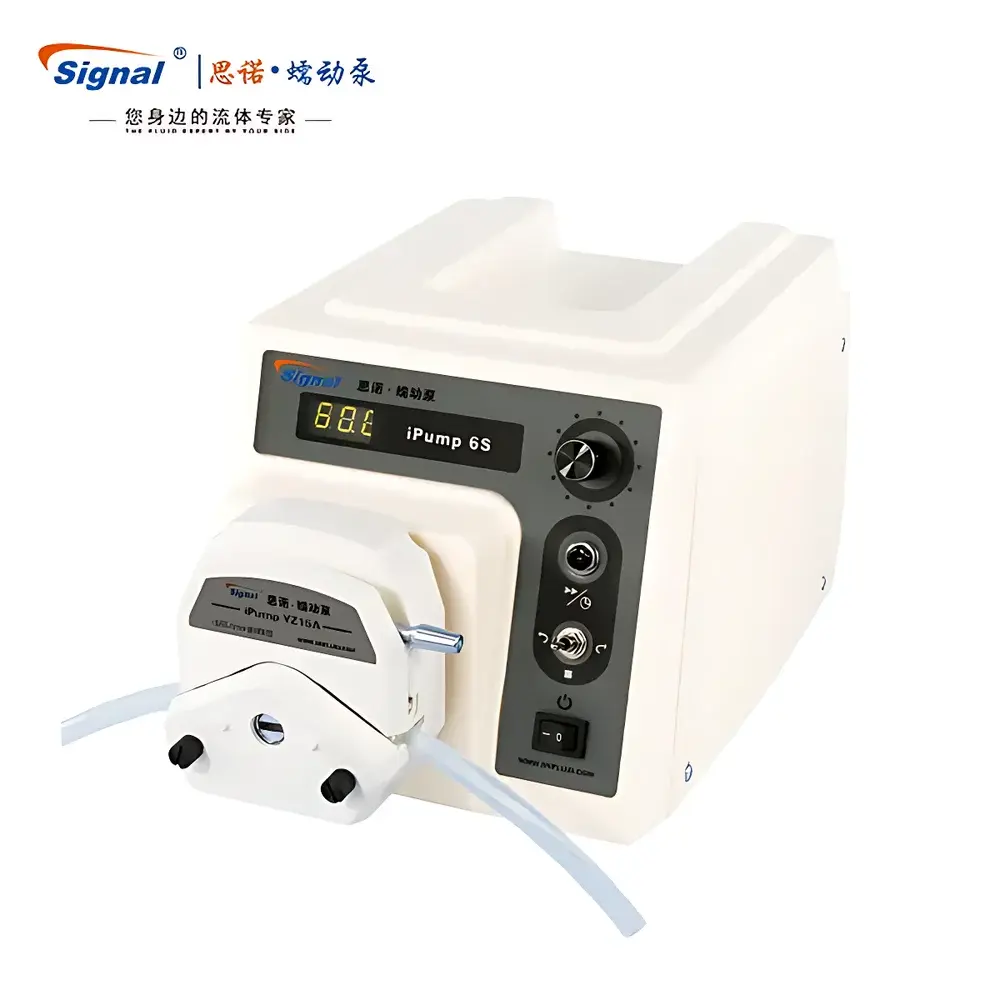
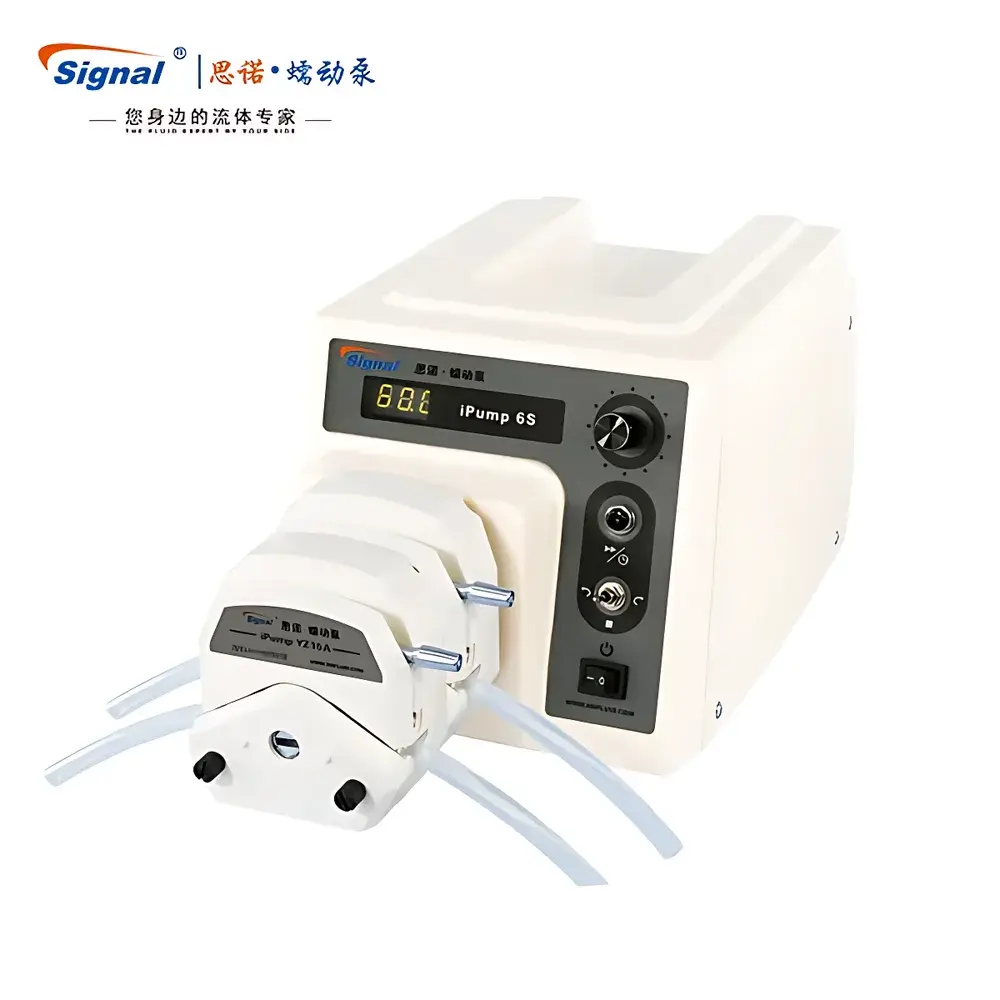
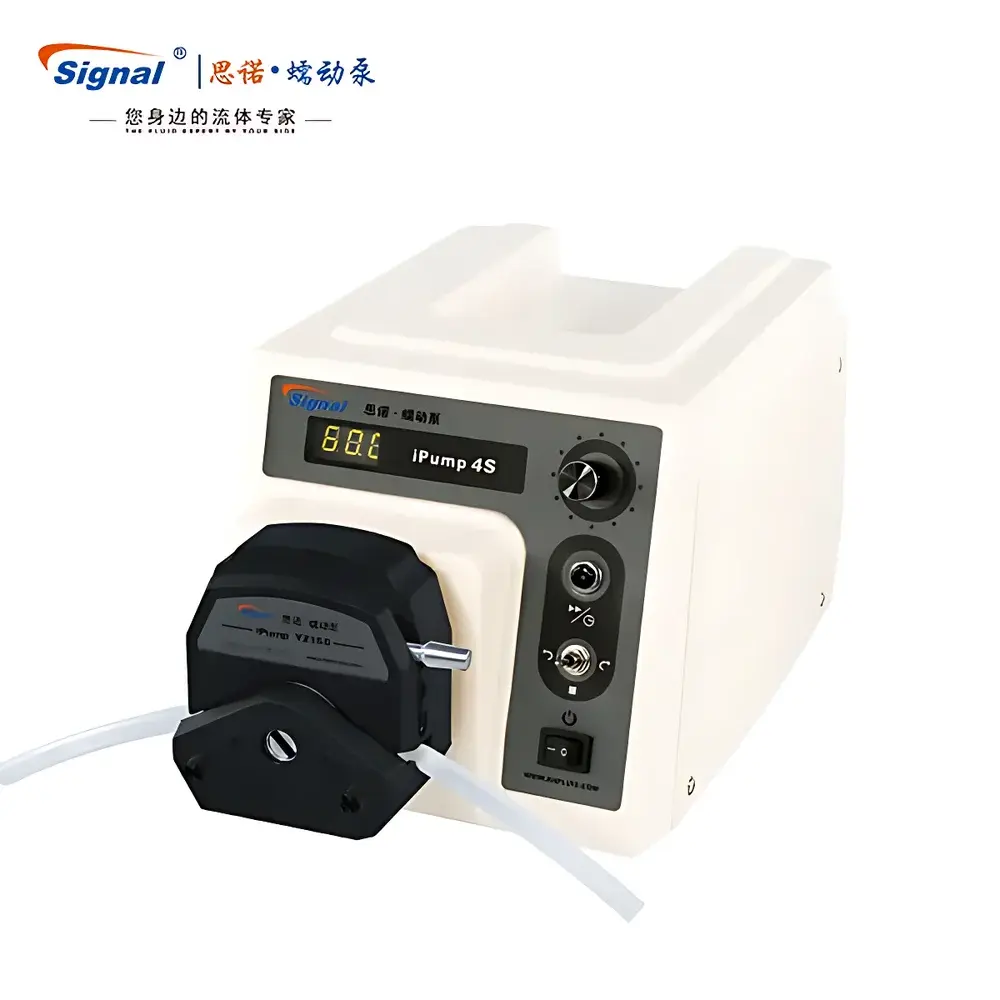
Signal iPump4S / iPump6S Precision Stepper-Driven Peristaltic Pump
| Brand | Signal |
|---|---|
| Origin | Hebei, China |
| Model | iPump4S / iPump6S |
| Flow Rate Range | 0.008–2416 mL/min |
| Speed Range | 0.1–200 RPM (iPump4S), 0.1–600 RPM (iPump6S) |
| Speed Resolution | 0.1 RPM (<100 RPM), 1 RPM (≥100 RPM) |
| Power Consumption | 50 W (iPump4S), 75 W (iPump6S) |
| Input Voltage | AC 90–260 V, 50/60 Hz |
| Operating Environment | 0–40 °C, <80% RH non-condensing |
| Dimensions (L×W×H) | 291 × 208 × 180 mm (excl. pump head) |
| Weight | 3.6 kg |
| IP Rating | IP31 |
| External Control Options | 0–5 V, 0–10 V, 4–20 mA, 0–10 kHz (optical isolation) |
| Communication | RS485 with Modbus RTU protocol (optional module) |
| Footswitch Support | Yes (optional) |
| Display | 3-digit LED, showing speed and timer |
| Direction Control | Bidirectional |
| Timer Range | 0.1 s – 99 h |
| Memory Function | Power-loss retention of operational state |
Overview
The Signal iPump4S and iPump6S are high-precision, stepper motor-driven peristaltic pumps engineered for reproducible fluid handling in regulated laboratory and industrial environments. Based on the fundamental principle of positive displacement via sequential occlusion—where rotating rollers compress elastomeric tubing against a curved housing to form discrete fluid “pillows”—these pumps deliver pulse-free, contamination-free flow without valve or seal contact. The volumetric output is determined by three deterministic parameters: rotational speed, tubing inner diameter, and the number of occlusions per revolution—enabling accurate, calibration-free flow prediction when tubing dimensions and pump geometry are known. Designed for integration into analytical workflows, bioprocessing skids, and automated sample preparation systems, the iPump series complies with core mechanical safety and electromagnetic compatibility requirements for Class I, Group II laboratory equipment (IEC 61010-1, EN 61326-1). Its wide input voltage range (AC 90–260 V) ensures stable operation across global power grids, while the IP31-rated enclosure provides basic protection against vertically falling drips and solid objects ≥2.5 mm.
Key Features
- High-resolution stepper motor control with 128-step microstepping—ensuring low vibration, ultra-quiet operation (<45 dB(A)), and exceptional positional repeatability.
- Dual-speed variants: iPump4S supports 0.1–200 RPM; iPump6S extends to 0.1–600 RPM, enabling broad dynamic flow coverage from nanoliter-per-minute precision dosing to rapid bulk transfer.
- Integrated 3-digit LED display showing real-time speed (RPM) and programmable timer duration (0.1 s to 99 h), with bidirectional rotation control and full-speed fill/empty mode.
- Industrial-grade PCBs coated with conformal acrylic tri-coat (IPC-CC-830B compliant) for long-term resistance to humidity, condensation, and chemical vapors encountered in wet-lab settings.
- Optically isolated analog and frequency-based external control inputs (0–5 V, 0–10 V, 4–20 mA, 0–10 kHz), supporting seamless integration with PLCs, DAQ systems, or custom automation controllers.
- Optional RS485 communication module implementing standard Modbus RTU protocol (Function Codes 03, 06, 16), facilitating remote configuration, status monitoring, and audit-trail-capable operation in GLP/GMP-aligned environments.
- Power-loss memory retains last operational state—including direction, speed, timer setting, and run/pause status—reducing manual reconfiguration after unexpected outages.
Sample Compatibility & Compliance
The iPump4S/6S accommodates standard YZ15 and YZ25 pump heads with interchangeable roller configurations (1–2 rollers, 3–4 occlusion points), compatible with silicone, Viton®, Tygon®, and Pharmapure® tubing (ID 0.5–6.4 mm). Flow performance data (e.g., 0.008–2416 mL/min) is empirically validated using calibrated silicone tubing under ISO 8536-4 test conditions. While not certified to FDA 21 CFR Part 11 out-of-the-box, the optional RS485 + Modbus implementation supports traceable command logging when paired with compliant SCADA or LIMS software. The device meets CE marking requirements for EMC (EN 61326-1) and safety (EN 61010-1), and its construction adheres to RoHS Directive 2011/65/EU restrictions on hazardous substances.
Software & Data Management
No proprietary software is required for basic operation; all functions are accessible via front-panel membrane keys. For advanced integration, the optional RS485 module enables ASCII or Modbus RTU command sets—supporting read/write access to speed, direction, timer, and status registers. When deployed in regulated environments, users may implement third-party middleware (e.g., LabVIEW, Python + pymodbus, or Ignition SCADA) to log timestamped commands, generate electronic records, and enforce user authentication—aligning with ALCOA+ data integrity principles. Audit trail functionality (e.g., operator ID, timestamp, parameter change) must be implemented at the host system level.
Applications
- Automated reagent dispensing in clinical chemistry analyzers and ELISA workstations.
- Continuous feed control in small-scale bioreactors and perfusion culture systems.
- Mobile phase delivery in preparative HPLC and inline dilution modules.
- Sampling and dosing in environmental water quality monitoring stations (e.g., nutrient analyzers, COD reactors).
- Controlled infusion in pharmacokinetic simulation rigs and dissolution testing apparatus.
- Food & beverage process validation—e.g., flavor concentrate metering, pH adjustment loops, and CIP rinse volume control.
FAQ
What tubing sizes are supported?
Standard YZ15 and YZ25 pump heads accept tubing IDs from 0.5 mm to 6.4 mm, including common sizes such as 13#, 14#, 16#, 18#, 24#, and 25# (per Cole-Parmer nomenclature).
Is calibration required for flow accuracy?
Peristaltic pumping is inherently volumetric; flow rate is calculated from RPM × pillow volume × occlusions/rev. For traceable accuracy, users should validate against gravimetric or timed-volume measurement per ASTM D3418 or ISO 8536-4.
Can the pump operate unattended for extended periods?
Yes—its thermal management, conformal-coated electronics, and robust stepper driver support continuous operation within ambient temperature and humidity limits (0–40 °C, <80% RH non-condensing).
Does it support regulatory compliance for pharmaceutical use?
The base unit is not GMP-certified, but its analog/Modbus interfaces and power-loss memory enable integration into validated systems meeting USP , EU Annex 11, and FDA guidance on computerized system validation.
How is directional reversal implemented?
Reversal is achieved electronically via internal H-bridge drive—no mechanical gear shifting—ensuring smooth, backlash-free transition and consistent torque delivery in both directions.



