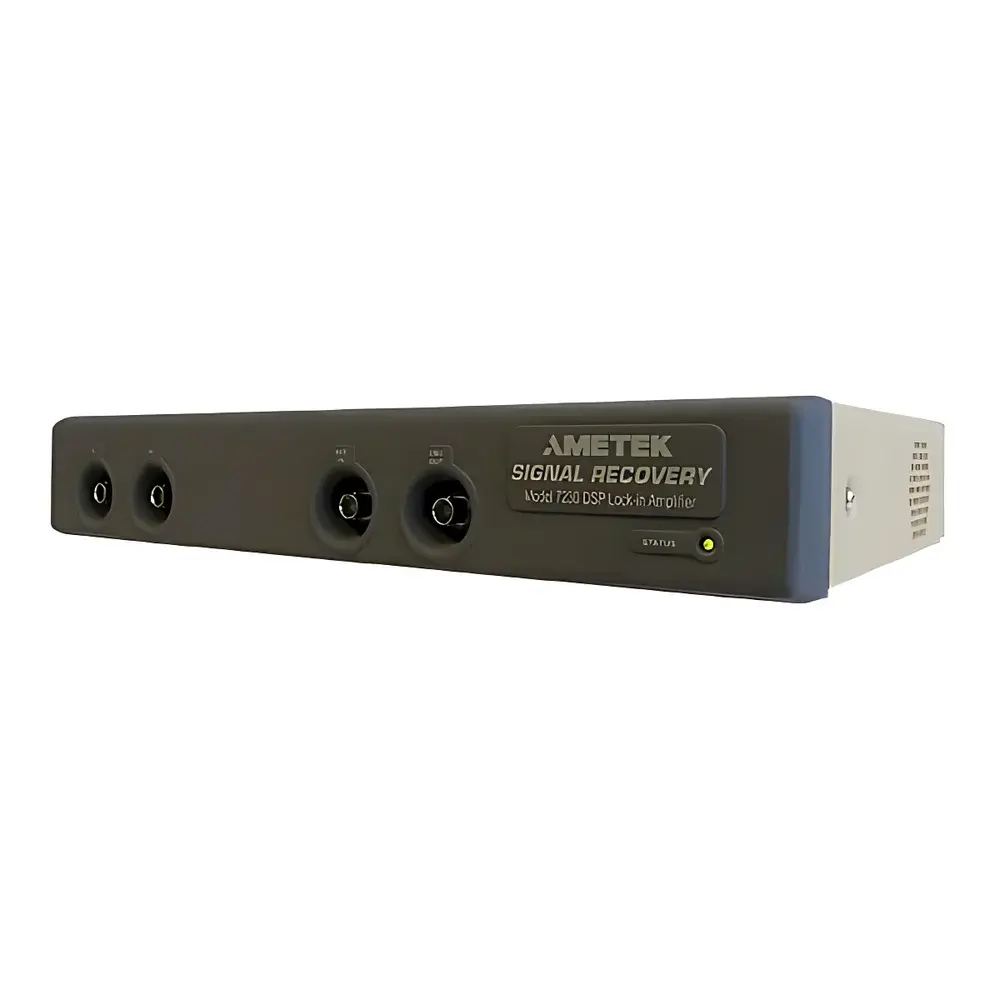
Signal Recovery 7230A Dual-Phase Lock-in Amplifier
| Brand | Signal Recovery |
|---|---|
| Origin | USA |
| Model | 7230A |
| Frequency Range | 1 mHz to 250 kHz |
| Dynamic Reserve | 100 dB (at 1 nV/√Hz) |
| Input Configuration | Single-ended / Differential, AC/DC Coupled |
| Communication Interfaces | Ethernet, USB, RS-232 (optically isolated) |
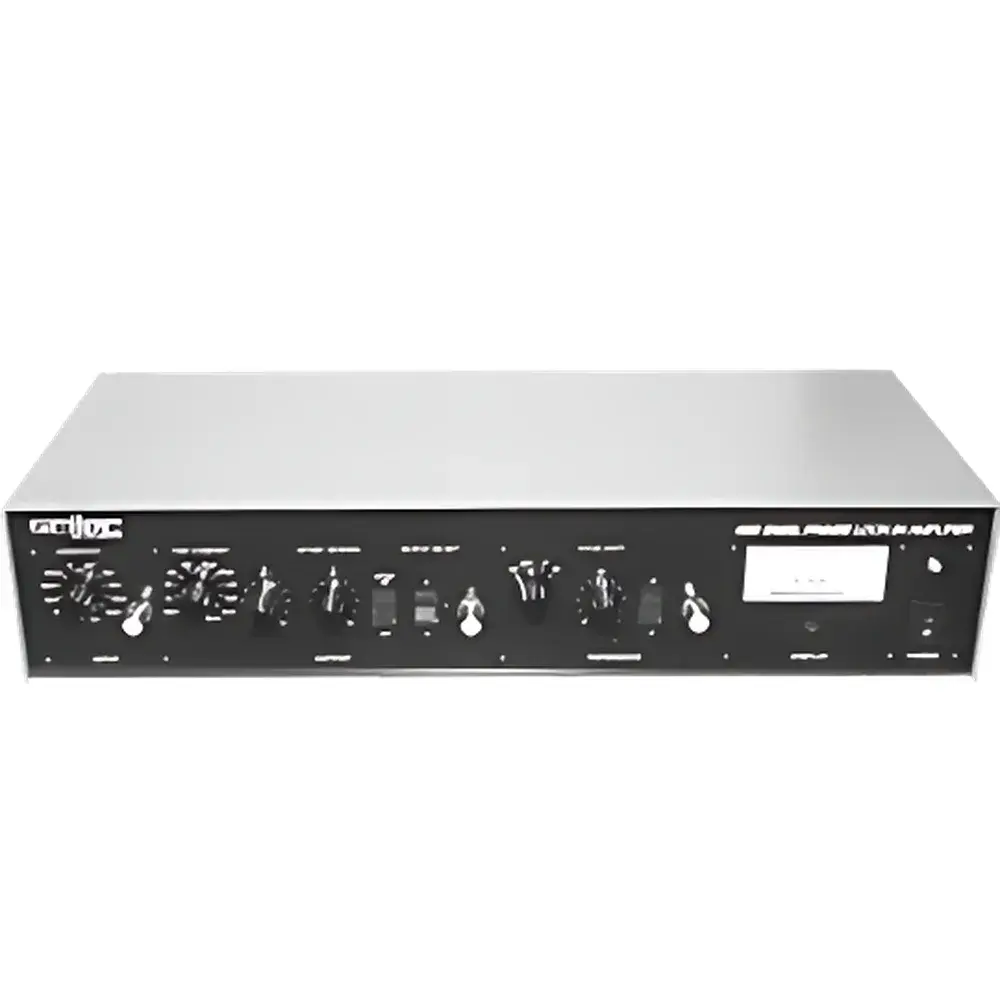
| Control Mode | Remote-only (no front-panel display) |
| Harmonic Detection | Dual-reference, dual-harmonic simultaneous measurement |
| Software Support | Acquire, LabVIEW, SRInstComms |
| Power Options | External DC supply or internal rechargeable battery |
| Form Factor | Compact, fanless design |
Overview
The Signal Recovery 7230A is a high-performance, dual-phase lock-in amplifier engineered for precision extraction of extremely weak periodic signals buried in high-noise environments. Based on the classic analog-digital hybrid architecture refined over decades by Signal Recovery — a lineage tracing back to Princeton Applied Research and EG&G — the 7230A implements phase-sensitive detection (PSD) using synchronous demodulation referenced to an external or internal oscillator. Its core function is to isolate signal components at a precisely defined frequency and phase relative to a reference, rejecting uncorrelated noise across all other frequencies. With a measurement bandwidth spanning from 1 mHz to 250 kHz and a dynamic reserve of 100 dB at 1 nV/√Hz, the 7230A enables reliable detection of nanovolt-level signals in applications where signal-to-noise ratios fall below –100 dB. Unlike general-purpose oscilloscopes or spectrum analyzers, the 7230A delivers deterministic, low-drift amplitude and phase outputs (X, Y, R, θ) with exceptional long-term stability — critical for quantitative measurements in physics laboratories, materials characterization setups, and low-temperature instrumentation.
Key Features
- Dual-reference and dual-harmonic detection: Simultaneously measure two independent signal frequencies or harmonics using separate reference inputs — essential for multi-frequency impedance spectroscopy or pump-probe experiments.
- Fanless, compact chassis: Engineered for integration into vibration-sensitive or acoustically isolated systems (e.g., cryostats, optical tables, ultra-low-noise chambers) without introducing mechanical noise or airflow disturbance.
- Optically isolated RS-232 interface: Ensures galvanic separation between control PC and instrument ground — eliminating ground loops in mixed-signal test benches.
- Flexible input configuration: Supports both single-ended and true differential inputs with switchable AC/DC coupling, enabling compatibility with voltage sources, transimpedance amplifiers (e.g., 5402A), and bridge-based sensors.
- Low-power operation with dual power options: Operates from either a regulated external DC source or an internal rechargeable battery — ideal for portable or battery-powered field deployments and mobile lab configurations.
- Remote-first architecture: Designed exclusively for computer-controlled operation via Ethernet, USB, or RS-232; no front-panel display reduces electromagnetic emissions and simplifies OEM system integration.
Sample Compatibility & Compliance
The 7230A interfaces seamlessly with a broad range of low-noise signal conditioning modules, including the 5113A low-noise voltage preamplifier (gain 1–10,000×, selectable high-pass/low-pass/band-pass filtering) and the 5402A low-current transimpedance amplifier (pA-level sensitivity, 100 kHz–4 MHz bandwidth depending on gain setting). Its input stage complies with IEC 61000-4-5 surge immunity standards and meets FCC Part 15 Class B emission limits for laboratory use. While not certified for medical or industrial safety-critical environments, its design supports GLP-compliant data acquisition workflows when used with audit-trail-enabled software (e.g., Acquire with timestamped metadata logging). The instrument adheres to standard IEEE 488.2 command syntax conventions for SCPI-compatible remote control, facilitating interoperability in automated test systems governed by ISO/IEC 17025-accredited calibration protocols.
Software & Data Management
The 7230A is fully supported by Signal Recovery’s Acquire software suite — a Windows-native application providing real-time parameter configuration, time-domain waveform capture, XY plotting, and harmonic sweep automation. Native LabVIEW VIs (via SRInstComms driver) enable seamless integration into custom VI-based DAQ architectures. All communication layers support full command logging and binary data streaming at up to 1 MS/s sample rate. Data exports are generated in ASCII CSV and HDF5 formats, preserving calibrated units, timestamps, and metadata (e.g., reference frequency, time constant, filter slope). When deployed in regulated environments, Acquire can be configured to enforce user authentication, electronic signatures, and 21 CFR Part 11–compliant audit trails — provided the host OS and file system meet required security baselines.
Applications
- Low-temperature physics: Detection of quantum oscillations in magnetotransport measurements (e.g., Shubnikov–de Haas, de Haas–van Alphen) under high magnetic fields and sub-Kelvin temperatures.
- Electrochemical impedance spectroscopy (EIS): Multi-frequency perturbation analysis of battery electrodes, fuel cell membranes, and corrosion interfaces using dual-reference harmonic tracking.
- Optical metrology: Lock-in detection of photothermal or photoacoustic signals in trace gas sensing, thin-film thickness monitoring, and laser Doppler vibrometry.
- Materials science: Quantitative evaluation of dielectric loss tangents, piezoelectric coefficients, and magnetostrictive strain responses under modulated excitation.
- Biomedical instrumentation: Extraction of evoked potentials from EEG/MEG recordings and impedance-based cell viability assays in microfluidic platforms.
FAQ
Does the 7230A include a built-in display or front-panel controls?
No — the 7230A is a remote-only instrument with no integrated display or manual controls. All configuration and monitoring must be performed via computer using Ethernet, USB, or RS-232.
Can the 7230A perform simultaneous measurements at two different frequencies?
Yes — its dual-reference architecture allows concurrent detection of two independent signal frequencies or harmonics using separate reference inputs and independent demodulator channels.
What is the minimum detectable signal level under typical conditions?
At 1 Hz with a 1-s time constant and 1 nV/√Hz input noise density, the theoretical RMS noise floor is approximately 1.3 fV/√Hz — though actual sensitivity depends on source impedance, cabling, and external preamplification.
Is the 7230A compatible with third-party DAQ systems beyond LabVIEW?
Yes — its SCPI-compliant command set enables integration with Python (PyVISA), MATLAB Instrument Control Toolbox, and C/C++ applications using standard TCP/IP or VISA libraries.
How is calibration maintained over time and temperature?
The 7230A uses oven-controlled crystal oscillators (OCXO) for reference stability (<±0.1 ppm over 0–50°C) and auto-zeroing circuitry to minimize DC drift; annual verification against NIST-traceable standards is recommended for metrological applications.