
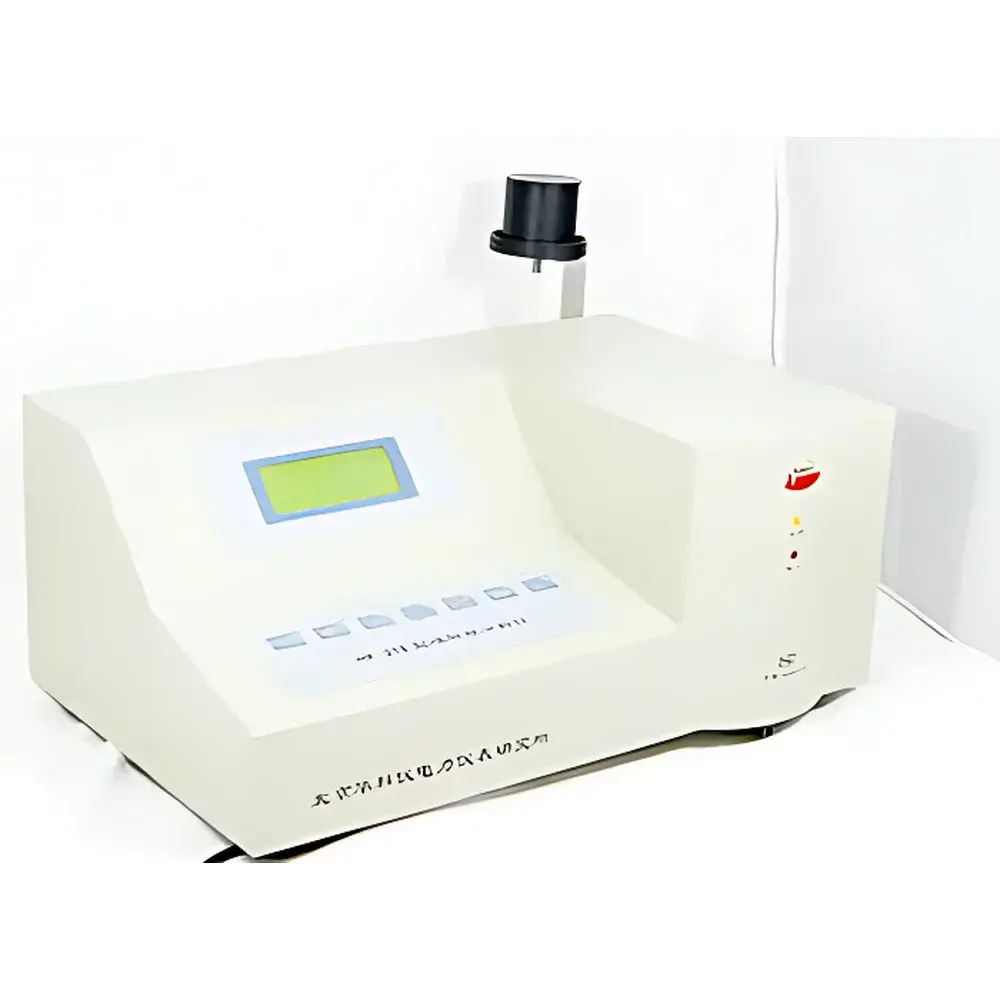
Silicon Analyzer SENHK-218
| Origin | Beijing, China |
|---|---|
| Manufacturer Type | Authorized Distributor |
| Origin Category | Domestic (China) |
| Model | SENHK-218 |
| Price | Upon Request |
| Display | Chinese-language dot-matrix LCD |
| Measurement Range | 0–200 μg/L or 0–2000 μg/L (user-selectable) |
| Accuracy | ≤ ±2% of Full Scale (F.S.) |
| Resolution | 0.1 μg/L |
| Repeatability | ≤ 1% (RSD) |
| Drift Stability | ≤ ±1% F.S. over 4 hours |
| Operating Temperature | 5–45 °C |
| Relative Humidity | ≤ 90% RH (non-condensing) |
| Dimensions (L×W×H) | 420 × 190 × 280 mm |
| Power Supply | 198–242 VAC, 50 Hz ±1 Hz |
| Power Consumption | 30 VA |
| Weight | 5 kg |
| Light Source | Imported U.S.-made monochromatic LED |
| Photodetector | Imported U.S.-made photodiode |
| Calibration | Reagent-free blank-water calibration |
| Calibration Options | Multi-point curve calibration (up to 6 points) |
| Security | Password-protected operational interface |
| Data Logging | 6-channel historical data storage with timestamped recall |
Overview
The SENHK-218 Silicon Analyzer is a dedicated photometric instrument engineered for the quantitative determination of dissolved silicate (as SiO₂) in ultrapure water, boiler feedwater, condensate, and steam-cycle samples across power generation, semiconductor manufacturing, and pharmaceutical water systems. It operates on the molybdenum blue spectrophotometric principle—where orthosilicic acid reacts with ammonium molybdate under acidic conditions to form a heteropoly acid, subsequently reduced to a stable blue-colored complex measurable at 650 nm. Unlike conventional colorimetric analyzers requiring reagent addition and precise timing, the SENHK-218 implements a reagent-free calibration protocol using only high-purity deionized water as blank, eliminating reagent degradation, stoichiometric drift, and operator-dependent reaction control. Its optical architecture integrates a temperature-stabilized U.S.-sourced monochromatic LED emitter and a low-noise, high-linearity photodiode detector—ensuring long-term photometric integrity without lamp aging or spectral shift. The analyzer delivers trace-level sensitivity (detection limit <1 μg/L), high repeatability (RSD ≤1%), and robust stability (<±1% F.S./4 h), making it suitable for continuous monitoring in GLP-compliant laboratories and critical process water loops.
Key Features
- Reagent-free calibration using only certified blank water—eliminates reagent lot variability, shelf-life constraints, and procedural errors inherent in traditional molybdenum blue methods.
- User-selectable dual-range operation (0–200 μg/L and 0–2000 μg/L) optimized for both ultrapure water surveillance and higher-concentration condensate analysis.
- High-fidelity optical train: U.S.-imported monochromatic LED (peak emission at 650 nm ±2 nm) coupled with a matched silicon photodiode ensures minimal stray light, thermal drift, and signal noise.
- Intuitive Chinese-language dot-matrix LCD interface with hierarchical menu navigation—designed for rapid deployment by plant technicians without specialized analytical training.
- Multi-point calibration capability (up to six concentration points) supports non-linear response compensation across the full dynamic range, improving accuracy per ISO 8466-1 guidelines.
- Integrated password protection restricts access to calibration, range configuration, and data management functions—supporting audit readiness under FDA 21 CFR Part 11 and ISO/IEC 17025 requirements.
Sample Compatibility & Compliance
The SENHK-218 accepts standard 10-mm pathlength quartz or high-transmission glass cuvettes and is compatible with sample matrices including ASTM D1193 Type I–IV water, ASME PTC 19.11 boiler water, and USP Purified Water/ Water for Injection (WFI) streams. It meets the performance criteria outlined in ASTM D859 (Standard Test Method for Silica in Water) when operated with validated calibration protocols. The instrument’s electrical design complies with IEC 61010-1 for laboratory equipment safety, while its environmental rating (5–45 °C, ≤90% RH non-condensing) aligns with ANSI/ISA-71.04 severity level G1 for industrial control environments. All firmware operations retain immutable timestamps and user identifiers for traceability—facilitating compliance with GLP, GMP, and internal QA documentation standards.
Software & Data Management
Data handling is performed locally via the embedded 6-channel historical memory, each channel storing up to 100 timestamped measurements (date, time, concentration, operator ID, calibration status). Records are retrievable directly on-screen with scroll navigation and export-ready formatting. While the unit does not feature Ethernet or USB host connectivity, measurement logs can be manually transcribed or interfaced via optional RS-232 serial output (available upon request) for integration into SCADA or LIMS platforms. Audit trails—including calibration events, range changes, and password resets—are retained in non-volatile memory and cannot be altered or deleted without administrative authentication.
Applications
- Real-time monitoring of silica breakthrough in mixed-bed ion exchange polishers and EDI units within power plant makeup water treatment trains.
- Verification of silica removal efficiency in semiconductor fab ultrapure water (UPW) distribution loops per SEMI F63 specifications.
- Boiler drum water and turbine condensate surveillance to prevent silica deposition on superheater tubes and turbine blades—critical for ASME B31.1 and EPRI guidelines.
- Periodic verification of silica levels in pharmaceutical purified water systems during routine system suitability testing (SST) per USP .
- Field-based validation of portable silica test kits and laboratory ICP-MS reference measurements in third-party water quality labs.
FAQ
Does the SENHK-218 require chemical reagents for routine operation?
No. It uses a reagent-free calibration method based on high-purity blank water only. No molybdate, reducing agent, or acid solutions are consumed during daily use.
Can the instrument be recalibrated in the field without sending it to a service center?
Yes. Multi-point calibration is fully supported onsite using NIST-traceable silica standards; no firmware update or hardware adjustment is required.
Is the measurement traceable to international standards?
Calibration is compatible with NIST SRM 2042 (Silicon in Water) and follows methodology consistent with ASTM D859 and ISO 15304 for spectrophotometric silica analysis.
What maintenance is required beyond routine cleaning?
Annual verification of photometric linearity and zero stability is recommended; optical components have no scheduled replacement interval due to solid-state LED and photodiode construction.
How is data security ensured during multi-user operation?
Password enforcement applies separately to calibration, configuration, and data export functions—enabling role-based access control aligned with ISO/IEC 27001 information security principles.



