
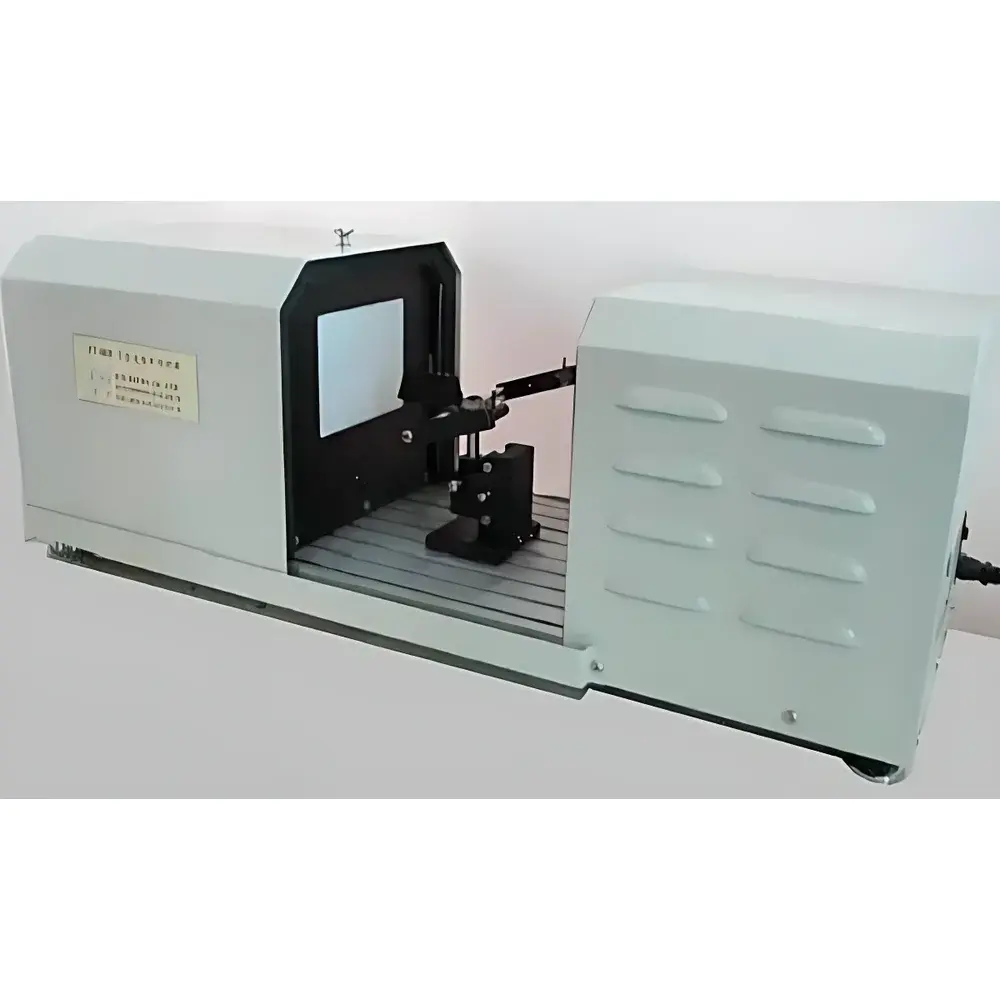
Silverzone YT-669 Multi-Point Visible Light Transmittance Analyzer
| Origin | Taiwan |
|---|---|
| Manufacturer Type | Authorized Distributor |
| Domestic Production Status | PRC-assembled |
| Model | YT-669 |
| Price Range | USD 14,000 – 28,000 |
| CCD Sensor | Photopic Luminosity-Weighted (CIE V(λ)-matched) |
| Light Source | 100 W Tungsten-Halogen Lamp |
| Illumination Area | 140 mm × 110 mm |
| Operating System | Windows 10 IoT Enterprise |
| Data Storage | Local SSD + CSV/PDF Export |
| Measurement Points | Configurable 3×3 grid (9-point) or user-defined multi-point array |
| Fixture Options | Integrated eyeglass frame holder + adjustable bare-lens stage (interchangeable) |
Overview
The Silverzone YT-669 Multi-Point Visible Light Transmittance Analyzer is an engineered optical metrology system designed for quantitative, spatially resolved transmittance measurement of ophthalmic lenses under photopic viewing conditions. It operates on the principle of spectrally weighted luminous transmittance (Tv), as defined in ISO 8980-3:2010 and ANSI Z80.1-2020, using a CIE 1931 photopic luminosity function (V(λ))-matched CCD sensor to replicate human photopic visual response across the 380–780 nm spectral range. Unlike single-point integrators or generic spectrophotometers, the YT-669 delivers position-specific Tv values across up to nine discrete locations—enabling verification of optical homogeneity, gradient consistency in progressive addition lenses (PALs), and compliance with regional regulatory thresholds for UV-blocking and visible-light transmission (e.g., EN ISO 14889:2013 for sunglass attenuation classes). Its fixed-aperture, large-area illumination geometry ensures minimal edge diffraction effects and high inter-unit reproducibility (< ±0.8% RSD per point, verified per ISO/IEC 17025 calibration protocols).
Key Features
- Photopic-weighted transmittance measurement compliant with CIE V(λ) spectral sensitivity curve, traceable to NIST-traceable reference standards.
- Uniform 140 mm × 110 mm tungsten-halogen illumination field (100 W, color temperature ~2856 K), optimized for stable radiometric output and minimal thermal drift during sequential multi-point acquisition.
- Dual-purpose mechanical fixture system: integrated adjustable eyeglass frame mount for finished spectacles and precision bare-lens stage with XYZ micro-adjustment (±0.1 mm resolution), both swappable without tools.
- Embedded industrial PC running Windows 10 IoT Enterprise, eliminating external host dependency and ensuring deterministic real-time data capture and processing latency < 120 ms per measurement point.
- Configurable spatial sampling: default 3×3 grid (9-point) mode for rapid QC screening; optional user-defined coordinate sets (up to 25 points) via GUI-based mapping interface.
- Onboard data management: automatic timestamped storage of raw pixel-intensity matrices, calculated Tv values, and positional metadata to internal SSD; export formats include CSV (for LIMS integration) and PDF (with embedded pass/fail annotations per ISO 8980-3 Annex B).
Sample Compatibility & Compliance
The YT-669 accommodates plano and powered ophthalmic lenses (±20.00 D spherical equivalent), including CR-39, polycarbonate, Trivex, high-index plastics (1.67–1.74), and photochromic/transition lenses. It supports both unmounted lenses (diameter 40–80 mm) and mounted spectacles (frame width ≤ 150 mm, temple angle ≤ 15°). All measurements adhere to the geometric constraints and viewing-angle specifications outlined in ISO 8980-3:2010 (Clause 6.2.1) and ANSI Z80.1-2020 (Section 6.3.1). The system’s firmware implements mandatory reporting fields required for FDA 510(k) submissions (e.g., lens identification, test date/time, operator ID, instrument serial number) and supports audit-trail-enabling configurations compatible with GLP/GMP environments under 21 CFR Part 11 when deployed with validated electronic signature modules.
Software & Data Management
The proprietary TransmittanceVision™ software (v3.2.x) provides calibrated image acquisition, V(λ)-weighted pixel integration, and statistical analysis per measurement point. It includes automated outlier detection (Grubbs’ test at α = 0.05), spatial uniformity heatmaps, and comparative overlay functions for batch-to-batch trending. Data files are stored with SHA-256 checksums and support hierarchical folder structures aligned with ISO/IEC 17025 documentation requirements. Integration with enterprise systems is enabled via OPC UA server interface (optional license), allowing direct ingestion into SAP QM, LabWare LIMS, or TrackWise quality databases. Software validation documentation (IQ/OQ/PQ protocols) and source code escrow options are available upon request.
Applications
- Final inspection of prescription lenses for Tv uniformity compliance prior to packaging (per ISO 8980-3 Clause 7.1).
- Verification of photochromic activation kinetics and fade recovery profiles across lens zones.
- Quality control of anti-reflective (AR) coating uniformity on multi-layer coated substrates.
- R&D validation of new lens materials against regional transmittance limits (e.g., EU Regulation (EU) 2017/745 Class I/IIa requirements for UV protection labeling).
- Root-cause analysis of haze or scattering anomalies in injection-molded thermoplastic lenses.
FAQ
Does the YT-669 comply with ISO 8980-3:2010 for ophthalmic lens transmittance testing?
Yes—the system’s V(λ)-matched CCD, defined illumination geometry, and measurement algorithm are validated against ISO 8980-3 Annex A reference methods and certified by an ILAC-accredited calibration laboratory.
Can it measure lenses with strong base curves or wrap angles?
It supports lenses with base curves up to 8.00 D and wrap angles ≤ 12°; beyond this, measurement uncertainty increases due to vignetting—users should consult the included geometric tolerance guide before qualification.
Is remote operation or network deployment supported?
Local operation only; however, exported CSV reports are compatible with centralized SPC dashboards, and optional OPC UA connectivity enables real-time data streaming to plant MES systems.
What calibration standards are supplied with the instrument?
Each unit ships with a NIST-traceable neutral-density reference tile (certified Tv = 50.0 ± 0.3%) and a V(λ)-response verification filter set, accompanied by full calibration certificates valid for 12 months.
How is software validation handled for regulated environments?
A complete GxP-compliant validation package—including documented IQ/OQ/PQ test scripts, risk assessments (FMEA), and change control logs—is available as an add-on service, aligned with ASTM E2500-13 and Annex 11 principles.





