
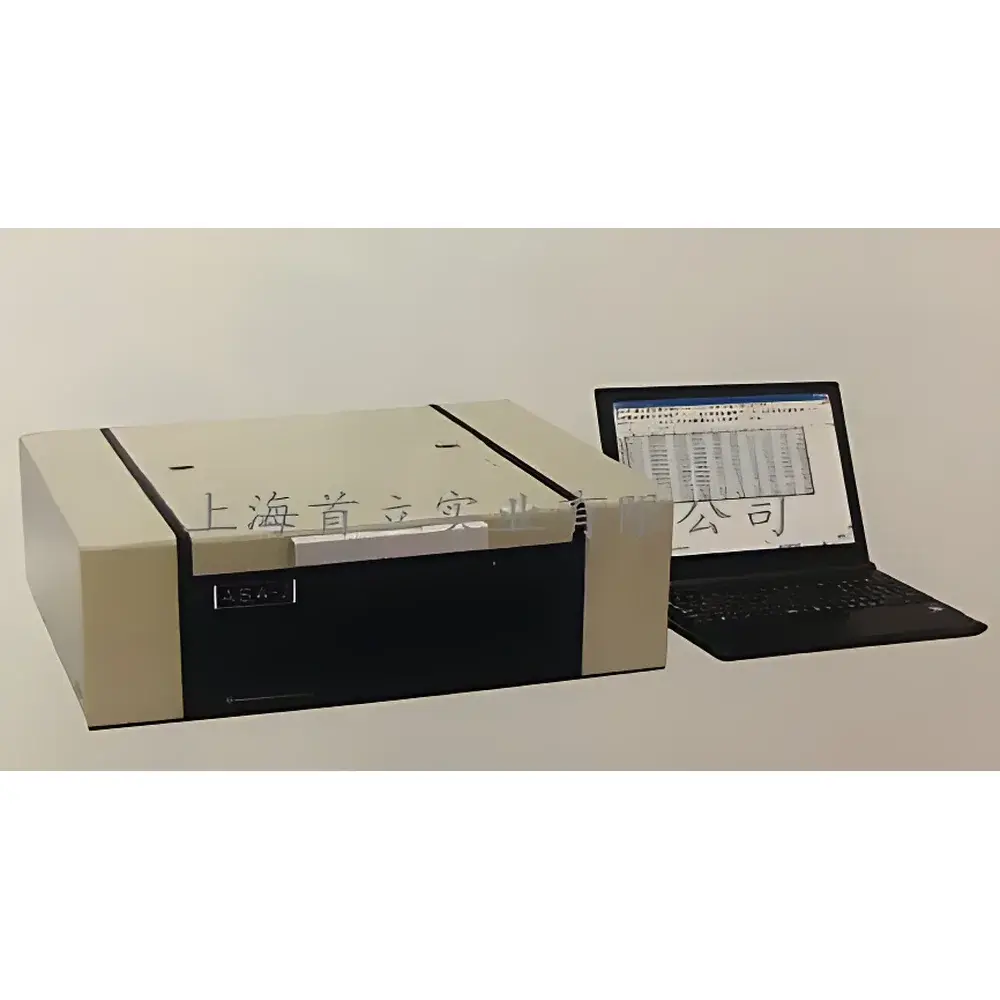
NIPPON DENSHOKU ASA-2 Long-Path Spectrophotometric Color Difference Meter
| Brand | NIPPON DENSHOKU |
|---|---|
| Origin | Japan |
| Model | ASA-2 |
| Type | Benchtop Color Difference Meter |
| Optical Geometry | 0°/0° (d/8° equivalent per JIS Z 8722) |
| Light Source | 12 V, 50 W Halogen Lamp |
| Spectral Range | 400–700 nm (20 nm interval) |
| Repeatability | ΔE*ab ≤ 0.10 (20 consecutive measurements at 10 s intervals) |
| Sample Aperture | Incident 1 mm × 3 mm |
| Output Diameter | φ2 mm (Type A), φ3 mm (Type B) |
| Compliance | JIS Z 8722, ASTM E308 |
| Illuminants | A, C, D65, F6, F8, F10 |
| Observer Angles | 2° and 10° |
| Measured Parameters | XYZ, L*a*b*, ΔL*a*b*, L*C*h*, L*u*v*, Hunter Lab, YI, WI, spectral transmittance distribution |
Overview
The NIPPON DENSHOKU ASA-2 is a benchtop spectrophotometric color difference meter engineered for high-precision transmittance color measurement of near-colorless, transparent, and semi-transparent sheet materials. Unlike conventional reflectance-based instruments, the ASA-2 employs a long-path, double-beam, post-dispersion optical architecture with fixed 0° illumination and 0° detection—functionally equivalent to d/8° geometry per JIS Z 8722 for transmittance applications. Its core design addresses the metrological challenge of low-absorbance substrates—such as molded acrylic plates, polycarbonate light guide panels (LGPs), and LCD backlight diffusers—where conventional short-path systems lack sufficient signal-to-noise ratio. The instrument delivers spectral transmittance data across the visible spectrum (400–700 nm) in discrete 20 nm steps, enabling rigorous compliance with ASTM E308 for tristimulus value computation and chromaticity coordinate derivation under multiple standard illuminants and observer functions.
Key Features
- Long-path optical configuration optimized for high-sensitivity transmittance measurement of low-optical-density materials (e.g., <0.1 OD)
- Dual interchangeable optical units (Type A and Type B) accommodating distinct sample dimensions: Type A supports 350 × 300 × 3 mm plates; Type B accommodates elongated 550 × 100 × 4 mm specimens—critical for uniformity mapping of display-grade LGPs
- Stable 12 V / 50 W halogen light source with thermally regulated output, ensuring consistent spectral irradiance over extended measurement cycles
- Simultaneous acquisition of full spectral transmittance curves and derived colorimetric values—including CIE L*a*b*, L*C*h*, YI (ASTM D1925), WI (ASTM E313), and Hunter Lab—without post-processing interpolation
- Calibration traceability maintained via built-in reference standards and user-accessible calibration verification protocols aligned with JIS Z 8722 Annex B
Sample Compatibility & Compliance
The ASA-2 is specifically validated for flat, rigid, transparent or translucent sheet materials up to 4 mm thick. It meets the geometric and photometric requirements of JIS Z 8722 for transmittance color measurement and conforms to ASTM E308–22 for spectral data integration using CIE 1931 2° and CIE 1964 10° standard observer functions. Its optical aperture design (1 mm × 3 mm incident slit, φ2 mm or φ3 mm output) ensures minimal edge diffraction effects and high spatial resolution across heterogeneous samples. The system supports routine GLP-compliant operation: all measurements are timestamped, instrument ID-tagged, and stored with full metadata (illuminant, observer, aperture type, calibration date). Audit trails comply with FDA 21 CFR Part 11 when used with validated software configurations.
Software & Data Management
The proprietary color management software provides native support for spectral curve visualization, batch comparison (ΔE*ab, ΔYI, ΔWI), and multi-sample uniformity analysis (e.g., edge-to-center transmittance gradients across LGP panels). Data export formats include CSV, XML, and CIE S002-compliant .cie files. Measurement reports include full spectral tables, chromaticity diagrams (CIE 1931 xy, u’v’), and deviation heatmaps. Software validation documentation is available for GMP environments; electronic signatures, role-based access control, and change history logging satisfy ALCOA+ principles for regulated quality labs.
Applications
- Quality assurance of light guide plates and diffuser sheets in LCD and OLED backlight modules
- Color consistency evaluation of transparent polymer injection-molded parts (e.g., automotive lenses, medical device housings)
- Batch-to-batch spectral transmittance verification for optical filters and anti-reflective coated substrates
- R&D characterization of UV-stabilized acrylics and polycarbonates where yellowing index (YI) and whiteness index (WI) trends must be quantified over accelerated aging cycles
- Process validation of coating thickness uniformity on transparent conductive films (ITO, AgNW) via correlated transmittance shifts
FAQ
What is the primary distinction between the ASA-2 and standard reflectance colorimeters?
The ASA-2 is a transmittance-specific spectrophotometer with long-path optics—designed exclusively for transparent/semi-transparent materials—not a reflectance instrument. Its 0°/0° geometry eliminates specular exclusion complications inherent in d/8° reflectance devices.
Can the ASA-2 measure curved or non-planar samples?
No. It requires optically flat, parallel-faced specimens mounted in the dedicated sample holder. Curved surfaces induce beam divergence and invalidate spectral fidelity.
Is spectral data export compatible with third-party color analysis platforms?
Yes. Raw 20 nm-interval transmittance spectra are exported in ASCII CSV and standardized .cie formats, supporting import into MATLAB, Python (using colour-science library), and commercial QC software such as BYK-Gardner labVIEW modules.
How frequently must the instrument be recalibrated?
NIPPON DENSHOKU recommends annual factory recalibration. Daily verification using the supplied air-reference and certified glass standard is required prior to critical measurements per JIS Z 8722 Section 7.2.
Does the ASA-2 support measurement under D50 illuminant?
No. Standard firmware includes A, C, D65, F6, F8, and F10. D50 support requires optional firmware upgrade and additional spectral calibration—contact technical support for validation documentation.





