
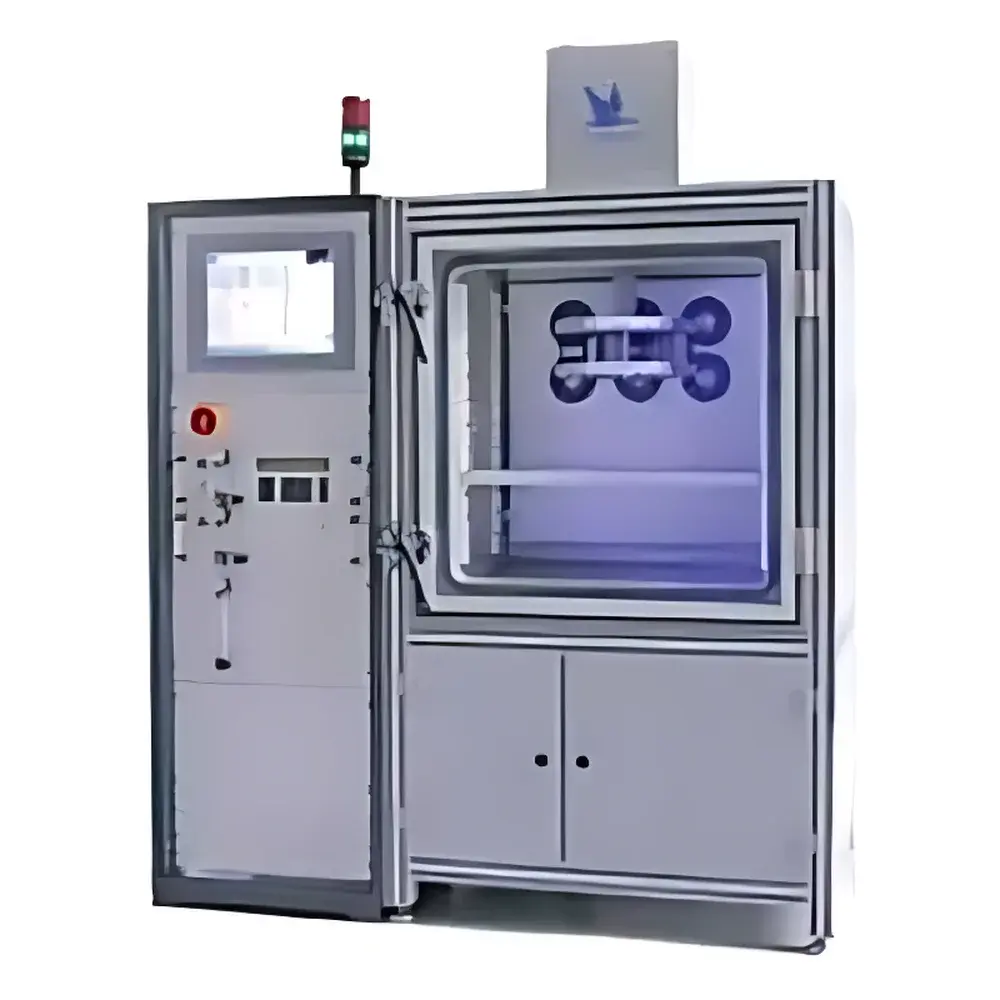
SIM 6300 Ozone Aging Test Chamber
| Origin | Germany |
|---|---|
| Manufacturer Type | Authorized Distributor |
| Origin Category | Imported |
| Model | SIM 6300 |
| Pricing | Upon Request |
| Air Velocity | 600 mm/s |
| Air Exchange Rate | Up to 500 dm³/h |
| Exterior Material | Anodized Aluminum |
| Viewing Window Dimensions | 680 × 680 mm |
| Adjustable Sample Height | ±20 mm |
| Weight | 143 kg |
| Ozone Concentration Range | 25–1000 ppm (PPHM) |
| Power Consumption | Max. 1000 W |
Overview
The SIM 6300 Ozone Aging Test Chamber is a precision-engineered environmental simulation system developed by Anseros, a German manufacturer specializing in accelerated material degradation testing. Designed in strict accordance with the physical and chemical mechanisms of ozone-induced elastomer degradation, this chamber applies controlled concentrations of ozone gas under regulated temperature and humidity conditions to induce and quantify surface cracking in rubber and elastomeric materials. Its operation is grounded in the well-established principle that ozone reacts selectively with unsaturated carbon–carbon double bonds (e.g., in natural rubber, SBR, NBR), initiating chain scission and microcrack propagation—processes accelerated under tensile strain and elevated ozone partial pressure. The SIM 6300 replicates real-world atmospheric aging stressors in a reproducible, time-compressed manner, enabling laboratories to assess material resistance prior to field deployment.
Key Features
- Programmable logic controller (PLC) with integrated analog data acquisition for simultaneous, independent regulation of ozone concentration (pphm), chamber temperature (±0.5 °C stability), and relative humidity (±3% RH).
- Dual-mode test capability: static (unstressed) and dynamic (mechanically strained) configurations via motorized sample fixtures and adjustable tensioning systems.
- High-precision ozone generation and monitoring using UV absorption spectroscopy (254 nm) with closed-loop feedback control—ensuring long-term concentration stability and traceability.
- Robust chamber architecture featuring anodized aluminum construction, safety-interlocked viewing window (680 × 680 mm tempered glass), and hermetic sealing compliant with DIN EN 61000-6-4 electromagnetic compatibility requirements.
- Integrated safety subsystems including emergency stop button, door-position interlock switch, ozone destruct catalyst unit, and audible/visual alarm triggers for over-concentration or thermal excursion.
Sample Compatibility & Compliance
The SIM 6300 accommodates standard test specimens per ASTM D1149, ISO 1431-1, and DIN 53509-1, including dumbbell-shaped strips, O-rings, extruded profiles, and molded components up to 143 kg total load capacity. Its internal dimensions and ±20 mm vertical adjustability support multi-tiered sample racks and custom fixture integration. All operational parameters—including ozone setpoint, dwell time, temperature ramp profiles, and humidity hold cycles—are fully configurable to match material-specific test protocols. The system meets essential regulatory prerequisites for GLP-compliant laboratories, with audit-ready event logging, user-access controls, and calibration traceability to national standards (e.g., PTB Germany). It supports validation documentation packages aligned with ISO/IEC 17025 and FDA 21 CFR Part 11 when paired with optional electronic signature modules.
Software & Data Management
The chamber interfaces with Anseros’ proprietary OzoneControl Suite v3.2—a Windows-based application supporting real-time parameter visualization, automated report generation (PDF/CSV), and historical trend analysis. All sensor readings (ozone, T, RH, airflow) are timestamped and stored with metadata (operator ID, method version, calibration certificate ID). Data export complies with ASTM E2500-22 for analytical instrument qualification, and raw logs include checksum-protected records suitable for regulatory submission. Optional OPC UA connectivity enables integration into centralized MES or LIMS platforms for enterprise-scale test orchestration and quality analytics.
Applications
- Accelerated aging evaluation of vulcanized rubber compounds used in automotive seals, brake hoses, and engine mounts.
- Qualification testing of cable insulation (XLPE, EPDM) per IEC 60811-506 and IEEE 930 reliability standards.
- Comparative benchmarking of antioxidant package efficacy across polymer formulations.
- Failure mode analysis of tire sidewalls and tread compounds exposed to urban ozone-rich atmospheres.
- Pre-compliance screening for medical device elastomers (e.g., silicone tubing) under ISO 10993-12 biocompatibility guidelines.
FAQ
What ozone generation method does the SIM 6300 use?
It employs corona discharge ozone generation with catalytic decomposition bypass, calibrated against NIST-traceable ozone transfer standards.
Is the chamber suitable for continuous unattended operation?
Yes—equipped with redundant thermal cutoffs, ozone leak detection, and auto-shutdown on communication loss; validated for 168-hour uninterrupted test cycles.
Can humidity be controlled independently of temperature?
Yes—dual PID-controlled steam humidification and refrigerated dehumidification allow decoupled RH regulation from 10% to 95% RH at 25–80 °C.
Does the system support IQ/OQ/PQ documentation templates?
Anseros provides GxP-aligned validation kits—including protocol drafts, acceptance criteria checklists, and calibration certificates—for IQ/OQ/PQ execution.
What maintenance intervals are recommended for ozone sensors?
UV absorption cells require annual verification; ozone generator electrodes are rated for 12,000 operating hours and include wear-level diagnostics in firmware.
Related Products







