
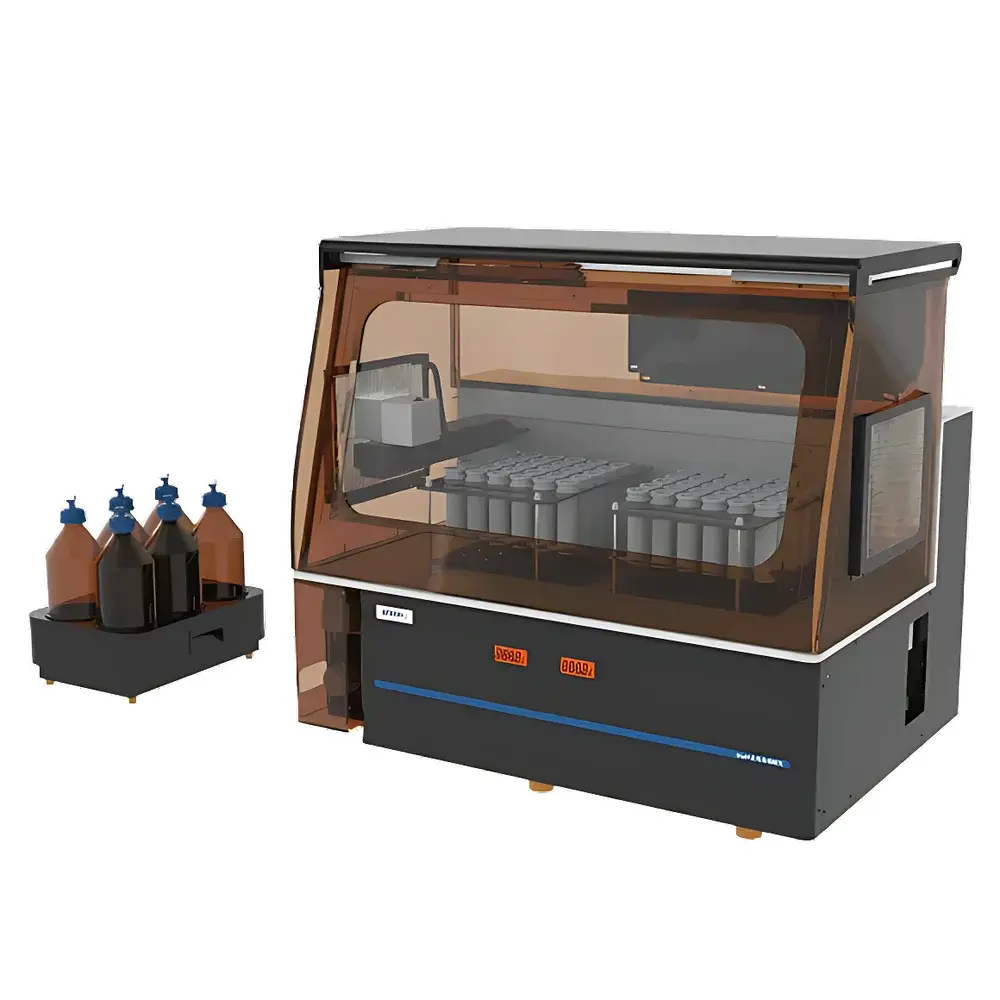
Sineo SH60A Fully Automated Graphite Block Digestion System
| Brand | Sineo |
|---|---|
| Origin | Shandong, China |
| Model | SH60A |
| Instrument Type | Graphite Block Digestion System |
| Automation Level | Fully Automated |
| Digestion Positions | 2 × 30 positions |
| Temperature Range | Ambient +5°C to 240°C |
| Temperature Control Accuracy | ±0.1°C |
| Heating Principle | Cavity-type Heated Graphite Module |
| Reagent Channels | 10 independent PTFE-lined channels |
| Power Supply | 220 V AC / 50 Hz |
| Rated Power | 3 kW |
| Digestion Vessel Capacity | 50 mL |
| Dimensions (W×D×H) | 860 × 610 × 520 mm |
| Weight | Not specified |
| Sample Handling | X-Y robotic arm with auto-pipetting, lift-and-shake mixing, real-time liquid-level sensing, endpoint color detection, and post-digestion cooling/定容 (volumetric completion) |
Overview
The Sineo SH60A Fully Automated Graphite Block Digestion System is an engineered solution for high-throughput, reproducible sample preparation in inorganic elemental analysis. Designed specifically for pre-digestion workflows supporting ICP-OES, ICP-MS, and AAS instrumentation, the SH60A implements cavity-heated graphite block technology combined with integrated robotics and multi-sensor feedback control to execute wet acid digestion—spanning reagent addition, thermal ramping, shaking, reflux, evaporation (hotplate赶酸), cooling, and volumetric finalization—without manual intervention. Its core measurement principle relies on precise thermal energy delivery via a dual-zone, PID-regulated graphite heating module, ensuring uniform heat distribution across all 60 digestion positions (2 × 30) with inter-hole temperature deviation ≤ ±1°C. This architecture directly addresses critical analytical pain points: batch-to-batch reproducibility, operator safety during exposure to aggressive acids (e.g., HNO₃, HClO₄, HF), and trace-level contamination control through full PTFE fluidic pathways and corrosion-resistant structural components.
Key Features
- Fully automated X-Y robotic arm with gravimetric and volumetric calibration routines for reagent dispensing—achieving <1% volumetric error at 50 mL and ≥2 mL/s delivery speed.
- Dual independent graphite heating modules, each controllable in temperature and timing, enabling parallel digestion protocols with differing acid matrices or thermal profiles.
- Intelligent mixing system featuring motorized vertical lift and continuously variable-speed orbital shaking—adjustable from 0–300 rpm—to ensure homogeneous reagent–sample interaction without splashing or aerosol generation.
- Multi-sensor fusion platform: ultrasonic liquid-level sensors for automatic volumetric completion; high-resolution CMOS imaging for real-time visual monitoring of digestion progression; RGB color sensors for endpoint determination in chromogenic reactions (e.g., Cr(VI) reduction, Mn oxidation).
- PTFE-lined 10-channel reagent manifold with air-filtered bottle ports and real-time reagent volume tracking—supporting aggressive chemistries including hydrofluoric acid, perchloric acid, and potassium permanganate solutions.
- Corrosion-hardened construction: fluoropolymer-coated graphite blocks, PTFE-machined work surface, and acid-resistant mechanical components—including robotic grippers and exhaust ducting—validated for continuous operation under ISO 17025-compliant laboratory environments.
Sample Compatibility & Compliance
The SH60A accommodates standard 50 mL digestion vessels (including EPA-compliant borosilicate and quartz variants) and supports method-defined sample masses up to 2 g for solid matrices. It complies with key regulatory frameworks governing elemental analysis workflows: methods alignment with US EPA Methods 3050B, 3051A, and 3052; adherence to GB 5009.15–2014 (Chinese national standard for Cd in food); and compatibility with ISO/IEC 17025 requirements for documented calibration, traceability, and audit-ready operational logs. All temperature setpoints, reagent volumes, and process timestamps are digitally recorded with immutable timestamps—enabling full GLP/GMP traceability when paired with 21 CFR Part 11–compliant software extensions (available upon request).
Software & Data Management
The SH60A operates via a dedicated Windows-based control interface with bilingual (Chinese/English) toggle support. The software employs modular method programming: users drag-and-drop heating ramps, reagent sequences, shaking parameters, and endpoint criteria into a timeline-based editor. Real-time visualization includes live temperature curves per zone, cumulative reagent consumption graphs, and video feed overlays synchronized with process events. All raw data—including sensor readings, actuator states, and alarm logs—are stored in SQLite format with SHA-256 hash integrity verification. Export options include CSV, PDF reports (with digital signature fields), and direct integration with LIMS via OPC UA or RESTful API endpoints. Remote supervision is supported over Wi-Fi or RS-232, permitting off-site monitoring and emergency protocol suspension without physical access.
Applications
The SH60A delivers validated performance across regulated and research-driven domains. In food safety laboratories, it enables routine Cd quantification in cereals per GB 5009.15–2014, achieving intra-batch RSD <4% and spike recoveries of 93–98%. Environmental labs utilize its dual-module capability to concurrently digest soil (EPA 3050B) and water filter residues (EPA 200.8) under distinct acid combinations. Pharmaceutical QC departments apply it to residual catalyst metal analysis (e.g., Pd, Pt, Rh) in APIs, where low blank levels (<0.05 ng/mL) and high throughput (60 samples/4 h) reduce turnaround time versus manual hot-block systems. Feed and fertilizer testing benefits from its robust handling of high-silica and phosphate-rich matrices, while cosmetics labs leverage color-sensing functionality for redox-based As speciation workflows.
FAQ
What types of acids are compatible with the SH60A’s fluidic system?
All reagents—including concentrated nitric acid, hydrochloric acid, hydrofluoric acid (up to 40%), perchloric acid (up to 72%), and hydrogen peroxide—are fully supported due to PTFE-lined tubing, valves, and reservoirs.
Can the SH60A be integrated into an existing LIMS environment?
Yes—via configurable RESTful API or OPC UA server mode, allowing bidirectional exchange of method parameters, sample IDs, and completion status.
Is temperature calibration traceable to national standards?
Each unit ships with a factory-issued calibration certificate referencing NIST-traceable RTDs; field recalibration requires only a certified reference thermometer and one-click software initiation.
How does the system prevent cross-contamination between batches?
Automated tip-wash cycles, air-gap aspiration, and positive-pressure purging of all fluid paths between runs eliminate carryover; vessel positioning accuracy is ±0.1 mm.
What safety certifications does the SH60A hold?
CE marking (2014/30/EU EMC Directive and 2014/35/EU Low Voltage Directive); conforms to IEC 61010-1:2010 for laboratory electrical equipment safety.



