
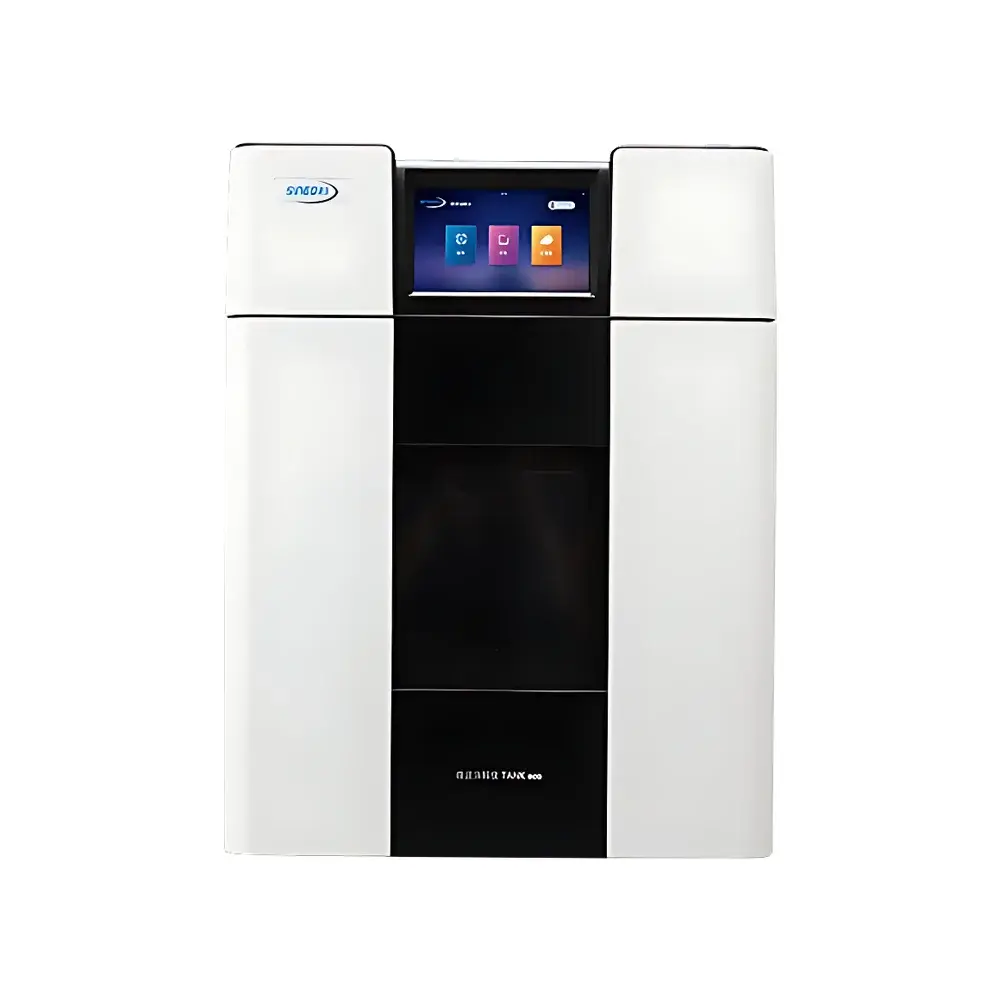
Sineo TANK eco Microwave Digestion System
| Brand | Sineo |
|---|---|
| Origin | Shandong, China |
| Model | TANK eco |
| Cavity Class | Industrial-grade |
| Sample Capacity | 6/8/10 positions |
| Microwave Source | Frequency-variable magnetron with high-energy microwave field emission |
| Max Temperature | 300 °C |
| Max Pressure | 15 MPa (≈2200 psi) |
| Power Supply | 220–240 VAC, 50/60 Hz, 20 A |
| Microwave Frequency | 2450 MHz |
| Installed Power | 1800 W |
| Max Microwave Output | 1000 W |
| Cavity Volume | 31.6 L |
| Cavity Material | 316 stainless steel with multi-layer PTFE coating |
| Safety Door | Auto-ejecting explosion-proof sliding door with anti-leakage interlock |
| Cooling | High-flow corrosion-resistant turbo fan |
| Dimensions (W×D×H) | 480 × 560 × 575 mm |
| Net Weight | 45 kg |
| Pressure Control Range | 0–15 MPa, accuracy ±0.01 MPa |
| Temperature Control Range | 0–305 °C (IR), or –40–305 °C (fiber-optic), accuracy ±0.1 °C |
| Safety Systems | COT real-time anomaly monitoring, directional safety bolt pressure relief, full-cavity pressure monitoring, microwave cutoff on fault detection |
| Software | Android-based OS |
Overview
The Sineo TANK eco Microwave Digestion System is an industrial-grade, fully sealed high-pressure microwave platform engineered for reproducible, trace-level sample preparation in regulated and research laboratories. It operates on the principle of controlled microwave energy absorption by polar molecules and ionic species within closed-vessel reaction environments—enabling rapid, uniform thermal transfer and kinetic acceleration of acid digestion reactions. Unlike open-vessel or low-pressure systems, the TANK eco employs a true isochoric (constant-volume) digestion architecture, eliminating volatile element loss and ensuring quantitative recovery of analytes such as As, Cd, Hg, Pb, Se, and Cr(VI). Its design adheres to core principles defined in ASTM D5511, ISO 11885, USP <231>, and EPA Methods 3050B, 3051A, and 3052—making it suitable for environmental, food, pharmaceutical, geological, and materials science applications where data integrity and regulatory compliance are non-negotiable.
Key Features
- Fully sealed rotor system with 6/8/10-position configuration, supporting standardized 55 mL quartz or high-purity PTFE-TFM digestion vessels rated to 15 MPa and 300 °C.
- Frequency-variable magnetron delivering stable, tunable microwave power (0–1000 W) across dynamic load conditions—ensuring consistent energy coupling regardless of sample matrix heterogeneity.
- Dual independent temperature sensing: infrared-based full-cavity real-time monitoring (±0.1 °C) supplemented by optional multi-core fiber-optic probes with PTFE-sheathed durability (5× lifespan vs. single-core alternatives).
- High-precision semiconductor pressure transducers with chemically passivated diaphragms and corrosion-resistant signal pathways—maintaining long-term stability under aggressive HNO₃/HF/HClO₄ matrices.
- Composite outer vessels constructed from aerospace-grade carbon-fiber-reinforced polymer with integral PTFE coating—rated to 70 MPa burst pressure and 600 °C thermal tolerance, exceeding PEEK mechanical limits in both tensile strength and chemical inertness.
- COT (Constant Overpressure Tracking) intelligent fault-detection system: continuously monitors individual vessel pressure/temperature profiles and triggers immediate microwave cutoff plus audible/visual alerts upon deviation beyond preset thresholds.
- Directional safety bolt mechanism enabling controlled, quantitative pressure release at precisely calibrated thresholds—preventing uncontrolled venting while preserving analytical integrity.
Sample Compatibility & Compliance
The TANK eco accommodates a broad spectrum of solid and semi-solid matrices—including soils, sediments, biological tissues, polymers, ceramics, and metal alloys—without requiring pre-dilution or matrix masking. Its robust cavity construction and corrosion-resistant internal coatings ensure compatibility with aggressive reagent combinations (e.g., aqua regia, HF-containing mixtures, and peroxide-assisted oxidants). All operational parameters—including method execution logs, user authentication events, parameter edits, and calibration records—are captured with time-stamped, immutable entries compliant with FDA 21 CFR Part 11 requirements. Audit trails support GLP/GMP audits, and method validation documentation aligns with ISO/IEC 17025 clause 7.2.2 for method verification.
Software & Data Management
Running a certified Android-based OS, the TANK eco integrates a purpose-built laboratory software suite featuring role-based access control, electronic signatures, and granular permission settings. The interface supports real-time visualization of temperature/pressure/time curves, stepwise protocol editing, and automatic rotor position recognition—eliminating manual vessel count entry. Local storage (8 GB) retains ≥10,000 complete digestion runs with full metadata. Cloud synchronization is implemented via TLS 1.2–encrypted channels; users may store methods, reports, and raw sensor data on private or institutional cloud instances. Remote firmware updates, method library downloads, and cross-platform data export (CSV, PDF, XML) are supported via Wi-Fi, Ethernet, or USB host mode—all without compromising data sovereignty or cybersecurity posture.
Applications
- Environmental testing: heavy metal quantification in wastewater sludge, fly ash, and contaminated soil per EPA 3052 and ISO 17294-2.
- Food safety: determination of toxic elements (Cd, Pb, As) in cereals, infant formula, and seafood using ICP-MS/OES-ready digests.
- Pharmaceutical QC: residual catalyst metal analysis (Pd, Pt, Rh) in active pharmaceutical ingredients (APIs) following USP <232> <233>.
- Materials synthesis: microwave-assisted hydrothermal preparation of functional nanomaterials (e.g., SiO₂ nanospheres, Nd-doped ZnO photocatalysts) with precise thermal ramping and hold control.
- Geochemical analysis: silicate rock digestion for rare earth element (REE) profiling using HF-HNO₃-HClO₄ blends under inert atmosphere options.
FAQ
What safety certifications does the TANK eco hold?
The system complies with IEC 61000-6-3 (EMC), IEC 61010-1 (electrical safety), and EN 62233 (microwave leakage ≤5 mW/cm² at 5 cm distance). Full test reports are available upon request.
Can the instrument be integrated into a LIMS environment?
Yes—via configurable RESTful API endpoints and standardized CSV/JSON export formats. Audit trail data meets LIMS ingestion requirements for chain-of-custody tracking.
Is HF digestion supported, and how is corrosion managed?
HF-compatible vessels (TFM-lined quartz or pure PTFE) are standard. Internal cavity surfaces feature triple-layer PTFE coating; pressure sensors employ Hastelloy C-276 wetted parts and ceramic isolation barriers.
How is method validation supported?
The system includes pre-validated application notes aligned with AOAC, EPA, and ISO protocols. Users may generate IQ/OQ documentation templates and perform repeatability studies using built-in statistical reporting tools.
What maintenance intervals are recommended?
Annual calibration of pressure/temperature sensors and verification of safety bolt torque are advised. No routine magnetron replacement is required—the frequency-variable design extends component lifetime beyond 5,000 operating hours.



