
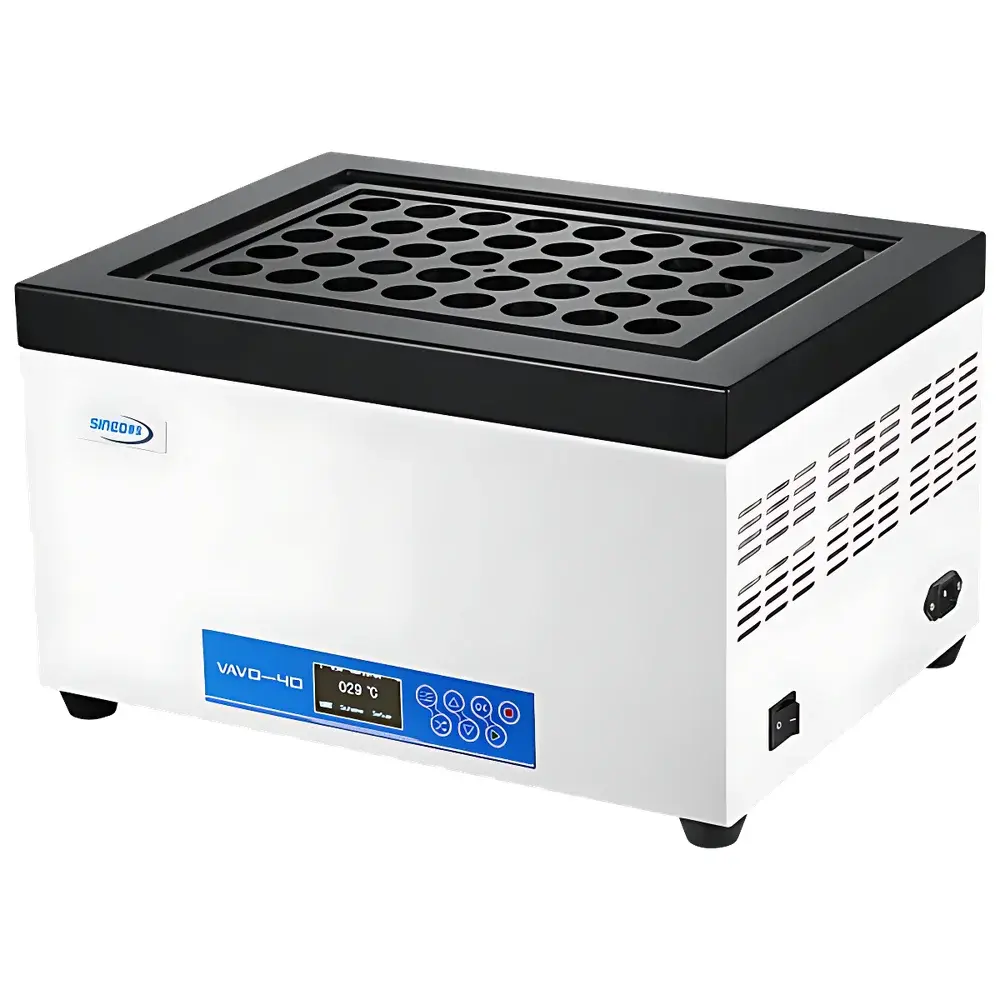
Sineo TK/VAVO Series Electric Hot Block Digestion Systems for Acid Evaporation and Sample Pre-Digestion
| Brand | Sineo |
|---|---|
| Origin | Shandong, China |
| Model Range | TK-12 / TK-16 / TK-20 / TK-24 / TK-24D / VAVO-28 / VAVO-40 / TK-40 |
| Heating Principle | Cast-Aluminum Block with Deep-Well Design |
| Max Temperature | 240 °C (TK series) / 250 °C (VAVO series) |
| Temperature Accuracy | ±1 °C |
| Heating Uniformity | Optimized via High-Thermal-Conductivity Cast-Aluminum Block |
| Control System | Embedded PID Algorithm with Real-Time Thermal Monitoring |
| Safety Features | Over-Temperature, Over-Current, Over-Pressure, and Heating Element Fault Detection |
| Surface Finish | PTFE-Coated for HNO₃, HF, HCl, and Aqua Regia Resistance |
| Application Mode | Atmospheric-Pressure Wet Digestion & Post-Microwave Acid Evaporation |
| Compliance | Designed to support EPA Methods 3050B, 3051A, 3052 |
Overview
The Sineo TK and VAVO Series Electric Hot Block Digestion Systems are precision-engineered thermal platforms designed for two critical stages in elemental analysis workflows: pre-microwave sample conditioning (pre-digestion) and post-microwave acid evaporation (‘acid removal’ or ‘acid fuming’). Unlike conventional hot plates or open-flame digesters, these systems employ a monolithic cast-aluminum heating block with precisely machined deep wells—ensuring uniform radial and axial heat distribution across all sample positions. The principle of operation relies on conductive heating through high-density aluminum, which delivers rapid thermal response, minimal temperature gradient (<±0.8 °C across 40 wells), and negligible heat loss during prolonged operation at up to 250 °C. This architecture is essential for maintaining stoichiometric integrity during nitric-perchloric or nitric-hydrofluoric acid treatments, especially when processing high-matrix samples such as soils, sediments, biological tissues, and polymer-rich food matrices per EPA 3051A, ISO 17294-2, and GB/T 5009.12 protocols.
Key Features
- PID-Controlled Embedded Firmware: Proprietary microprocessor-based temperature regulation with adaptive learning algorithms ensures stable setpoint maintenance (±1 °C) under variable ambient and load conditions—critical for reproducible recoveries in trace metal analysis.
- PTFE-Encapsulated Structural Integrity: Entire external housing and internal cavity surfaces are electrostatically coated with industrial-grade polytetrafluoroethylene, providing continuous resistance to concentrated mineral acids including 49% HF and boiling aqua regia—eliminating corrosion-induced calibration drift and extending service life beyond 10 years under routine QC use.
- Deep-Well Cast-Aluminum Block Architecture: Wells range from 30.5 mm to 39.5 mm in diameter and up to 160 mm in depth, accommodating standard 50 mL and 100 mL quartz or PFA digestion tubes while minimizing vapor condensation and promoting directional acid reflux—thereby improving analyte retention and reducing blank contributions.
- Multi-Layer Electronic Protection: Independent hardware-level monitoring of current draw, surface temperature, and thermal cutoff thresholds triggers immediate shutdown and audible/visual alerts upon detection of heater failure, short circuit, or uncontrolled exothermic reaction—fully compliant with IEC 61010-1 safety requirements for laboratory electrical equipment.
- Modular Scalability: Eight model variants (TK-12 to TK-40 and VAVO-28/VAVO-40) allow laboratories to align throughput capacity (12–40 samples per run) with analytical volume demands without compromising thermal fidelity—each configuration validated for identical temperature homogeneity profiles.
Sample Compatibility & Compliance
The TK/VAVO series supports digestion vessels made of quartz, borosilicate glass, PFA, and ETFE—enabling compatibility with aggressive chemistries required for certified reference material (CRM) validation and regulatory submissions. It meets the thermal stability and repeatability prerequisites outlined in USP , ASTM D5175-19 (for fuel ash analysis), and GLP-compliant environmental testing labs conducting analyses under ISO/IEC 17025:2017. When operated with validated SOPs, the system enables full traceability of digestion parameters—including ramp rate, hold time, and final evaporation endpoint—supporting audit readiness for FDA 21 CFR Part 11-compliant data management environments when integrated with optional RS-485 or Ethernet-enabled logging modules.
Software & Data Management
While the base unit operates via intuitive front-panel controls, optional digital interfaces (RS-485 Modbus RTU or TCP/IP) enable integration into centralized LIMS or ELN platforms. Time-stamped temperature logs—including real-time deviation alerts and heater status—are exportable in CSV format for QA review. All firmware revisions adhere to IEC 62304 Class B software lifecycle standards, with version-controlled update protocols and factory-calibrated sensor verification reports provided with each instrument shipment. No proprietary drivers or cloud dependencies are required—ensuring long-term operational continuity in regulated GMP and clinical research settings.
Applications
- Routine acid evaporation following closed-vessel microwave digestion (e.g., CEM Mars 6, Anton Paar Multiwave PRO)
- Atmospheric-pressure wet digestion of water, wastewater, sludge, and plant tissue per EPA Method 3050B
- Pre-concentration of digests prior to ICP-MS or ICP-OES analysis to minimize polyatomic interferences
- HF-assisted silicate dissolution for geological and ceramic samples (ASTM D5175, ISO 11047)
- High-throughput preparation of food and feed samples for heavy metal screening (GB 5009.12–2023, GB 5009.15–2023)
FAQ
What distinguishes the TK-24D and VAVO-40 models from standard configurations?
The TK-24D features dual-zone power delivery (3.2 kW total) for accelerated ramp-up in high-thermal-mass applications, while the VAVO-40 extends maximum operating temperature to 250 °C with enhanced insulation—optimized for perchloric acid fuming and refractory oxide dissolution.
Can these units be used with Teflon-lined microwave rotor vessels?
Yes—provided vessels are rated for continuous exposure to temperatures ≥250 °C and are placed upright within the wells; however, direct contact between vessel base and aluminum surface must be verified for thermal expansion compatibility.
Is third-party calibration certification available?
Sineo provides NIST-traceable temperature calibration certificates (per ISO/IEC 17025) upon request, including multi-point verification across the full operating range using accredited platinum resistance thermometers.
How is over-temperature protection implemented at the hardware level?
Each unit integrates redundant K-type thermocouples—one embedded in the aluminum block core and one mounted on the outer casing—with independent solid-state relays that cut power within 120 ms if either sensor exceeds preset limits by >5 °C.
Do the PTFE coatings withstand repeated HF exposure?
Yes—the electrostatically applied coating (≥120 µm thickness) has been validated for 500+ cycles of 49% HF at 180 °C without blistering, flaking, or measurable fluorine leaching in blank tests.



