
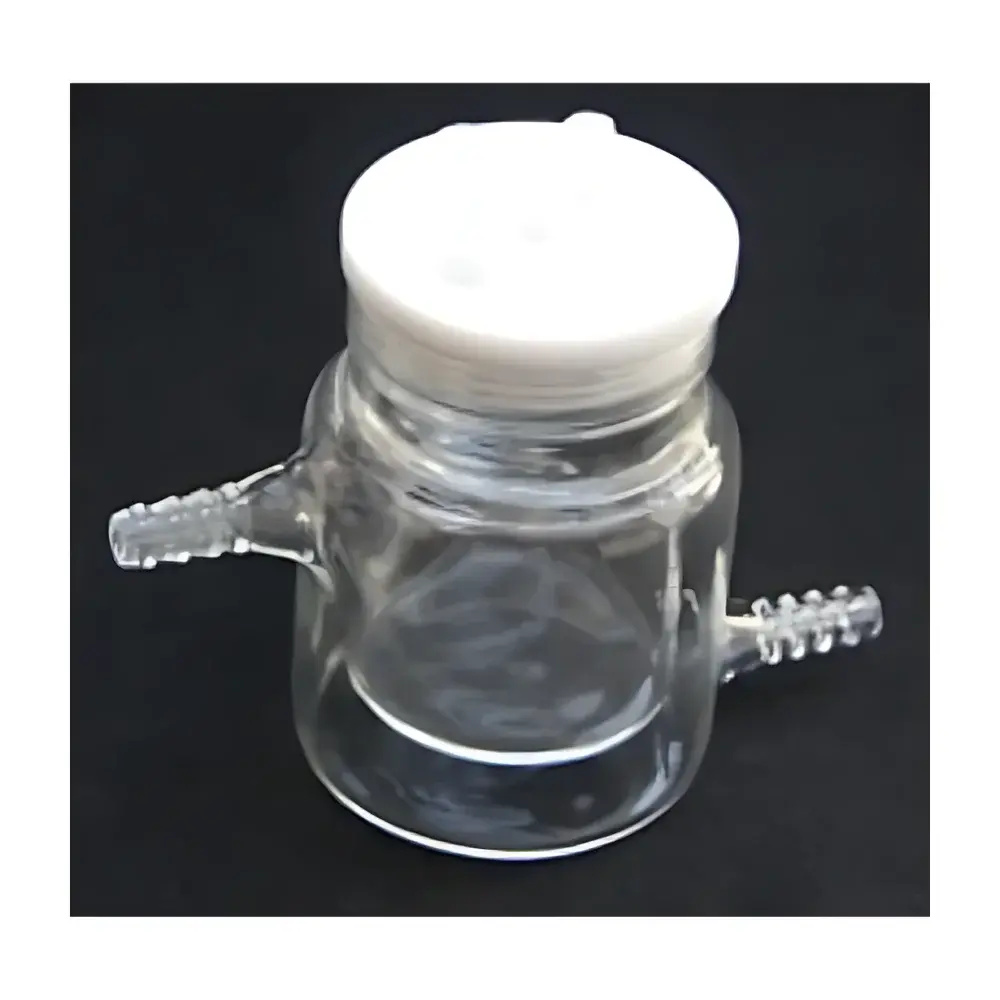
Single-Water-Bath Electrolytic Cell
| Brand | CNI (Zhongjiao Jinyuan) |
|---|---|
| Origin | Beijing, China |
| Manufacturer Type | Direct Manufacturer |
| Country of Origin | China |
| Model | Single-Water-Bath Electrolytic Cell |
| Pricing | Available Upon Request |
| Volume Options | 30 mL, 50 mL, 100 mL, 150 mL |
| Temperature Control | External Water Bath Integration |
| System Sealing | Hermetic Glass Joint Assembly |
| Electrodes | Not Included (Electrode Selection Compatible with Standard 10/32 or M6 Threaded Ports) |
Overview
The CNI Single-Water-Bath Electrolytic Cell is a precision-engineered electrochemical reaction vessel designed for controlled, reproducible studies under thermostatically stabilized conditions. Unlike jacketed cells, this design relies on immersion within an external circulating water bath—enabling uniform thermal equilibration across the entire cell body while minimizing thermal gradients and mechanical complexity. The cell operates on a sealed, all-glass architecture with standardized conical (e.g., 24/40 or 29/32) or threaded (10/32 or M6) ports to accommodate interchangeable working, counter, and reference electrodes, as well as gas inlet/outlet fittings, pH/temperature probes, and optical windows. Its modular configuration supports both aqueous and non-aqueous electrolyte systems, making it suitable for fundamental kinetic investigations, photoelectrochemical measurements (when paired with quartz windows), and controlled-potential electrolysis under inert or reactive atmospheres.
Key Features
- Hermetically sealable borosilicate glass construction with PTFE-coated ground joints or threaded interfaces for leak-tight operation up to 1 atm.
- Multiple standard volume options (30 mL, 50 mL, 100 mL, and 150 mL) optimized for scalability from screening experiments to preparative-scale electrolysis.
- No integrated heating/cooling elements—designed exclusively for passive thermal coupling via external water bath circulation, ensuring minimal electromagnetic interference and long-term calibration stability.
- Electrode-agnostic port geometry compatible with common laboratory-grade electrodes (e.g., Pt wire, GC rods, Ag/AgCl reference, Hg pool, or custom photoanodes).
- Optional quartz side-arm or bottom window variants available for in situ UV-Vis spectroelectrochemistry or laser-based probing (not included in base configuration).
- Chemical resistance validated for use with strong acids (e.g., 6 M H₂SO₄), alkalis (e.g., 1 M KOH), organic solvents (acetonitrile, DMF), and ionic liquids.
Sample Compatibility & Compliance
The cell accommodates liquid-phase electrochemical samples ranging from microliter-scale catalyst slurries to bulk electrolyte volumes exceeding 100 mL. It supports standard three-electrode configurations and is routinely deployed in ASTM D6319-compliant conductivity testing, ISO 17025-accredited corrosion rate determination (via polarization resistance), and USP –aligned stability studies of redox-active pharmaceutical intermediates. All glass components meet ISO 3585 specifications for hydrolytic resistance (Class HGB), and joint tolerances conform to DIN 12270 standards. While the cell itself carries no CE or UL certification (as a component-level device), its design enables full integration into GLP/GMP-compliant electrochemical workstations when paired with validated potentiostats and data acquisition modules.
Software & Data Management
As a passive hardware component, the Single-Water-Bath Electrolytic Cell does not incorporate embedded firmware or native software. However, it is fully interoperable with industry-standard electrochemical instrumentation platforms—including BioLogic SP-300, Metrohm Autolab PGSTAT302N, and Princeton Applied Research VersaSTAT series—enabling synchronized acquisition of current, potential, charge, and real-time temperature feedback (when used with external Pt100 or thermistor probes). Experimental metadata—including bath setpoint, flow rate, ambient pressure, and electrode history—can be logged alongside electrochemical data using compliant LIMS or ELN systems supporting ASTM E2500 and FDA 21 CFR Part 11 audit-trail requirements.
Applications
- Controlled-potential bulk electrolysis for synthetic organic electrochemistry (e.g., Kolbe coupling, Shono oxidation).
- Stability assessment of battery electrolytes and SEI-forming additives under thermal stress (30–80 °C range).
- In situ monitoring of electrocatalytic CO₂ reduction product distribution via online GC-MS coupling.
- Photoelectrochemical water splitting studies using TiO₂, BiVO₄, or perovskite photoanodes under AM 1.5G illumination.
- Corrosion inhibition evaluation in simulated cooling water or oilfield brine environments.
- Electrochemical impedance spectroscopy (EIS) of conducting polymer films under isothermal conditions.
FAQ
Does the cell include electrodes?
No. Electrodes are not supplied with the base unit; users select appropriate working, counter, and reference electrodes based on their specific reaction chemistry and measurement requirements.
What temperature range is supported?
The operational range is limited only by the external water bath and electrolyte stability—typically 5 °C to 80 °C for aqueous systems and –10 °C to 60 °C for low-volatility organic media.
Can the cell be used under inert atmosphere?
Yes. Equipped with gas-tight septum ports or Schlenk-style stopcocks, it supports continuous N₂ or Ar purging and maintains anaerobic conditions throughout extended experiments.
Is customization available for optical access or specialized ports?
CNI offers OEM modifications including fused-silica windows (UV-grade, 200–2500 nm transmission), auxiliary Luer-lock inlets, and custom electrode sleeve dimensions upon formal engineering review.
How is temperature uniformity verified?
Users are advised to calibrate bath-to-cell thermal lag using a calibrated microprobe inserted through a dedicated port; typical equilibration time to ±0.2 °C at steady state is ≤5 minutes for 50 mL fill volume.



