
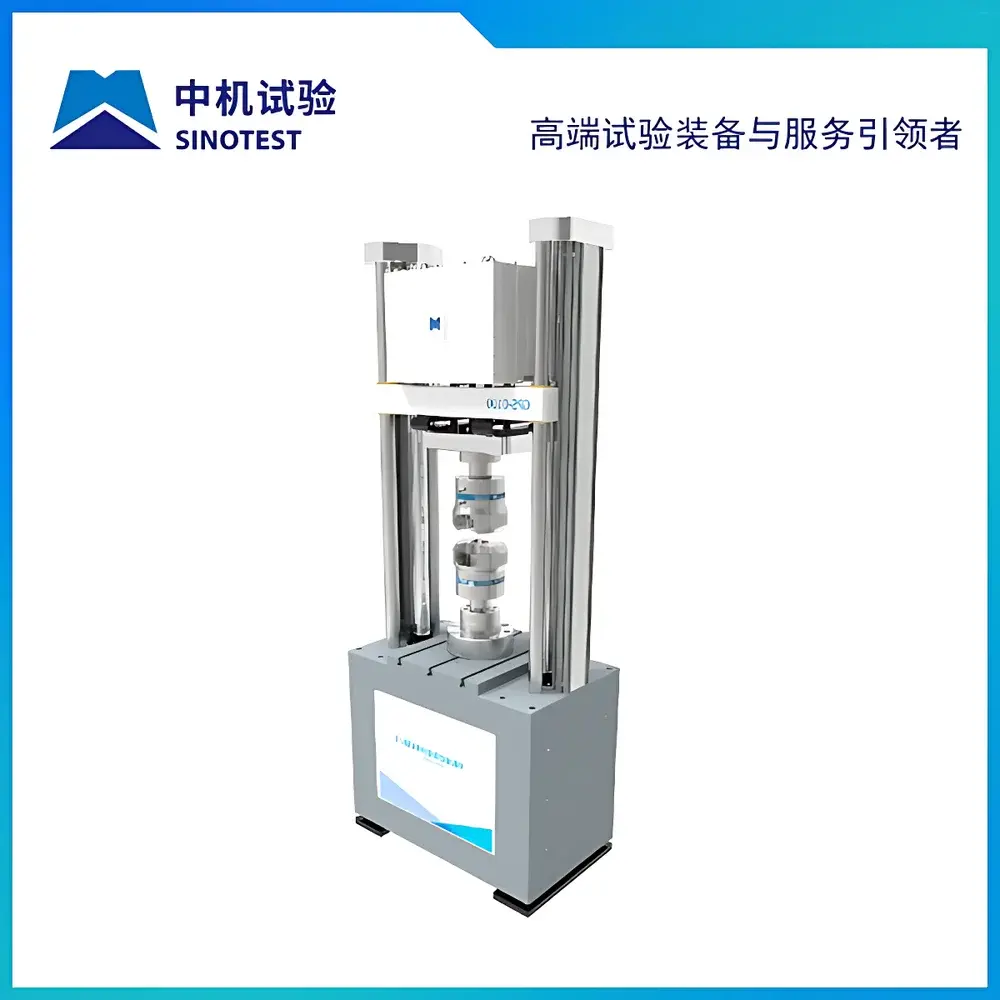
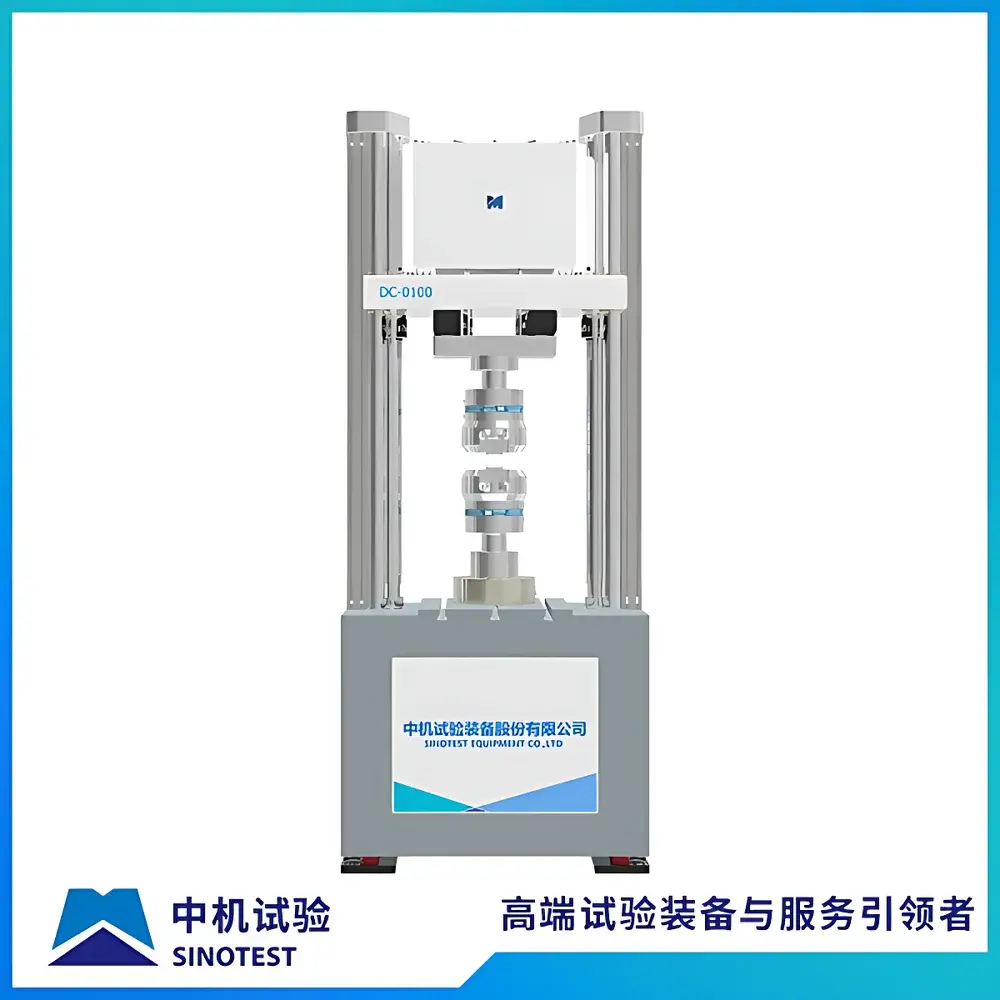
SINOTEST DC0100 Electromagnetic Resonant High-Frequency Fatigue Testing Machine
| Brand | SINOTEST |
|---|---|
| Origin | Jilin, China |
| Manufacturer Type | Direct Manufacturer |
| Model | DC0100 |
| Frequency Range | ≥400 Hz |
| Dynamic Force Accuracy | ±1% FS |
| Load Alignment (Coaxiality) | 1–3% |
| Frequency Adjustment | 5-step non-mass-loading tuning |
| Static Tensile Capability | Integrated |
| MTBF | ≥4000 h |
| Compliance | ISO 1099, GB/T 3075, GB/T 2611, JB/T 5488-1991, JJG 556-2011, HB 5287 |
Overview
The SINOTEST DC0100 is an electromagnetic resonant high-frequency fatigue testing machine engineered for high-cycle fatigue (HCF) characterization of metallic materials and structural components under controlled dynamic loading. Operating on the principle of electromagnetic resonance—where a precisely tuned AC current drives a moving coil within a static magnetic field to generate harmonic axial force—the DC0100 achieves stable, repeatable sinusoidal loading at frequencies up to and exceeding 400 Hz. Unlike servo-hydraulic or electrodynamic shaker-based systems, this resonant architecture delivers exceptional energy efficiency, minimal thermal drift, and high mechanical fidelity over extended test durations. Designed for laboratories requiring rigorous compliance with international fatigue standards—including ISO 1099 (metallic materials — fatigue testing — axial force-controlled method), GB/T 3075 (Chinese national standard for axial fatigue testing), and ASTM E466 (standard practice for conducting force-controlled constant amplitude axial fatigue tests)—the DC0100 serves as a core platform for HCF evaluation in mission-critical sectors such as aerospace propulsion systems, rail vehicle bogie components, automotive powertrain parts, nuclear pressure boundary materials, and defense-grade fasteners.
Key Features
- Electromagnetic resonant actuation system enabling stable, low-distortion sinusoidal loading at ≥400 Hz—optimized via multi-degree-of-freedom structural simulation and electromagnetic field modeling.
- Full-digital closed-loop controller with real-time adaptive tuning, supporting both open-loop resonance tracking and closed-loop force/strain regulation modes.
- Integrated static tensile module compliant with GB/T 228.1, permitting seamless transition between quasi-static tensile testing and high-frequency fatigue cycling without specimen re-fixturing.
- Five-step frequency tuning mechanism eliminating traditional dead-weight calibration masses—enhancing operational safety, reducing setup time, and minimizing mechanical hysteresis.
- Load train coaxiality maintained within 1–3%, verified per JJG 556-2011 requirements, ensuring uniform stress distribution and mitigating bending artifacts during axial fatigue tests.
- Mean time between failures (MTBF) certified at ≥4000 hours under continuous operation, validated through accelerated life testing and documented in third-party reliability reports.
Sample Compatibility & Compliance
The DC0100 accommodates standardized cylindrical, rectangular, and notched specimens per ISO 1099 Annex A, ASTM E606, and GB/T 3075. Specimen gripping options include hydraulic wedge grips, threaded end fixtures, and custom adapters for miniature or high-aspect-ratio geometries. All hardware and control firmware are designed to meet functional safety requirements outlined in IEC 61508 (SIL2) for laboratory equipment. Test data integrity aligns with GLP and GMP principles: audit trails, user access controls, electronic signatures, and raw data immutability are enforced via embedded firmware-level logging—not reliant on post-processing software. The system satisfies metrological traceability per JJG 556-2011 and supports calibration verification using NIST-traceable reference load cells and displacement transducers.
Software & Data Management
The proprietary SINOTEST FatigueSuite™ software provides native support for ISO-standardized test protocols including step-stress, block-loading, spectrum loading (e.g., Mini-Max, FALSTAFF), and crack growth rate (da/dN) analysis per ASTM E647. All test parameters—frequency, peak/mean load, waveform type, cycle count, termination criteria—are programmable with sub-cycle resolution. Real-time data acquisition records force, displacement, and optional extensometer signals at ≥10 kHz sampling rate, stored in HDF5 format for long-term archival and interoperability with MATLAB, Python (h5py), or commercial CAE tools. Software validation documentation includes IQ/OQ/PQ protocols, and the platform is compatible with FDA 21 CFR Part 11-compliant environments when deployed with enterprise identity management integration.
Applications
- Aerospace: Turbine disk and blade HCF screening under simulated engine-order vibrations; fretting fatigue assessment of dovetail joints.
- Rail Transportation: Fatigue life prediction of axle steel under 10⁷–10⁹ cycle regimes; weld toe evaluation of bogie frame assemblies.
- Automotive: Valve spring endurance testing at 400–600 Hz; crankshaft fillet fatigue under combined bending-torsion spectra.
- Nuclear Energy: Stress corrosion cracking (SCC) initiation studies on Zr-alloy cladding tubes under cyclic thermal-mechanical loading.
- Academic Research: Fundamental investigation of dislocation dynamics and microstructural evolution during ultrasonic-frequency fatigue.
FAQ
What is the maximum achievable frequency for axial fatigue testing on the DC0100?
The system is rated for stable operation at ≥400 Hz under full-rated dynamic load; actual upper limit depends on specimen mass, stiffness, and grip configuration.
Does the DC0100 support non-sinusoidal waveforms (e.g., triangular, square)?
No—it is optimized exclusively for sinusoidal harmonic excitation via electromagnetic resonance; non-sinusoidal waveforms require external signal conditioning and are not covered by factory calibration.
Can the machine perform fatigue crack growth (FCG) testing per ASTM E647?
Yes, when equipped with a calibrated clip-on or attachment-type crack mouth opening displacement (CMOD) gauge and operated within the validated K-range and R-ratio envelope.
Is remote monitoring or integration with a central LIMS supported?
Yes—via TCP/IP-based API and OPC UA server interface; raw data streams and status variables are accessible for real-time ingestion into laboratory information management systems.
What maintenance intervals are recommended for sustained ISO 1099 compliance?
Annual metrological verification of force and displacement channels is required; biannual inspection of electromagnetic gap clearance and cooling system performance is advised per maintenance manual Section 7.2.



