
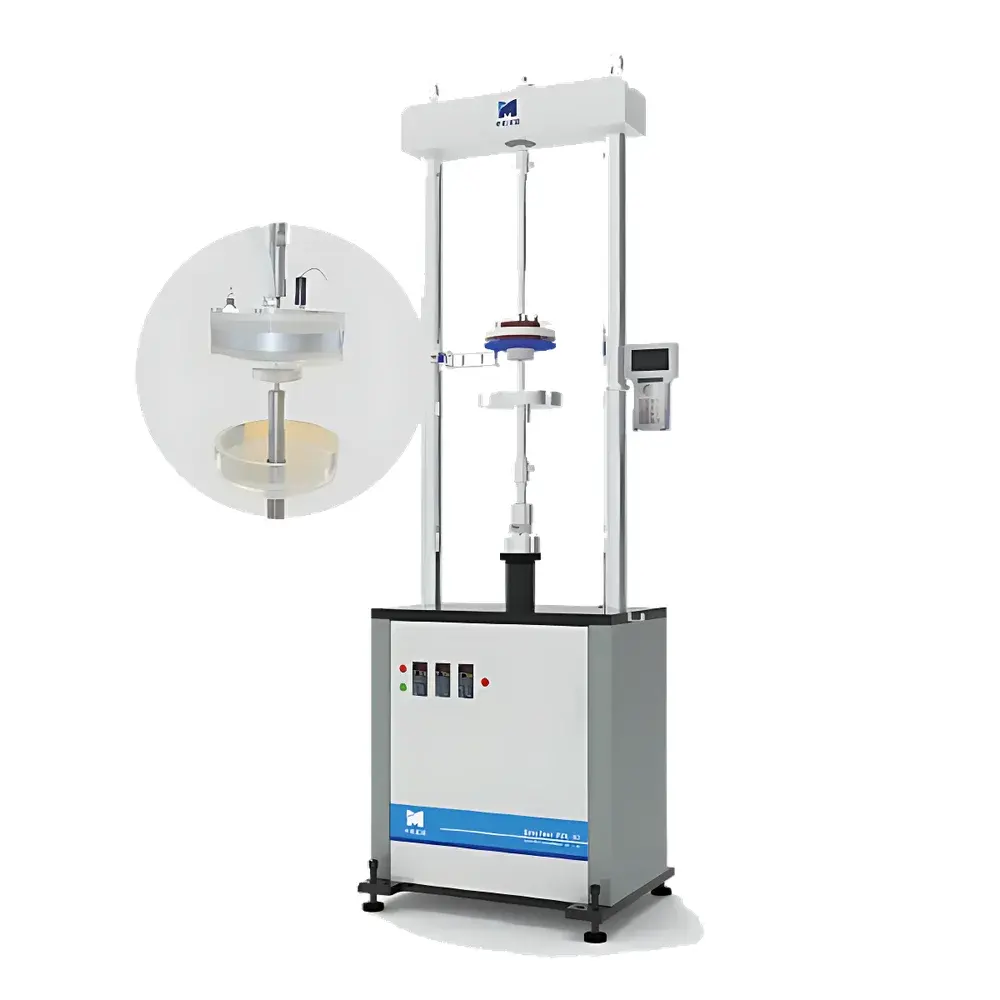
SINOTEST MFDL Slow Strain Rate Pre-cracked (Constant Load) Stress Corrosion Testing Machine
| Brand | SINOTEST |
|---|---|
| Origin | Jilin, China |
| Manufacturer Type | Direct Manufacturer |
| Country of Origin | China |
| Model | MFDL |
| Pricing | Upon Request |
| Max Load Capacity | 10 kN / 30 kN / 50 kN / 100 kN |
| Force Measurement Accuracy | ±1% of reading (1–100% full scale) |
| Slow Strain Rate Range | 1×10⁻⁶ mm/s to 1×10⁻⁴ mm/s (infinitely adjustable) |
| Strain Rate Stability | ±1% deviation over 24-hr average |
| Effective Test Stroke | ≥400 mm |
| Specimen Fixation | Threaded (M6/M10) for cylindrical specimens |
| Control Modes | Force, displacement, time, loading rate, stepwise loading, unidirectional cyclic loading |
| Corrosion Vessel Volume | ≥400 mL |
| Corrosion Medium Temperature Range | Ambient to 55 °C (water-bath heated) |
| Temp. Control Stability | ±2 °C |
| Compliance | GB/T 2039–1997, ISO 204:1997, ASTM E139, ASTM E328–86, GB/T 15970.4–1995, GB/T 15970.6–1995, GB/T 15970.7–2000 |
Overview
The SINOTEST MFDL Slow Strain Rate Pre-cracked (Constant Load) Stress Corrosion Testing Machine is an engineered solution for evaluating the susceptibility of metallic materials to environmentally assisted cracking under sustained mechanical loading in aggressive chemical environments. It operates on the principle of controlled slow strain rate testing (SSRT) and constant load stress corrosion cracking (SCC) evaluation—two standardized methodologies used to quantify crack initiation and propagation kinetics in structural alloys exposed to corrosive media such as chloride (Cl⁻), hydroxide (NaOH), hydrogen sulfide (H₂S), nitrate (NO₃⁻), ammonia (NH₃), methanol, dinitrogen tetroxide (N₂O₄), humid air, and aqueous solutions. The system integrates high-precision electromechanical actuation with real-time environmental control, enabling reproducible simulation of service conditions where tensile stress and electrochemical degradation coexist—critical for aerospace components, nuclear fuel cladding, offshore pipeline steels, and pressure vessel alloys.
Key Features
- TPHS dual-column rigid frame architecture ensures mechanical stability, minimal deflection, and uniform load transmission during ultra-slow deformation cycles.
- Electro-servo loading system delivers force resolution down to 0.01% of full scale, with closed-loop digital controller supporting programmable ramp-hold-step profiles across six independent control modes: force, displacement, time, loading rate, stepwise loading, and unidirectional cyclic loading.
- Proprietary non-linear sensor calibration algorithm compensates for long-term drift and thermal hysteresis, maintaining measurement integrity over multi-day or multi-week tests.
- Dynamic inertia compensation technology reduces dynamic force measurement error to <0.5% within 0–50 Hz bandwidth, essential for capturing transient fracture events during slow-rate testing.
- Cylindrical corrosion chamber design (≥400 mL volume) features integrated water-bath heating, condensate reflux system, and automated medium replenishment—ensuring stable concentration and immersion depth throughout extended exposures.
- Temperature regulation range: ambient to 55 °C, with stability maintained at ±2 °C—compliant with ISO 204 and ASTM E139 requirements for thermal consistency in creep and SCC studies.
- Android-based remote monitoring and control interface enables secure off-site operation, data streaming, and real-time parameter adjustment without physical access to the test cell.
Sample Compatibility & Compliance
The MFDL accommodates standard pre-cracked compact tension (CT), single-edge notched bend (SENB), and round-bar tensile specimens per ASTM E399, E1820, and GB/T 15970 series standards. Cylindrical specimens are secured via precision-machined M6 or M10 threaded connections; flat specimens utilize hardened pin fixtures compatible with 3 mm and 5 mm thicknesses. All corrosion vessels are constructed from chemically resistant alloys rated for halide, acidic, alkaline, and oxidizing media—including seawater, NaOH, NH₃, and H₂S-saturated solutions. The system meets full regulatory alignment with GB/T 2039–1997 (metallic creep testing), ASTM E139 (tensile creep and rupture), ASTM E328–86 (stress relaxation), and GB/T 15970.7–2000 (slow strain rate SCC testing), and supports audit-ready documentation per GLP and GMP frameworks.
Software & Data Management
The embedded industrial PC (dual-core CPU, 4 GB RAM, 500 GB SSD, 23″ display) runs a deterministic real-time OS with dedicated SCC acquisition software. Data logging is synchronized across force, displacement, temperature, and elapsed time channels at user-defined intervals—from 10 ms to 1 hour—with automatic Excel (.xlsx) export. Advanced post-processing includes unlimited curve zooming, overlay of multiple test runs, coordinate translation, annotation insertion, and customizable report generation. All raw datasets retain timestamped metadata, including calibration history, environmental setpoints, and operator ID—supporting FDA 21 CFR Part 11 compliance when configured with electronic signature modules and audit trail logging.
Applications
- Quantification of SCC threshold stress (KISCC) and time-to-failure in austenitic stainless steels, nickel-based superalloys, and aluminum-lithium alloys.
- Evaluation of inhibitor efficacy in oilfield brines and nuclear coolant chemistry.
- Validation of weldment integrity in sour service pipelines per NACE TM0177 and ISO 15156.
- Long-duration environmental fatigue studies under combined mechanical and chemical loading.
- Material qualification for hydrogen energy infrastructure, including electrolyzer balance-of-plant components and hydrogen transport tubing.
- Research into hydrogen embrittlement mechanisms in high-strength fasteners and landing gear steels.
FAQ
What types of corrosion media can be used with the MFDL system?
The corrosion chamber supports aqueous solutions containing Cl⁻, NO₃⁻, OH⁻, H₂S, NH₃, and organic solvents such as methanol and N₂O₄, as well as humid air and distilled water—subject to material compatibility of seals and wetted parts.
Does the system support pre-cracked specimen testing per ASTM E1820?
Yes—the MFDL is fully compatible with standardized CT and SENB geometries, and includes fixture tooling for precise alignment and load-line calibration required by fracture mechanics protocols.
Can test data be exported in machine-readable formats for statistical analysis?
All acquired data are stored in native binary format with ASCII-export capability; time-series outputs are generated as .csv or .xlsx files with column headers compliant with ASTM E1300 and ISO/IEC 17025 reporting conventions.
Is the temperature control system validated per ISO/IEC 17025 requirements?
The water-bath heating module includes NIST-traceable PT100 sensors and factory-certified calibration reports; users may perform in-house verification using secondary reference thermometers per ISO 17025 Clause 6.4.6.
How is system reliability ensured during multi-week continuous testing?
Redundant power conditioning, self-diagnostic firmware, uninterruptible power supply (UPS) interface, and fail-safe emergency stop logic ensure operational continuity; controller retains full functionality even if host PC fails.
Related Products



