
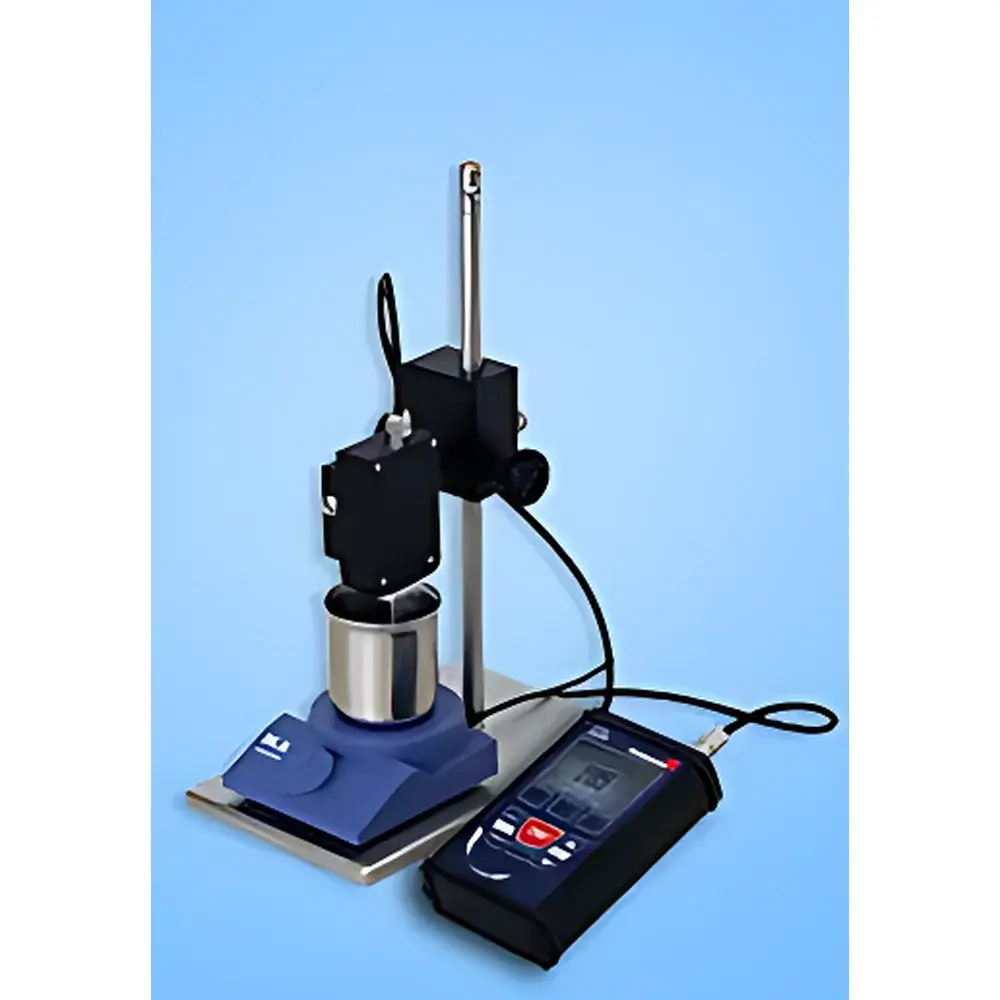
SITA ConSpector Fluorescence-Based Solution Contamination Analyzer
| Brand | SITA |
|---|---|
| Origin | Germany |
| Model | ConSpector |
| Excitation Wavelength | 365 nm (max. 150 mW, adjustable) |
| Emission Detection Wavelength | 465 nm |
| Power Supply | Internal Li-ion battery (1950 mAh, 3.6 V) |
| Power Consumption | ~2.5 W |
| Operating Temperature | 10–50 °C |
| Storage Temperature | −20–60 °C |
| Relative Humidity Limit | <70 % RH |
| Atmospheric Pressure Range | 300–1060 hPa |
| Display | Backlit LCD, 128 × 64 pixels |
| Memory Capacity | 255 user-defined fluid profiles |
| Measurement Modes | ContLevel (contamination index), Fluorescence (relative fluorescence intensity) |
Overview
The SITA ConSpector is a portable, fluorescence-based solution contamination analyzer engineered for rapid, non-destructive assessment of organic contaminant load in industrial process liquids. It operates on the principle of ultraviolet-induced fluorescence (UV-IF): when exposed to precisely tuned 365 nm UV excitation, fluorophores—such as residual coolants, drawing oils, lubricants, and release agents—absorb photon energy and re-emit light at longer wavelengths (peak detection at 465 nm). The instrument quantifies this emitted signal to derive two complementary metrics: a dimensionless ContLevel index reflecting overall contamination severity, and a relative Fluorescence intensity value proportional to fluorophore concentration. Designed for in-lab or near-line deployment, the ConSpector supports real-time decision-making in cleaning process validation, bath life management, and quality gate monitoring—particularly in metalworking, precision machining, and surface finishing operations where trace organic residues directly impact coating adhesion, corrosion resistance, and dimensional stability.
Key Features
- Optimized dual-mode optical architecture: Independent calibration pathways for ContLevel (empirical contamination grading) and Fluorescence (quantitative fluorophore response), enabling both process trending and comparative analysis across fluid types.
- Adjustable 365 nm UV LED source (max. 150 mW) with stable spectral output and minimal thermal drift—ensuring reproducible excitation across ambient temperature fluctuations (10–50 °C operating range).
- Integrated high-sensitivity photodetector with narrowband 465 nm optical filtering to suppress background scatter and ambient light interference, critical for low-concentration detection in turbid or colored solutions.
- Onboard memory supporting 255 customizable fluid profiles, each retaining up to 8191 timestamped measurements—facilitating longitudinal bath health tracking without continuous PC connectivity.
- Robust portable design with IP54-rated enclosure, lithium-ion battery (1950 mAh, 3.6 V), and USB-C interface for charging and data export—suitable for cleanroom-adjacent environments and production floor use.
- Backlit monochrome LCD (128 × 64 pixels) with intuitive icon-driven menu navigation—enabling operation by technicians without specialized spectroscopy training.
Sample Compatibility & Compliance
The ConSpector is validated for aqueous and semi-aqueous cleaning solutions, water-miscible coolants, mineral- and synthetic-based lubricants, drawing oils, deep-drawing compounds, and anti-stick release agents. It does not require sample dilution, filtration, or chemical derivatization—minimizing operator error and analytical turnaround time. While not a gravimetric or chromatographic method, its fluorescence response correlates strongly with total organic carbon (TOC) load and particulate-bound hydrocarbon content in controlled industrial matrices. The device complies with general laboratory safety standards (IEC 61010-1) and electromagnetic compatibility requirements (EN 61326-1). Its measurement methodology aligns with ASTM D7217 (Standard Practice for Fluorescence-Based Monitoring of Cleaning Process Efficiency) and supports GLP-compliant documentation workflows when paired with SITA’s optional audit-trail-enabled software.
Software & Data Management
The ConSpector interfaces via USB with SITA ConSpector Control Software (Windows-compatible), providing full remote instrument control, real-time graphing of ContLevel/Fluorescence trends, batch export to CSV/Excel, and profile synchronization. The software enforces user-level access controls, records operator ID, measurement timestamps, and environmental metadata (ambient temperature, battery level), satisfying basic 21 CFR Part 11 data integrity expectations for non-GMP environments. All stored readings retain their native profile context, enabling statistical process control (SPC) charting—e.g., X-bar/R charts for cleaning bath stability—or automated alert thresholds based on historical baseline deviation.
Applications
- Monitoring degradation kinetics of alkaline and acidic cleaning baths in automotive component manufacturing.
- Validating rinse efficiency after solvent-based degreasing in aerospace turbine blade processing.
- Quantifying carryover contamination from stamping lubricants into subsequent phosphating or e-coat lines.
- Establishing empirical end-of-life criteria for ultrasonic cleaning solutions used in medical device assembly.
- Supporting root-cause analysis during adhesive bonding failures linked to residual mold release agents on plastic substrates.
- Documenting cleaning validation for ISO 14644-1 Class 7/8 cleanroom component washing protocols.
FAQ
Does the ConSpector require calibration with certified reference standards?
No—each instrument undergoes factory calibration using NIST-traceable fluorescent reference materials. Field recalibration is not required under normal use; however, users may perform zero-point verification with deionized water or blank solvent per SOP.
Can it distinguish between different types of contaminants (e.g., coolant vs. oil)?
Not spectrally—the ConSpector reports aggregate fluorescence response. Discrimination requires correlating ContLevel trends with known process inputs or coupling with GC-MS or FTIR for compound identification.
Is the 365 nm UV source safe for routine handling?
Yes—the irradiance at the sample port remains below ICNIRP occupational exposure limits for UVA (315–400 nm); no protective eyewear is mandated during standard operation.
How frequently should the optical window be cleaned?
After every 10–15 measurements in high-residue environments; use lint-free wipes moistened with isopropanol—never abrasive cleaners or acetone.
Does battery life support full-shift operation?
Yes—typical usage (100 measurements/day, display backlight on 30% duty cycle) yields >8 hours of continuous operation per charge.



