
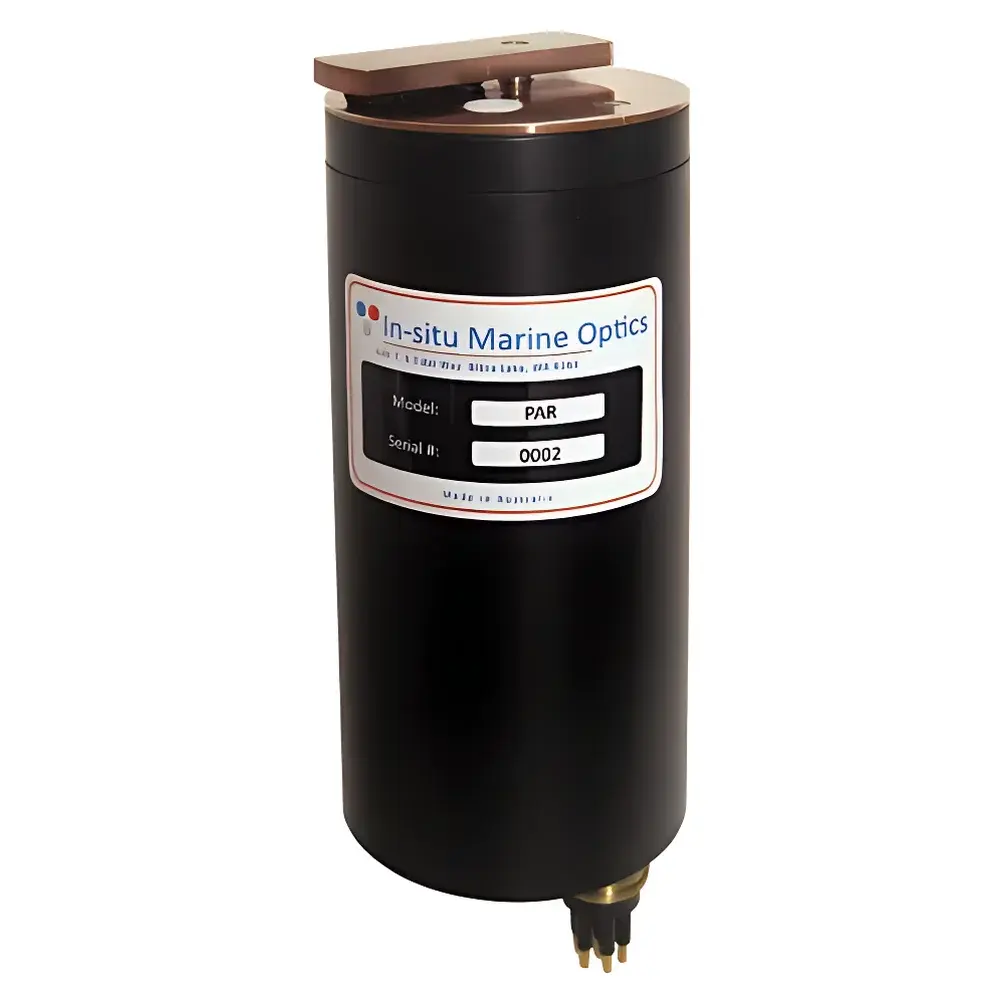
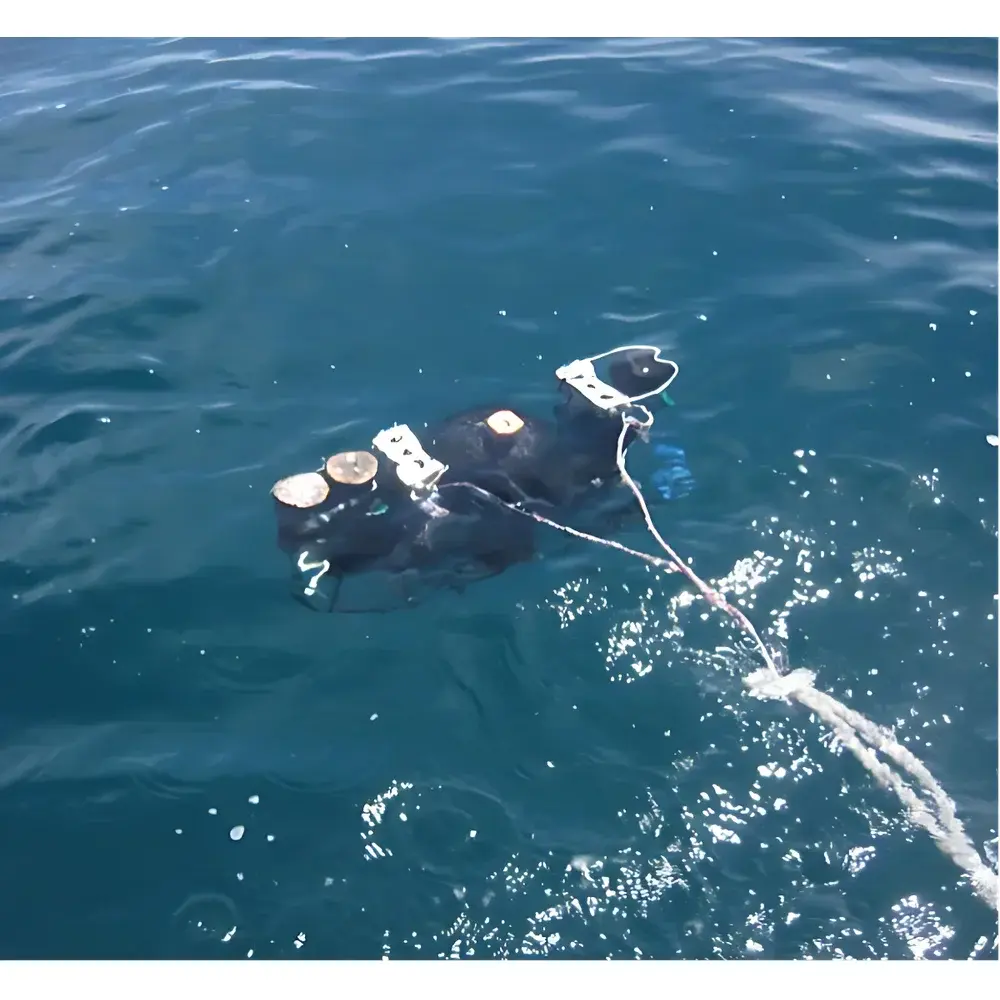
In-situ Marine PAR Quantum Sensor for Underwater Photosynthetic Active Radiation Measurement
| Brand | In-situ Marine |
|---|---|
| Origin | Australia |
| Manufacturer Status | Authorized Distributor |
| Origin Category | Imported |
| Model | PAR |
| Pricing | Upon Request |
Overview
The In-situ Marine PAR Quantum Sensor is an underwater-optimized optical instrument engineered to quantify photosynthetically active radiation (PAR) in the 400–700 nm spectral band—the biologically relevant range driving photosynthesis in aquatic primary producers. Based on the quantum (photon) detection principle, it measures irradiance in units of μmol photons·m⁻²·s⁻¹, conforming to the international standard definition of PAR as defined by ISO 17122:2018 and adopted by the International Society for Optical Engineering (SPIE) and the Ocean Optics Conference community. Designed specifically for marine and freshwater environments, the sensor integrates a calibrated silicon photodiode with spectrally optimized optical filtering and a precision cosine-corrected diffuser to ensure accurate angular response under variable incident light conditions—critical for profiling vertical light attenuation in water columns or quantifying benthic light exposure across tidal cycles.
Key Features
- Marine-grade mechanical architecture: Acetal housing with PTFE-diffused optical window and corrosion-resistant copper brush assembly for long-term anti-fouling performance in high-biofouling environments.
- Integrated environmental sensing suite: Onboard real-time clock (RTC), digital compass, dual-axis tilt sensor, and thermistor enable spatially and temporally referenced PAR measurements—essential for profiling systems and autonomous platforms requiring orientation-aware data alignment.
- User-configurable acquisition: Programmable sampling rate up to 10 Hz via RS-232 serial interface; supports NMEA-0183-style output framing for seamless integration with standard oceanographic telemetry and data loggers (e.g., Sea-Bird Electronics, RBR, and Teledyne RD Instruments platforms).
- Traceable calibration infrastructure: Factory-applied NIST-traceable quantum responsivity calibration performed in controlled spectral irradiance facilities; calibration coefficients stored permanently in non-volatile memory and applied automatically during data conversion.
- Optimized underwater optical design: Diffuser geometry and spectral transmission profile engineered to minimize immersion-induced shifts in cosine response and spectral sensitivity—validated per ASTM E2629-20 guidelines for underwater radiometric sensors.
- Low-power, high-resolution signal chain: 24-bit analog-to-digital converter with <1.3×10⁻⁶ μmol·m⁻²·s⁻¹ resolution; dynamic range spans 0–2300 μmol·m⁻²·s⁻¹ (extendable upon factory configuration for specialized deployments).
Sample Compatibility & Compliance
The sensor is compatible with standard oceanographic mounting interfaces—including wet-mateable Micro WET-CON MCBH6M connectors—and mechanically interoperable with CTD frames, mooring chains, AUV/ROV manipulator arms, and benthic lander housings. Its 300 m depth rating meets IEC 60529 IP68 requirements for continuous submersion. All optical and electronic components comply with RoHS 2011/65/EU directives. Calibration traceability adheres to ISO/IEC 17025:2017-accredited procedures, supporting GLP-compliant field studies and regulatory monitoring programs aligned with EPA Method 445.0 and EU Water Framework Directive Annex V protocols.
Software & Data Management
Data output follows ASCII-based serial protocol at 19200 bps (RS-232), configurable for time-stamped, orientation-tagged, and temperature-compensated records. The sensor supports both raw ADC counts and fully processed quantum irradiance values. Firmware updates and parameter reconfiguration are performed via terminal-emulation software (e.g., PuTTY or Tera Term). No proprietary drivers or closed-source applications are required. Metadata—including calibration date, serial number, tilt angle, heading, and internal temperature—is embedded in each data packet, enabling automated ingestion into FAIR-aligned data pipelines compliant with NOAA’s IOOS NetCDF-CF conventions and OBIS metadata standards.
Applications
- Quantification of light availability for benthic microalgae, seagrass, and coral symbionts in reef and estuarine ecosystems.
- Integration into vertical profiling systems (e.g., SeaBird SBE19plus, RBRconcerto) for deriving Kd(PAR) extinction coefficients and euphotic zone depth estimation.
- Time-series monitoring on fixed moorings or autonomous gliders to assess diel and seasonal variability in subsurface PAR flux.
- Validation of satellite-derived PAR products (e.g., NASA Ocean Color MODIS-Aqua, VIIRS) through in situ ground-truthing campaigns.
- Controlled experimental setups in mesocosms and flow-through seawater systems where precise photon flux regulation is required for physiological assays.
FAQ
Is the sensor suitable for freshwater deployments?
Yes—the optical design and pressure housing are validated for use in both marine and freshwater environments, including turbid inland waters.
Can the measurement range be extended beyond 2300 μmol·m⁻²·s⁻¹?
Yes—custom factory recalibration and optical attenuation options are available for high-light applications such as surface buoy deployments or shallow tropical reef monitoring.
Does the sensor support synchronization with external GPS or timing sources?
While it features an onboard RTC with ±2 s/month accuracy, it does not accept external PPS or NTP inputs; however, timestamp alignment with GPS-enabled platforms is achievable via post-deployment data fusion using embedded UTC timestamps.
How often is recalibration recommended?
Annual recalibration is advised for mission-critical applications; biennial recalibration is acceptable for routine monitoring when operated within specified temperature and fouling limits.
Is firmware upgrade capability retained after deployment?
Yes—field-upgradable firmware allows protocol enhancements and bug fixes without hardware return, provided access to the RS-232 interface and power supply.
Related Products







