
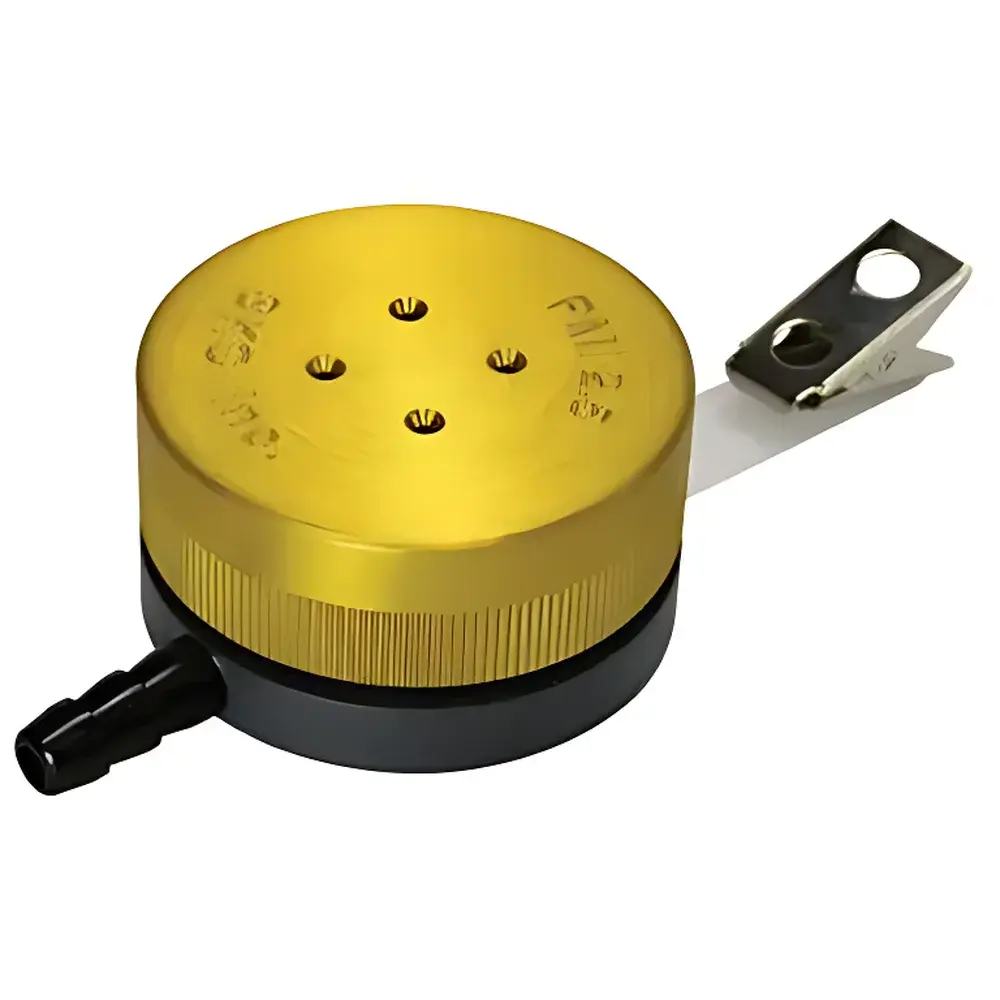
SKC PMI Personal Modular Impactor Particulate Matter Sampler
| Brand | SKC |
|---|---|
| Origin | USA |
| Model | PMI Series |
| Flow Rate | 3 L/min |
| Cut-Point | 10 µm (PM₁₀) or 2.5 µm (PM₂.₅) |
| Filter Diameter | 37 mm |
| Impactor Substrate | 25 mm disposable pre-oiled porous plastic disk |
| Weight | 71 g |
| Compliance | EPA-defined PM₂.₅ and PM₁₀ sampling criteria |
Overview
The SKC PMI Personal Modular Impactor is a lightweight, field-deployable aerosol sampling device engineered for precise, regulatory-compliant collection of inhalable particulate matter in occupational and environmental monitoring applications. Based on inertial impaction principles, the PMI separates airborne particles by aerodynamic diameter using a sharp-cut single-stage impactor stage followed by downstream filter collection. Its design adheres strictly to U.S. Environmental Protection Agency (EPA) reference and equivalent methods for PM₁₀ and PM₂.₅—specifically meeting the performance criteria outlined in 40 CFR Part 53 for federal reference methods (FRMs) and federal equivalent methods (FEMs). Unlike passive samplers or gravimetric filters alone, the PMI integrates a calibrated inertial cutoff with a defined 50% aerodynamic cut-point (d₅₀), ensuring high-fidelity size-selective sampling without reliance on post-collection data correction. With a nominal flow rate of 3 L/min, it operates optimally with constant-flow personal sampling pumps—such as the SKC AirChek Touch (Model 220–5000TC)—to maintain consistent aspiration velocity across variable ambient conditions.
Key Features
- Modular, tool-free assembly: Enables rapid configuration for PM₁₀, PM₂.₅, or coarse fraction (PM₁₀–PM₂.₅) sampling via interchangeable impactor stages and accessory rings.
- Disposable pre-oiled 25 mm porous plastic impactor substrate: Eliminates need for cleaning, lubrication, or solvent handling; minimizes particle bounce and re-entrainment for >95% collection efficiency at d₅₀.
- Integrated 37 mm removable filter cassette: Accommodates standard glass fiber, quartz, PTFE, or PVC membranes—selected per analytical requirements (e.g., gravimetric, ICP-MS, IC, or organic carbon analysis).
- Ultra-lightweight construction: Weighing only 71 g, the PMI meets ISO 7203 and ACGIH TLV® recommendations for personal sampling devices worn within the worker’s breathing zone.
- Robust mechanical design: Precision-machined aluminum housing with corrosion-resistant anodized finish ensures long-term dimensional stability under repeated field use and thermal cycling.
- Universal pump compatibility: Designed exclusively for use with certified constant-flow sampling pumps delivering 3.0 ± 0.1 L/min—enabling traceable volumetric calibration per ISO 13137 and NIOSH Manual of Analytical Methods (NMAM) Chapter 2.
Sample Compatibility & Compliance
The PMI supports both gravimetric and chemical analysis workflows. Collected samples are compatible with standard laboratory protocols including EPA Method IO-4.2 (PM₂.₅ gravimetric), EPA Method IO-2.2 (PM₁₀), and NMAM Method 0600 (total dust). The 37 mm filter format aligns with ASTM D7520 and ISO/IEC 17025-accredited laboratory practices. When used with quartz fiber filters and thermal-optical analysis (TOA), the system satisfies IMPROVE network specifications for organic and elemental carbon quantification. All configurations comply with OSHA 29 CFR 1910.1200 (Hazard Communication), MSHA 30 CFR Part 56, and EU Directive 2004/107/EC for ambient PM₂.₅ monitoring. Device geometry and cut-point performance have been validated against NIST-traceable wind tunnel calibrations per ISO 29463-3.
Software & Data Management
While the PMI itself is a passive mechanical sampler, its integration into digital exposure assessment workflows is facilitated through pairing with SKC’s AirChek Touch or other pump systems equipped with internal datalogging (e.g., time-stamped flow, temperature, pressure, battery status). Raw sample mass data—when entered into laboratory information management systems (LIMS)—can be linked to pump calibration certificates, filter lot numbers, and chain-of-custody records. For GLP/GMP-aligned studies, full audit trails—including operator ID, sampling start/stop times, and environmental metadata—are retained in accordance with FDA 21 CFR Part 11 requirements when using compliant data acquisition platforms.
Applications
- Occupational hygiene assessments for cement, mining, pharmaceutical manufacturing, and metal fabrication industries.
- Indoor air quality (IAQ) characterization in schools, offices, and healthcare facilities.
- Community-scale ambient PM monitoring where portability and low power demand are critical.
- Source apportionment studies requiring size-resolved mass concentration data paired with elemental or molecular speciation.
- Validation of real-time optical particle counters (OPCs) and beta attenuation monitors (BAMs) via co-located gravimetric reference sampling.
FAQ
What pump flow rate is required for proper PMI operation?
The PMI must be operated at a precisely maintained 3.0 ± 0.1 L/min flow rate, as specified in EPA guidance and verified during pump calibration per ISO 13137.
Can the same PMI unit collect both PM₂.₅ and PM₁₀ fractions?
Yes—by swapping the impactor stage and using appropriate accessory rings, a single PMI housing supports PM₂.₅, PM₁₀, and coarse fraction (PM₁₀–PM₂.₅) sampling configurations.
Is the pre-oiled impactor substrate reusable?
No—the 25 mm porous plastic disk is designed for single-use only to ensure consistent impaction efficiency and eliminate cross-sample contamination.
Which filter types are recommended for elemental analysis?
Quartz fiber filters (e.g., Pallflex Tissuquartz™) are preferred for trace metal analysis by ICP-MS or XRF; PTFE membrane filters are optimal for organic compound extraction via GC-MS.
Does the PMI meet international PM monitoring standards beyond EPA criteria?
Yes—it conforms to ISO 7708 for inhalable, thoracic, and respirable convention definitions, and its cut-point performance satisfies EN 12341 and WHO Air Quality Guidelines for PM₂.₅ and PM₁₀ monitoring.







