
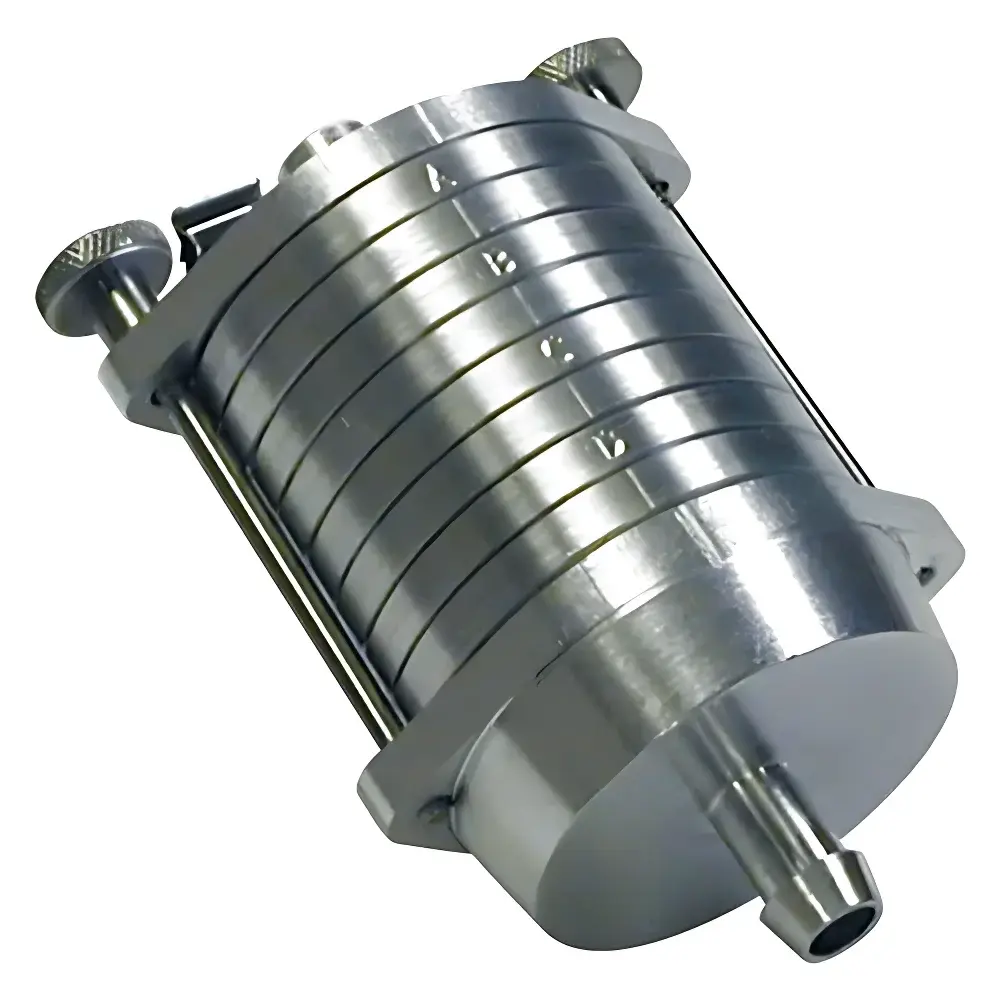
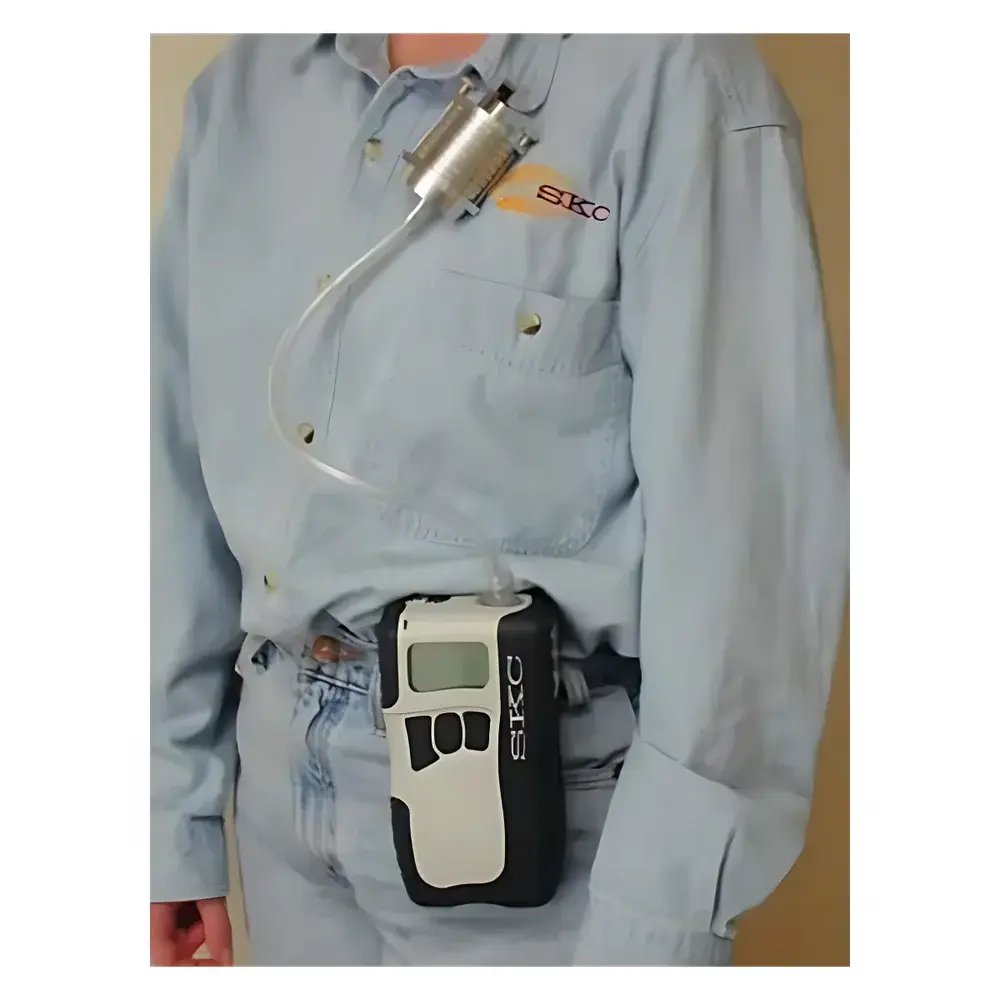
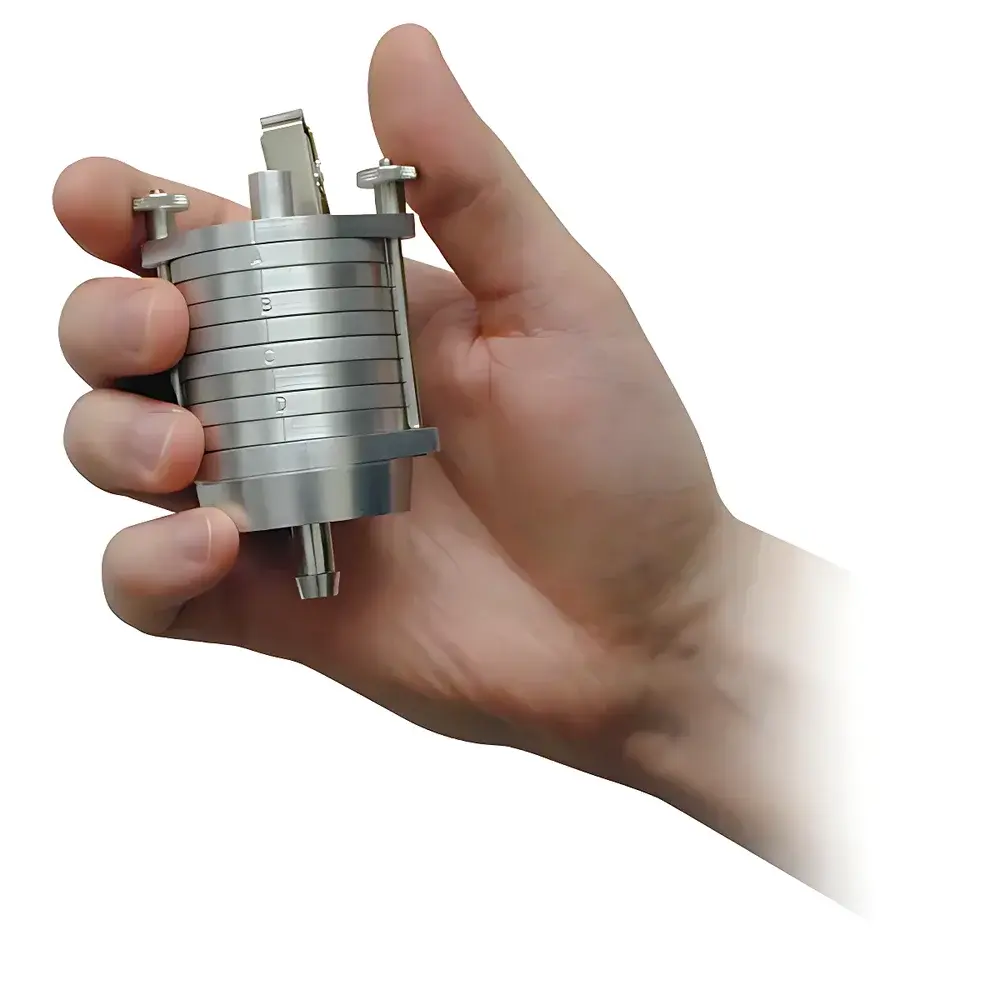
SKC Sioutas Personal Cascade Impactor
| Brand | SKC |
|---|---|
| Origin | USA |
| Model | Sioutas Impactor |
| Flow Rate | 9 L/min |
| Cut Points | 2.5 µm, 1.0 µm, 0.5 µm, 0.25 µm |
| Collection Substrate | 25 mm PTFE filters (stages 1–4), optional 37 mm backup filter (<0.25 µm) |
| Pressure Drop | Low at 9 L/min for 24-h sampling |
| Compliance | Designed for OSHA, NIOSH, and ISO 7708-compliant personal aerosol monitoring |
Overview
The SKC Sioutas Personal Cascade Impactor is a precision-engineered inertial impactor system designed for size-resolved collection of airborne particulate matter in occupational and environmental exposure assessment. Operating on the principle of aerodynamic inertial separation, it fractionates respirable aerosols into five discrete size fractions—coarse (>2.5 µm), coarse-fine transition (1.0–2.5 µm), fine (0.5–1.0 µm), ultrafine (0.25–0.5 µm), and sub-0.25 µm—using calibrated jet orifices and precisely dimensioned impaction stages. Unlike conventional grease-coated impactors, the Sioutas design employs uncoated, chemically inert polytetrafluoroethylene (PTFE) membrane filters as collection substrates, eliminating solvent extraction artifacts and preserving thermally labile or reactive compounds—including organic acids, nitro-polycyclic aromatic hydrocarbons (nitro-PAHs), and metal-organic complexes—for subsequent chemical speciation analysis. Its compact, wearable configuration enables true personal sampling in dynamic work environments, conforming to ISO 7708:1995 definitions of inhalable, thoracic, and respirable fractions.
Key Features
- Four validated aerodynamic cut points at 2.5 µm, 1.0 µm, 0.5 µm, and 0.25 µm—traceable to NIST-calibrated reference aerosols
- High-efficiency particle capture across all stages, maintained even under elevated ambient mass concentrations (>1 mg/m³)
- Optimized pressure drop profile: <1.2 kPa at 9 L/min flow rate, enabling stable 24-hour continuous operation with Leland Legacy or comparable constant-flow personal pumps
- Zero use of impactor grease or adhesive coatings—eliminates carbon background interference and analyte degradation during storage
- Minimal particle rebound and wall loss due to low-velocity impaction geometry and smooth PTFE surface finish
- Modular stage assembly with standardized 25 mm filter holders; optional 37 mm backup filter stage for quantitative recovery of sub-0.25 µm material
- Compatible with gravimetric analysis (ISO 7708, EN 481), ion chromatography (IC), inductively coupled plasma mass spectrometry (ICP-MS), and transmission electron microscopy (TEM) sample preparation
Sample Compatibility & Compliance
The Sioutas Impactor supports diverse analytical workflows without compromising sample integrity. Its PTFE filter substrates exhibit negligible extractables and are certified for low-metal background (≤10 pg/cm² for Pb, Cd, As), meeting USP elemental impurity requirements for inhalation toxicology studies. The device complies with OSHA Method ID-265 for respirable dust and aligns with NIOSH Manual of Analytical Methods (NMAM) Chapter 2530 for size-selective aerosol sampling. It satisfies GLP documentation requirements for regulatory submission when paired with audit-trail-enabled pump controllers and calibrated flow meters traceable to NIST SRM 1660. All components are RoHS-compliant and free of phthalates, bisphenol A (BPA), and halogenated flame retardants.
Software & Data Management
While the Sioutas Impactor itself is a passive mechanical device, its integration into modern exposure assessment protocols relies on synchronized digital pump logging. When used with SKC’s AirChek TOUCH or Leland Legacy pumps equipped with internal data loggers, time-stamped flow records—including real-time deviation alerts and cumulative volume tracking—are exportable via USB or Bluetooth to compliant laboratory information management systems (LIMS). Raw filter mass and chemical concentration data can be linked to pump metadata using standardized CSV or ASTM E2926-22-compliant XML templates, supporting 21 CFR Part 11–compliant electronic signatures and audit trails for FDA-regulated inhalation toxicology programs.
Applications
- Occupational hygiene surveys for mining, construction, pharmaceutical manufacturing, and nanomaterial handling
- Indoor air quality (IAQ) characterization in schools, hospitals, and office buildings—particularly for PM₂.₅-bound endotoxins and allergens
- Epidemiological cohort studies linking ultrafine particle exposure (UFPs) to cardiovascular and neurocognitive outcomes
- Inhalation toxicology testing per OECD Test Guideline 412 (subacute inhalation) and 413 (chronic inhalation)
- Aerosol science research on hygroscopic growth, coagulation dynamics, and volatile organic compound (VOC)–particle partitioning
- Environmental source apportionment using isotopic tracers (e.g., Pb-206/207 ratios) and organic marker compounds (e.g., levoglucosan, hopanes)
FAQ
What pump flow rate is required for accurate cut-point performance?
A constant 9.0 ± 0.1 L/min flow rate is mandatory; deviations >±3% alter aerodynamic cut points and compromise size resolution.
Can the Sioutas Impactor be used for nanoparticle sampling below 100 nm?
It captures particles down to ~25 nm aerodynamically, but for quantitative sub-100 nm sizing, coupling with a nano-DMA or CPC downstream is recommended per ISO/TR 12885.
Is post-sampling filter handling compatible with EPA TO-15 or TO-17 methods?
Yes—PTFE filters are validated for thermal desorption (TD) and solvent extraction; however, low-temperature storage (<−20°C) is advised for semi-volatile organics.
How often must the impactor be cleaned and recalibrated?
Stainless steel stages require ultrasonic cleaning in IPA every 10 field uses; annual calibration against polystyrene latex (PSL) aerosols is recommended per ISO 11155-1.
Does the device meet EU REACH or UK CA requirements for workplace monitoring?
Yes—it fulfills EN 481:2022 criteria for personal sampling and supports compliance with Control of Substances Hazardous to Health (COSHH) Regulations 2002 and EU Directive 2004/108/EC.
Related Products







