
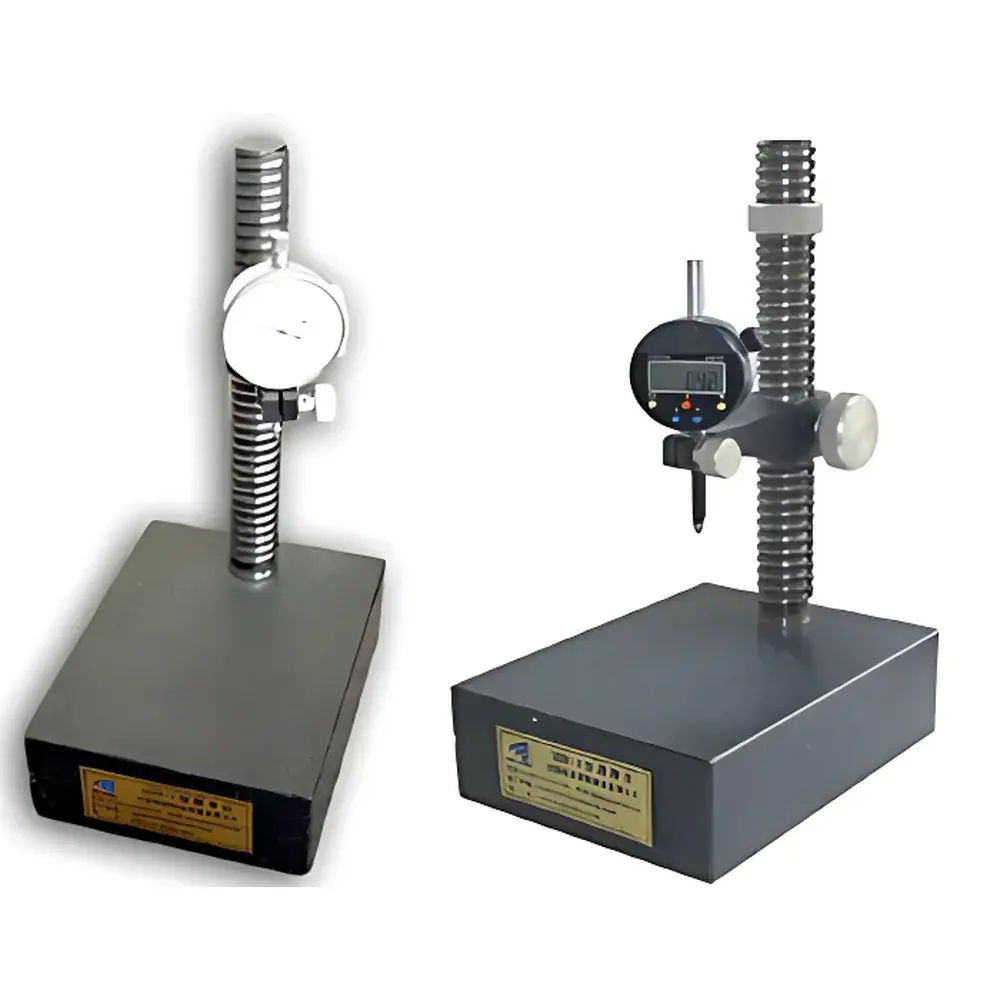
SKCH-1(A) Precision Thickness Gauge by KJ Group
| Brand | KJ Group (Shenyang Kejing) |
|---|---|
| Origin | Liaoning, China |
| Manufacturer Type | Authorized Distributor |
| Country of Origin | China |
| Model | SKCH-1(A) |
| Quotation | Upon Request |
| Measuring Range | 0–12.7 mm |
| Resolution | 0.001 mm |
| Base Material | Grade "00" Granite Platform |
| Dial Indicator Accuracy Class | Grade 1 |
| Dimensions (L×W×H) | 200 mm × 150 mm × 320 mm |
Overview
The SKCH-1(A) Precision Thickness Gauge is a manually operated mechanical metrology instrument engineered for high-repeatability thickness and height measurements of flat, rigid, or semi-rigid specimens in quality control laboratories, R&D facilities, and academic testing environments. It operates on the principle of mechanical displacement amplification using a calibrated dial indicator mounted orthogonally above a precision-ground granite base. The device conforms to fundamental metrological standards for contact-based dimensional measurement—specifically leveraging Abbe’s principle through coaxial alignment of the indicator plunger and measurement axis to minimize cosine error. Unlike electronic or optical alternatives, the SKCH-1(A) delivers traceable, drift-free readings without dependence on power supply, software calibration, or environmental compensation algorithms—making it particularly suitable for ISO/IEC 17025-accredited labs requiring documented measurement uncertainty budgets under stable ambient conditions.
Key Features
- Grade “00” black granite base platform (ASTM C192-compliant material specification), providing exceptional dimensional stability, thermal inertia, and surface flatness ≤0.5 µm over 200 mm × 150 mm working area
- Class 1 dial indicator (per ISO 6789-1:2017) with 0–12.7 mm measuring range and 1 µm (0.001 mm) resolution, featuring hardened steel plunger tip and anti-parallax mirrored scale
- Adjustable clamping column with fine-tuned vertical travel lock, enabling precise positioning and repeatable zeroing across multiple sample batches
- Compact footprint (200 mm × 150 mm × 320 mm) optimized for benchtop integration in constrained laboratory spaces without compromising rigidity or vibration damping
- Zero-reset function with vernier-assisted coarse/fine adjustment for rapid recalibration between measurement sessions
- Tool-free disassembly of indicator mount for periodic verification against certified gauge blocks (e.g., NIST-traceable Class AA standards)
Sample Compatibility & Compliance
The SKCH-1(A) is designed for direct-contact measurement of non-deformable or low-compliance materials including metal foils, silicon wafers, glass substrates, ceramic tiles, polymer sheets, and machined precision parts. Maximum specimen weight capacity is 5 kg; minimum measurable thickness is limited only by plunger tip geometry and surface finish (recommended Ra < 0.8 µm). The instrument complies with general requirements outlined in ISO 14253-1 (Geometrical product specifications — Inspection by measurement of workpieces and measuring equipment) and supports implementation of GMP/GLP documentation protocols when paired with controlled calibration logs and operator training records. While not intrinsically compliant with FDA 21 CFR Part 11, its analog readout eliminates electronic audit trail dependencies—facilitating straightforward validation under Annex 11-equivalent manual data recording workflows.
Software & Data Management
As a purely mechanical measurement system, the SKCH-1(A) does not incorporate embedded firmware, digital interfaces, or proprietary software. All readings are recorded manually into laboratory notebooks or LIMS-compatible spreadsheets. This architecture ensures full transparency in data lineage, eliminates cybersecurity risks associated with connected instrumentation, and simplifies regulatory inspection readiness. Users may integrate the gauge into digital workflows via optional third-party USB microscope cameras (e.g., for image-captured dial reading archiving) or coordinate measurement systems (CMMs) for cross-validation—though such configurations fall outside the scope of factory calibration and require independent uncertainty analysis per ISO/IEC Guide 98-3.
Applications
- Thickness verification of battery electrode coatings during pilot-scale manufacturing
- Quality assurance of semiconductor wafer backgrinding processes (pre- and post-polish thickness differentials)
- Evaluation of anodized layer uniformity on aluminum aerospace components
- Calibration reference checks for ultrasonic thickness gauges (UTG) and eddy-current sensors
- Teaching metrology fundamentals—including hysteresis, repeatability, and gage R&R studies—in university engineering laboratories
- Dimensional screening of printed circuit board (PCB) laminate stacks prior to lamination
FAQ
Is the SKCH-1(A) suitable for measuring soft or compressible materials such as rubber or foam?
No. The device applies nominal contact force (~1.5 N) via spring-loaded plunger; deformation of compliant surfaces will introduce systematic measurement bias. It is validated only for materials with elastic modulus ≥1 GPa.
Can the dial indicator be replaced with a digital one?
Yes—provided the replacement adheres to M6×0.75 thread specification and maintains plunger travel compatibility. However, any substitution voids factory calibration certification and requires full re-verification per ISO 17025 Clause 6.5.
What is the recommended recalibration interval?
Annually under normal usage, or after any impact event or visible indicator damage. Calibration must be performed using certified gauge blocks traceable to national metrology institutes (e.g., NIM, NIST, PTB).
Does the granite base require periodic leveling or maintenance?
The “00” grade granite platform is inherently stable but should be inspected quarterly for surface scratches or debris accumulation using optical flats and monochromatic light interference; cleaning is performed exclusively with isopropyl alcohol and lint-free microfiber cloths.
Is technical support available outside China?
KJ Group provides English-language documentation and remote troubleshooting assistance globally through authorized regional distributors; on-site service is coordinated via local metrology service partners accredited to ISO/IEC 17025.



