
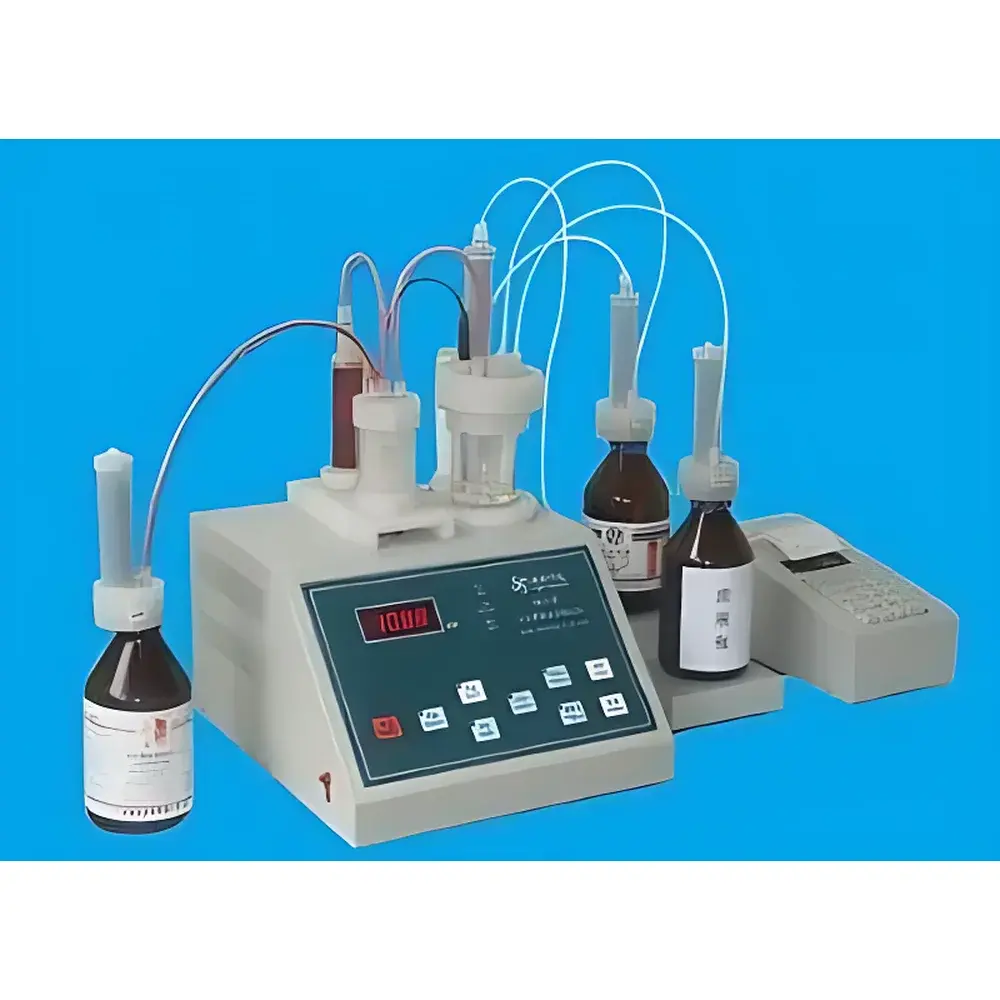
SKF-1(A) Automatic Karl Fischer Moisture Titrator
| Origin | Shanghai, China |
|---|---|
| Manufacturer Type | Authorized Distributor |
| Origin Category | Domestic (PRC) |
| Model | SKF-1(A) |
| Price | USD 3,500 (FOB Shanghai) |
| Endpoint Detection | Dual Platinum Electrode Polarization Voltage |
| Moisture Range | 0.001–100 wt% H₂O |
| Fluidic System | Fully Enclosed |
| Operation | Keypad-Controlled Automated Titration & Reagent Handling |
| Resolution | 0.01 mL |
| Power Supply | 220 ± 22 V, 50 ± 1 Hz |
| Compatible Reagents | Standard Pyridine-Based or Pyridine-Free KF Reagents |
| Repeatability (RSD) | ≤0.01% |
| Linearity Correlation Coefficient | ≥0.998 |
| Fast-Titration Mode | Yes |
| Integrated Thermal Printer | Yes |
Overview
The SKF-1(A) Automatic Karl Fischer Moisture Titrator is a precision volumetric titration instrument engineered for quantitative determination of trace to bulk water content in solid, liquid, and gaseous samples across pharmaceutical, chemical, petrochemical, polymer, and food quality control laboratories. Based on the electrochemical principle of Karl Fischer coulometric and volumetric titration—specifically utilizing dual platinum electrode polarization voltage detection—the system identifies the stoichiometric endpoint of iodine-water reaction in real time. Unlike coulometric variants, the SKF-1(A) operates in volumetric mode, delivering standardized KF reagent via a calibrated burette to quantify water mass fraction (wt%) with high reproducibility. Its fully enclosed fluidic architecture prevents ambient moisture ingress and hazardous reagent vapor release—critical for maintaining analytical integrity and operator safety during routine QC testing.
Key Features
- Fast-Titration Mode (“Quick-Drip”): Dynamically accelerates reagent delivery during initial titration phase, reducing idle time in blank titrations and significantly improving throughput for high-volume sample batches.
- Integrated Thermal Printer: Provides immediate hardcopy output of sample ID, titration curve metadata, calculated moisture %, endpoint volume, drift correction, and operator timestamp—supporting audit-ready documentation per GLP/GMP requirements.
- Dual Platinum Electrode Endpoint Detection: Employs polarization voltage measurement across inert Pt electrodes to detect the sharp redox potential shift at titration completion, ensuring robust endpoint recognition even in low-conductivity or viscous matrices.
- Sealed Fluidic Pathway: All reagent lines, titration cell, and sample port interfaces are hermetically isolated from ambient air, minimizing environmental moisture interference and eliminating exposure to toxic SO₂ or HI vapors generated during KF reactions.
- Keypad-Driven Automation: Intuitive membrane keypad enables full control over titration start/stop, manual purge, reagent refill, cell cleaning cycles, and method recall—no PC dependency required for daily operation.
- Reagent Flexibility: Compatible with both classical pyridine-based and modern pyridine-free KF reagents (e.g., imidazole or methanol-based formulations), accommodating evolving regulatory preferences and safety protocols.
Sample Compatibility & Compliance
The SKF-1(A) accommodates diverse sample types—including hygroscopic powders (e.g., APIs, excipients), solvents (acetone, DMF, THF), oils (lubricants, transformer fluids), polymers (PET, nylon), and packaged goods (via headspace sampling)—without modification. Its 0.001–100 wt% H₂O measurement range covers applications from ultra-dry lithium battery cathode materials (<10 ppm) to aqueous solutions and slurries. The instrument meets foundational design criteria aligned with ASTM E203, ISO 760, and USP for volumetric KF titration. While not inherently 21 CFR Part 11 compliant (as it lacks electronic signature and audit trail software), its printed records satisfy paper-based GLP documentation standards. For regulated environments requiring digital data integrity, integration with external LIMS via RS-232 is supported.
Software & Data Management
The SKF-1(A) operates as a standalone benchtop analyzer with embedded firmware; no proprietary PC software is bundled. All operational parameters—including titration speed profiles, endpoint thresholds, drift compensation settings, and unit preferences—are stored in non-volatile memory. Measurement data (sample ID, volume consumed, %H₂O, date/time) are retained in internal buffer (up to 100 results) and simultaneously output via thermal printer. For laboratories requiring long-term archiving or statistical process control (SPC), raw titration logs can be manually transcribed or captured via serial interface using third-party terminal emulators. Calibration verification is performed using certified water standards (e.g., 1.00 ± 0.02 mg H₂O/mg sodium tartrate dihydrate), with linearity confirmed per ISO 8655-6 gravimetric validation guidelines.
Applications
- Pharmaceutical QC: Water content verification of active pharmaceutical ingredients (APIs), lyophilized products, and excipients per ICH Q5C stability guidance.
- Petrochemical Testing: Moisture quantification in jet fuel (ASTM D6304), transformer oil (IEC 60814), and lubricants to prevent corrosion and dielectric failure.
- Polymers & Plastics: Residual moisture assessment in engineering resins prior to injection molding—critical for preventing hydrolysis-induced molecular weight degradation.
- Food & Feed Analysis: Determination of water activity precursors in dried fruits, dairy powders, and animal feedstuffs per AOAC 992.18.
- Electronics Manufacturing: Verification of moisture levels in solder pastes, encapsulants, and PCB substrates to mitigate popcorning defects during reflow soldering.
FAQ
What types of Karl Fischer reagents are compatible with the SKF-1(A)?
Standard pyridine-based reagents and commercially available pyridine-free alternatives (e.g., imidazole-methanol formulations) are fully supported. Always verify reagent compatibility with your sample matrix to avoid side reactions.
Does the instrument support automatic calibration or drift correction?
Yes—drift correction is applied automatically during endpoint calculation based on pre-titration baseline stabilization. Manual calibration using certified water standards is recommended before each analytical session.
Can the thermal printer output be disabled for silent operation?
Yes—printer activation is user-selectable via keypad menu; data remain stored internally even when printing is deactivated.
Is the titration cell interchangeable with other KF systems?
No—the SKF-1(A) uses a proprietary double-compartment glass cell with integrated electrodes and magnetic stirrer. Replacement cells must be ordered as OEM part #SKF-CELL-A.
What maintenance is required for long-term reliability?
Daily: Wipe electrode surfaces with lint-free tissue; weekly: rinse cell with dry methanol and purge with nitrogen; quarterly: replace drying tube desiccant and verify burette seal integrity.




