
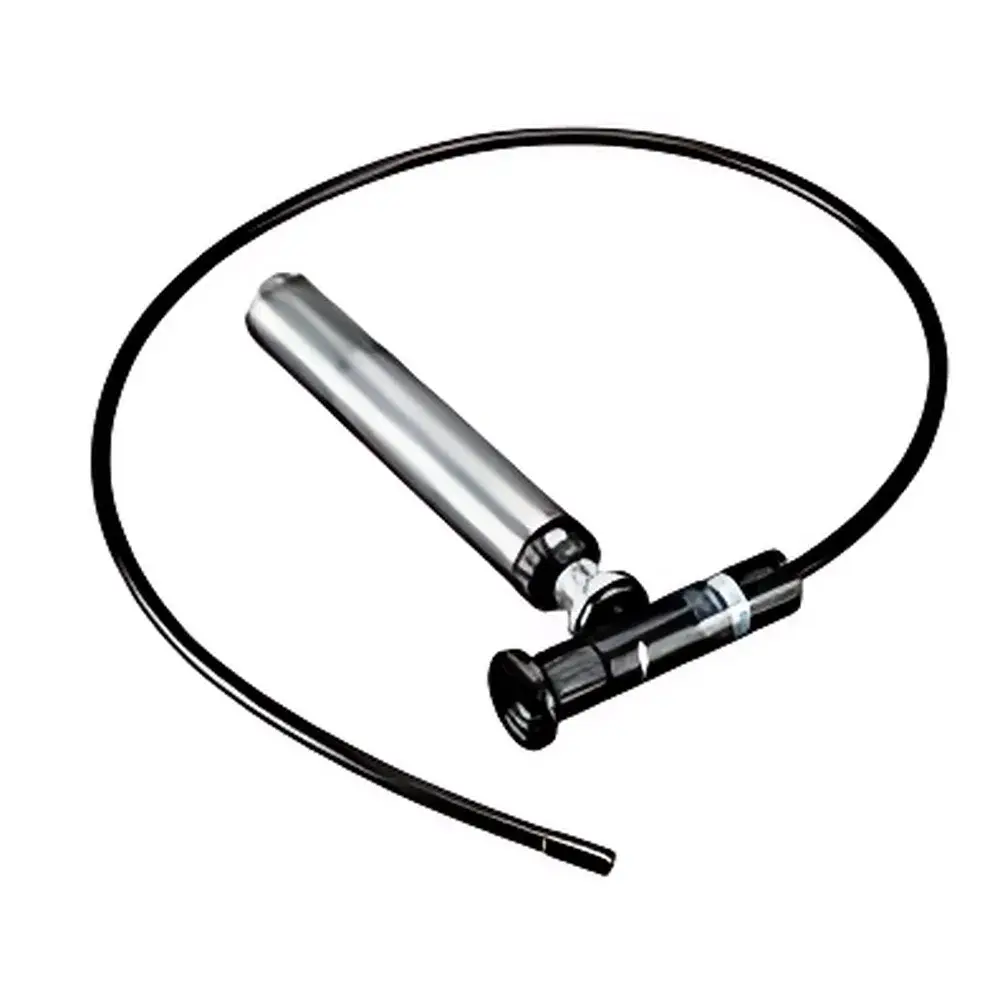
SKF TMES 1/2 Industrial Borescope
| Origin | Imported |
|---|---|
| Manufacturer Type | Authorized Distributor |
| Model | TMES 1/2 |
| Pricing | Upon Request |
| Fiber Optic Core | Acrylic |
| Pixel Count | TMES 1: 3,500 |
| TMES 2 | 7,400 |
| Fiber Diameter | TMES 1: 35 mm |
| TMES 2 | 13 mm |
| Max Fiber Damage Tolerance | TMES 1: ≤2% |
| TMES 2 | ≤0.5% |
| Cable Material | SUS304 stainless steel braid with PVC jacket |
| Minimum Bend Radius | 40 mm |
| Cable Length | TMES 1: 1 m |
| TMES 2 | 3 m |
| Cable Diameter | TMES 1: 8 mm |
| TMES 2 | 5 mm |
| Light Source | 3.5 V, 0.7 A, 2.55 W LED-equivalent incandescent |
| Power Supply | 3 × C (LR14) alkaline batteries |
| Viewing Direction | Straight-ahead |
| Field of View | TMES 1: 60° |
| TMES 2 | 55° |
| Fixed Focus Distance | 10 mm |
| Waterproof Rating | Objective lens and fiber cable rated for 1–1.3 bar air pressure (IP65 equivalent for probe section) |
| Operating Temperature | −20 °C to +60 °C |
| Total Weight | 1,135 g |
| Packaging Dimensions | 360 × 270 × 80 mm |
Overview
The SKF TMES 1/2 Industrial Borescope is a rigid-optic, handheld visual inspection instrument engineered for non-destructive examination of inaccessible internal components in industrial machinery. Based on coherent fiber-optic image transmission—where thousands of individually aligned acrylic optical fibers preserve spatial fidelity across the imaging path—the TMES series delivers real-time, high-fidelity optical visualization without requiring electronic image sensors or digital processing at the distal tip. This architecture ensures intrinsic electromagnetic immunity, mechanical robustness, and operational reliability in harsh environments where electronic endoscopes may fail due to moisture ingress, EMI, or thermal stress. Designed specifically for predictive maintenance workflows, the TMES 1/2 enables field engineers to perform rapid, on-site diagnostics of gearboxes, compressor housings, turbine blade roots, crankcase interiors, and other confined cavities—without disassembly, downtime, or reliance on external power sources.
Key Features
- Rigid fiber-optic probe with fixed-focus 10 mm working distance and straight-ahead viewing geometry for consistent depth-of-field alignment
- Two model variants: TMES 1 (3,500-pixel resolution, 35 mm fiber diameter, 1 m cable) optimized for general-purpose access; TMES 2 (7,400-pixel resolution, 13 mm fiber diameter, 3 m cable) engineered for high-resolution inspection in deep or narrow passages
- Stainless steel-reinforced fiber cable (SUS304 braid + PVC jacket) with 40 mm minimum bend radius—enabling navigation around tight bends while maintaining optical integrity
- Integrated, user-adjustable illumination powered by three C-cell batteries (LR14), delivering stable 2.55 W luminous output without external power adapters or heat-generating drivers
- IP65-equivalent sealing on objective lens and fiber cable section (1–1.3 bar air pressure test compliance), supporting use in humid, oily, or dust-laden environments common in wind turbine nacelles, hydraulic systems, and marine engine rooms
- Ergonomic, telescoping handle with integrated eyepiece—allowing direct ocular observation without calibration, software setup, or display latency
- Modular accessory ecosystem including 90° angled eyepieces (TMES 1-M / TMES 2-M), universal camera mounts (TMES 1-C / TMES 2-C), and replaceable tungsten-halogen bulbs (TMES 1-L)
Sample Compatibility & Compliance
The TMES 1/2 is validated for inspection of metallic, composite, and elastomeric components within rotating equipment, pressure vessels, and enclosed mechanical assemblies. Its optical design complies with ISO 8502-3 (surface cleanliness assessment prior to coating), ASTM E2578 (standard guide for borescopic examination), and EN 13018 (non-destructive testing — general principles for visual testing). While not classified as a medical device, its construction adheres to RoHS Directive 2011/65/EU for hazardous substance restrictions and meets IEC 60529 ingress protection requirements for the probe section. The instrument supports GLP-aligned documentation when used with optional digital camera integration (via TMES-C mount), enabling traceable image capture for maintenance logs, root cause analysis reports, and third-party audit submissions.
Software & Data Management
The TMES 1/2 operates independently of software—eliminating firmware updates, driver conflicts, or cybersecurity vulnerabilities associated with connected imaging platforms. However, when paired with a DSLR or mirrorless camera via the TMES-C mounting bracket, captured images and videos comply with standard EXIF metadata protocols and integrate seamlessly into enterprise CMMS (Computerized Maintenance Management Systems) such as IBM Maximo, SAP PM, or Fiix. Image timestamps, operator ID tags, and equipment asset tags can be manually annotated or embedded using compatible DICOM or PDF/A-2 archival workflows. No proprietary software license, cloud subscription, or data residency constraints apply—ensuring full ownership and long-term accessibility of inspection records per ISO/IEC 27001 information security guidelines.
Applications
- Predictive inspection of gear tooth pitting, scoring, or micro-cracking inside sealed transmissions
- Assessment of compressor vane erosion, carbon buildup, or foreign object damage (FOD) in axial flow units
- Visual verification of bearing raceway condition, cage integrity, and lubricant distribution in wind turbine main shafts
- Post-maintenance validation of weld seam continuity, bolt seating, and gasket placement in ASME Section VIII pressure vessels
- Root cause analysis of hydraulic pump failure through valve plate wear pattern recognition
- Verification of casting porosity, core shift, or machining burrs in aerospace structural housings
FAQ
Is the TMES 1/2 suitable for use in explosive atmospheres (ATEX/IECEx)?
No—this model lacks intrinsic safety certification. For Zone 1/21 applications, consult SKF’s certified Ex-rated borescope variants.
Can the fiber optic bundle be replaced in the field?
No—fiber replacement requires factory recalibration and optical alignment. Damaged probes must be returned for refurbishment under SKF’s service program.
What is the maximum operating temperature for continuous use?
The specified range is −20 °C to +60 °C; prolonged exposure above 50 °C may accelerate PVC jacket aging and reduce bend-cycle longevity.
Does the TMES 1/2 support video recording natively?
No—it is an optical-only instrument. Video capture requires external camera integration via the TMES-C bracket.
Are calibration certificates provided with each unit?
Yes—each TMES 1/2 ships with a manufacturer-issued Certificate of Conformance referencing ISO/IEC 17025-accredited optical performance verification at time of shipment.



