
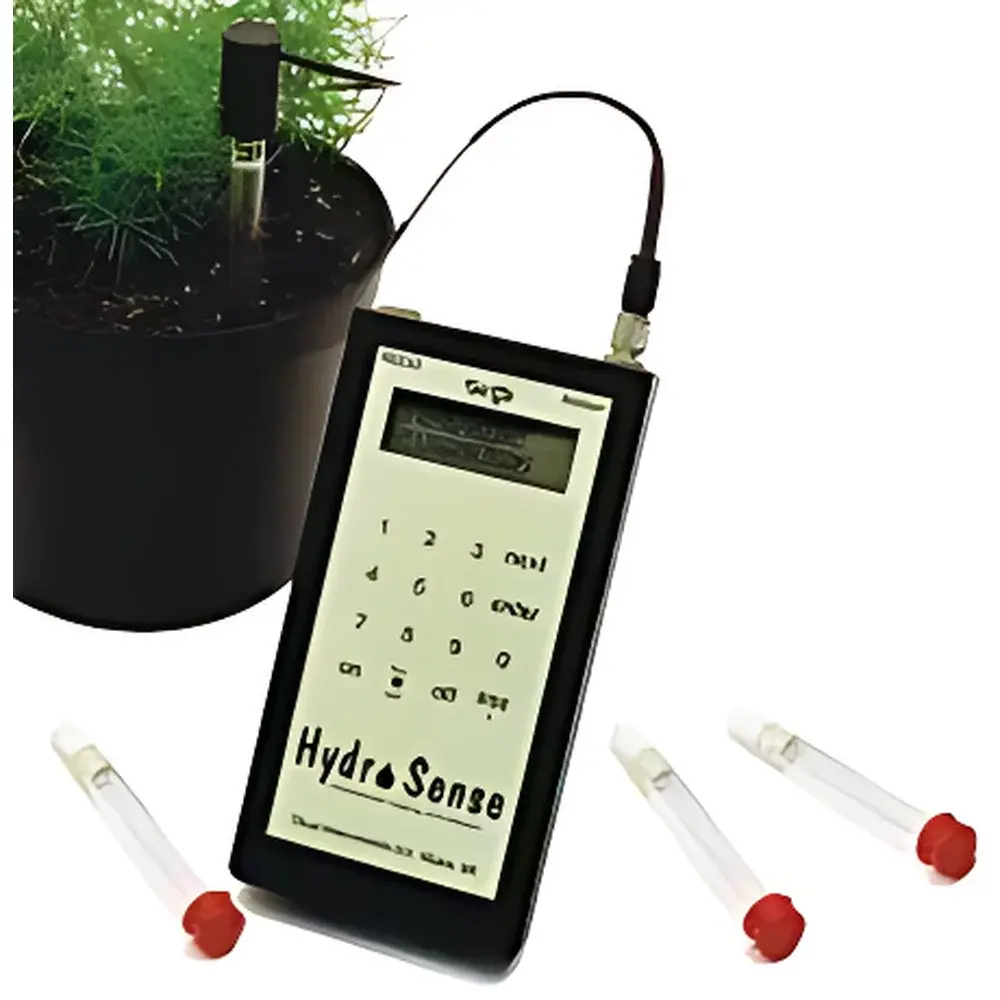
Skye Mini Tensiometer
| Origin | UK |
|---|---|
| Manufacturer Type | Distributor |
| Origin Category | Imported |
| Model | Skye Mini Tensiometer |
| Price | Upon Request |
| Ceramic Tip Length | 25 mm |
| Diameter | 13.5 mm |
| Cable Length | 3 m |
| Measurement Range | 0–850 mbar |
| Tube Length Options | 10, 20, 30, 40, 50 cm |
| Stability | ±0.1% of reading per year |
| Data Logger Compatibility | SKT 660/I Handheld Reader or SDL 5000 Series (1–8 channels) |
| Reader Memory Capacity | 1200 readings |
| Reader Sampling Interval | 1 min – 2 hr |
| Reader Operating Temperature | −20 °C to +70 °C |
| Reader Power | Rechargeable or alkaline batteries (60 hr / 120 hr typical field life) |
| Data Logger Resolution | 15-bit |
| Data Logger Sampling Interval | 10 s – 12 hr |
| Data Output | ASCII via RS232C |
| Data Logger Operating Temperature | −20 °C to +70 °C |
Overview
The Skye Mini Tensiometer is a precision-ceramic soil water potential sensor engineered for direct, in-situ measurement of matric potential in the range of 0 to −850 mbar (equivalent to −85 kPa). Based on the classical tensiometric principle—where porous ceramic material equilibrates with surrounding soil moisture and transmits hydrostatic tension to a calibrated pressure transducer—the instrument provides a physically grounded, thermodynamically meaningful metric of plant-available water. Unlike indirect proxies (e.g., dielectric sensors), tensiometry delivers absolute water potential values traceable to fundamental soil physics, making it indispensable for irrigation scheduling, drought stress phenotyping, root-zone hydrology modeling, and validation of remote sensing or numerical soil moisture simulations. Designed for long-term deployment in heterogeneous field conditions, the Skye Mini integrates a robust 25 mm sintered ceramic tip, 13.5 mm outer diameter profile, and 3-meter shielded cable optimized for low-noise signal transmission under variable temperature and electromagnetic environments.
Key Features
- Compact, field-deployable design with minimal soil disturbance during installation—ideal for replicated experimental plots and permanent monitoring stations.
- Multiple tube length options (10 cm, 20 cm, 30 cm, 40 cm, 50 cm) enable depth-resolved profiling of vertical water potential gradients across root zones.
- High mechanical stability: drift ≤0.1% of full-scale reading per year ensures data continuity across multi-seasonal studies without recalibration.
- Compatible with two operational modes: standalone use with the SKT 660/I handheld reader (real-time display + manual logging) or networked deployment via the SDL 5000-series data loggers (1–8 channel, programmable intervals).
- Wide operational temperature range (−20 °C to +70 °C) supports deployment in arid, temperate, and subtropical agroecosystems—including greenhouse, orchard, vineyard, and rangeland settings.
- RS232C ASCII output enables seamless integration with third-party SCADA systems, custom Python/Matlab acquisition scripts, or legacy laboratory data infrastructure.
Sample Compatibility & Compliance
The Skye Mini Tensiometer is validated for use in mineral soils (sandy loam to clay loam textures), peat-based horticultural substrates, and structured agricultural soils exhibiting moderate to high hydraulic conductivity. It is not recommended for permanently saturated, highly saline (>4 dS/m EC), or coarse gravelly media where ceramic–soil contact resistance may compromise equilibration. While the device itself carries no formal certification, its measurement methodology aligns with ASTM D4944 (Standard Test Method for Field Determination of Soil Water Potential) and ISO 11274 (Soil Quality — Determination of Soil Water Retention Characteristics). When deployed with SDL 5000 loggers configured for time-stamped, audit-trail-enabled logging, the system supports GLP-compliant data capture workflows required for regulatory agronomic trials and environmental impact assessments.
Software & Data Management
No proprietary software is required. Raw ASCII output from the SKT 660/I reader or SDL 5000 logger is compatible with standard spreadsheet applications (Microsoft Excel, LibreOffice Calc), statistical platforms (R, JMP), and time-series visualization tools (Grafana, Plotly). The SDL 5000 firmware supports user-defined sampling schedules (10-second to 12-hour intervals), automatic data rollover, and battery voltage monitoring. All logged records include embedded timestamps (YYYY-MM-DD HH:MM:SS), channel ID, and unit-tagged values (mbar), facilitating metadata-rich dataset curation. For laboratories operating under FDA 21 CFR Part 11 requirements, external validation of the ASCII ingestion pipeline (e.g., using LabArchives or Benchling) is recommended to ensure electronic record integrity and operator accountability.
Applications
- Optimizing deficit irrigation regimes in high-value horticulture by correlating midday leaf water potential with soil matric potential at critical root depths.
- Quantifying plant-soil hydraulic resistance in genotype × environment interaction trials for drought-tolerant crop breeding programs.
- Calibrating and validating HYDRUS-1D or SWAP model boundary conditions in lysimeter and field-scale water balance studies.
- Monitoring seasonal dynamics of unsaturated zone fluxes in riparian buffer zones and erosion-prone slopes for watershed management planning.
- Supporting ISO/IEC 17025-accredited soil testing laboratories in delivering traceable water potential reference measurements for method validation.
FAQ
What is the minimum soil water content at which the Skye Mini remains functional?
The sensor operates effectively down to the air-entry value of the host soil—typically corresponding to volumetric water contents of ~0.08–0.12 m³/m³ in sandy loams and ~0.18–0.25 m³/m³ in clay loams. Beyond the air-entry point, cavitation within the ceramic pore network leads to loss of hydraulic continuity.
Can the ceramic tip be cleaned or regenerated after long-term burial?
Yes—standard regeneration involves soaking the tip in 10% HCl for 2 hours, followed by thorough rinsing with deionized water and re-saturation in distilled water for ≥24 hours prior to reinstallation. Avoid ultrasonic cleaning or mechanical abrasion.
Is temperature compensation applied internally?
No—temperature effects on transducer output are minimal (<0.02% FS/°C) and fall within the specified stability tolerance; users conducting high-precision comparative studies should log concurrent soil temperature and apply empirical correction if required.
How deep can the 50 cm tube version be installed without risking cable strain or seal failure?
Maximum recommended installation depth is 45 cm to preserve the integrity of the cable-to-body junction and allow for surface-level strain relief loops. Use of rigid PVC access tubes is advised for installations exceeding 30 cm in loose or shifting soils.
Does the system support wireless telemetry?
Not natively—but the RS232C ASCII output can be interfaced with commercially available cellular or LoRaWAN gateway modules (e.g., Senzit, Dragino) using simple level-shifting circuitry and open-source firmware (Arduino/ESP32).
Related Products



