

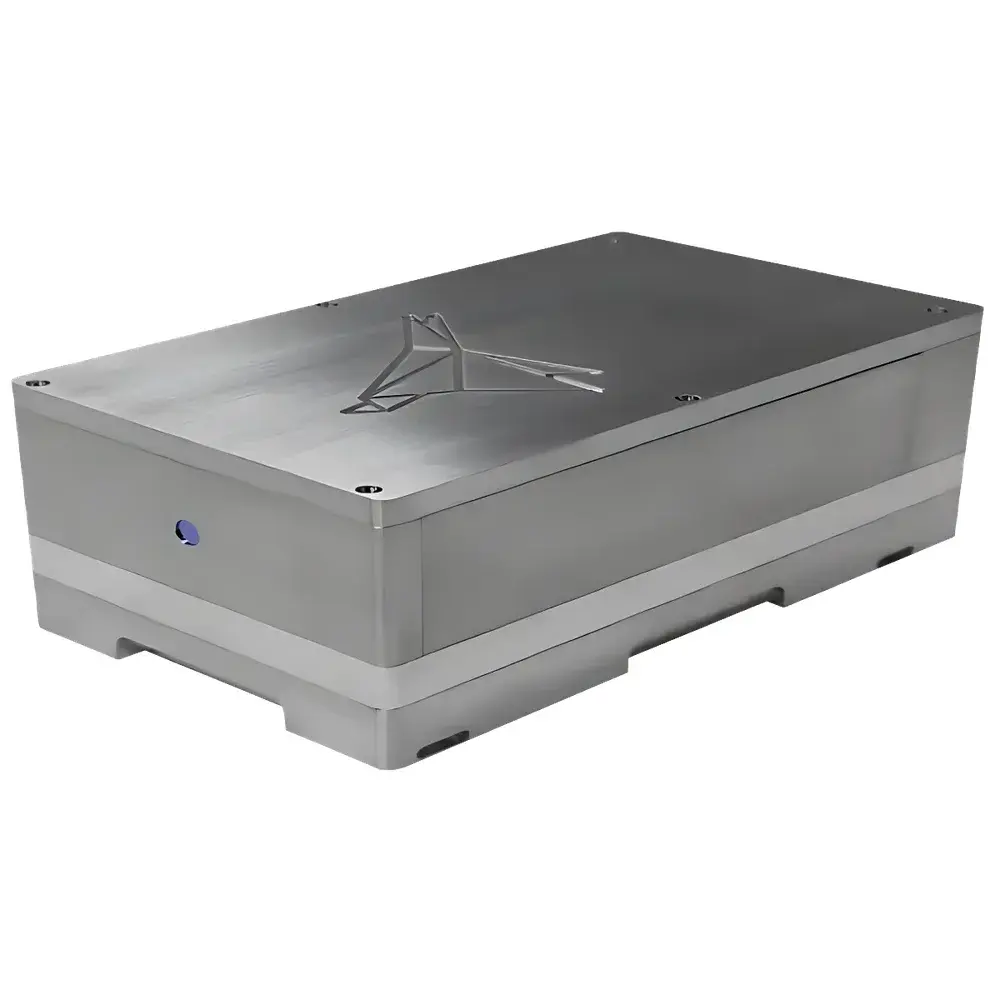
Skylark Lasers 349NX Single-Frequency CW C-DPSS Ultraviolet Laser
| Brand | Skylark Lasers |
|---|---|
| Origin | United Kingdom |
| Model | 349NX |
| Wavelength | 349 nm |
| Output Power | Up to 200 mW (fixed within operating range) |
| Spectral Bandwidth | ≤ 0.5 MHz |
| Spatial Mode | TEM₀₀ |
| Operation Mode | Continuous Wave (CW), Single Longitudinal Mode (SLM) |
| Spectral Stability (8 h) | ±0.2 pm |
| Power Stability (8 h) | ≤ 2% (peak-to-peak) |
| Intensity Noise (10 Hz–10 MHz) | ≤ 0.1% RMS |
| Coherence Length | > 100 m |
| Polarization Ratio | ≥ 100:1 (vertical) |
| Beam Diameter (exit aperture) | 0.6–1.2 mm |
| Beam Divergence | 1.0 mrad (diffraction-limited) |
| Beam Pointing Stability | ≤ 5 µrad/°C |
| Warm-up Time | 5–30 min |
| Power Consumption | < 200 W |
| Laser Head Dimensions (L×W×H) | 240 × 150 × 100 mm |
| Controller Dimensions (L×W×H) | 238 × 170 × 54 mm |
| Beam Height | 65 mm |
| Operating Temperature | 18–30 °C (laser head thermal stability ±1.5 °C) |
| Storage Temperature | 0–50 °C |
| Humidity | 0–50% RH (non-condensing) |
| Cooling Options | Fan-assisted heatsink or water-cooled TEC |
| Interface | USB (plug-and-play), remote diagnostics support |
| Optional Features | Closed-loop chiller, fiber coupling (multimode >95%, single-mode >70%), external AOM modulation up to 200 kHz, analog 0–10 V power control (0–100%) |
Overview
The Skylark Lasers 349NX is a high-performance, compact, diode-pumped solid-state (C-DPSS) ultraviolet laser engineered for applications demanding exceptional spectral purity, long coherence length, and ultra-stable continuous-wave (CW) output. Operating at a fixed center wavelength of 349 nm, it leverages Skylark’s proprietary BRaMMS (Broadband Resonator with Monolithic Mode Selection) platform — a patented resonator architecture designed specifically to suppress multi-longitudinal-mode oscillation while enabling scalable single-frequency (SLM) operation in the UV regime. Unlike conventional DPSS lasers limited by thermal lensing and spatial hole burning in nonlinear crystals, the 349NX integrates monolithic cavity design, active thermal stabilization, and precision mode-matching optics to deliver robust SLM emission with sub-MHz linewidth and coherence lengths exceeding 100 meters. Its fundamental design prioritizes metrological-grade stability: spectral drift is maintained within ±0.2 pm over an 8-hour period under controlled ambient conditions (±1.5 °C thermal regulation), and power fluctuations remain below 2% peak-to-peak — specifications critical for interferometric alignment, high-resolution spectroscopy, and quantum optical experiments where phase integrity directly determines measurement fidelity.
Key Features
- Single longitudinal mode (SLM) CW output at 349 nm with spectral bandwidth ≤ 0.5 MHz — suitable for coherent excitation and heterodyne detection
- TEM₀₀ spatial profile with M² < 1.1, beam divergence of 1.0 mrad (diffraction-limited), and pointing stability ≤ 5 µrad/°C — optimized for coupling into single-mode fibers and high-NA microscope objectives
- Integrated thermal management system supporting dual cooling configurations: fan-assisted passive heatsink (standard) or optional water-cooled thermoelectric cooler (TEC) for enhanced intensity and wavelength stability
- Plug-and-play USB interface with full remote diagnostics, real-time parameter monitoring, and firmware-upgradable controller — compliant with standard USB CDC class protocols for seamless integration into LabVIEW, Python, or MATLAB environments
- Compact modular architecture: laser head (240 × 150 × 100 mm) and separate controller (238 × 170 × 54 mm) enable flexible OEM integration into vacuum chambers, optical tables, or portable analytical platforms
- Factory-aligned, hermetically sealed laser head with no user-serviceable optics — ensures long-term reliability and eliminates routine realignment requirements in production or regulated laboratory settings
Sample Compatibility & Compliance
The 349NX is compatible with a wide range of optical components and sample interfaces common in UV-sensitive instrumentation, including fused silica optics, MgF₂-coated mirrors, and UV-grade photodetectors. Its vertical linear polarization (≥100:1 extinction ratio) and stable beam height (65 mm) simplify integration with commercial confocal microscopes, Raman spectrometers, and wafer inspection tools. From a regulatory standpoint, the system adheres to IEC 60825-1:2014 (Class 3B laser safety), CE marking requirements for electromagnetic compatibility (EMC Directive 2014/30/EU), and RoHS 2011/65/EU material restrictions. While not certified as GMP-compliant per se, its deterministic performance parameters — traceable via internal calibration logs and supported by full audit-trail-capable software — align with GLP and FDA 21 CFR Part 11 data integrity expectations when deployed in validated analytical workflows (e.g., semiconductor process control or biopharmaceutical characterization).
Software & Data Management
The included Skylark Control Suite provides cross-platform (Windows/macOS/Linux) GUI and command-line interface (CLI) access to all operational parameters, including real-time monitoring of output power, cavity temperature, pump diode current, and interlock status. All settings are stored in non-volatile memory with timestamped change history. The software supports SCPI-style ASCII commands over USB virtual COM port, enabling direct scripting for automated test sequences in production line validation or research reproducibility frameworks. Optional SDKs (C/C++, Python bindings) allow developers to embed laser control within custom acquisition pipelines — for instance, synchronizing AOM-driven intensity modulation (up to 200 kHz) with time-resolved fluorescence decay capture or lock-in amplified Raman signal acquisition. Raw telemetry data can be exported in CSV or HDF5 format, preserving metadata required for ISO/IEC 17025-compliant reporting.
Applications
- Raman & Brillouin Spectroscopy: Narrow linewidth and high spectral stability minimize instrumental broadening, enabling sub-wavenumber resolution in UV-resonant Raman measurements of carbon nanotubes, 2D materials, and pharmaceutical polymorphs
- Confocal & Super-Resolution Microscopy: High-brightness 349 nm output efficiently excites DAPI, Hoechst, and other UV-fluorophores; TEM₀₀ mode ensures diffraction-limited focus and uniform point-spread function across large FOVs
- Semiconductor Metrology: Used in mask inspection, wafer defect review, and lithography tool calibration due to precise wavelength definition and low pointing drift — critical for overlay accuracy in sub-10 nm node fabrication
- Holography & Interferometry: Coherence length >100 m supports large-path-difference interferometers and dynamic holographic storage systems requiring long temporal coherence
- Quantum Optics: Serves as pump source for UV-based SPDC (spontaneous parametric down-conversion) in entangled photon generation, benefiting from low-intensity noise (<0.1% RMS, 10 Hz–10 MHz) and stable polarization
- Grating & Master Disk Fabrication: Enables high-fidelity interference patterning in photoresist with minimal speckle-induced line-edge roughness
FAQ
Is the 349NX compliant with FDA 21 CFR Part 11 for electronic records and signatures?
The laser itself is not a regulated medical device, but its control software supports audit-trail logging, user authentication, and electronic signature workflows when deployed in validated environments — features configurable to meet Part 11 requirements during system-level qualification.
What is the typical warm-up time to achieve full spectral and power stability?
Full stabilization is achieved within 15 minutes under nominal lab conditions (22 ± 1 °C); worst-case specification is 30 minutes, verified per IEC 61228 Annex B test protocol.
Can the laser be fiber-coupled, and what coupling efficiencies are achievable?
Yes — multimode fiber coupling achieves >95% efficiency using standard SMA905 connectors; single-mode coupling (>70%) requires optional aspheric collimation and active alignment fixtures provided by Skylark.
Does the system support external analog modulation for intensity control?
Yes — optional 0–10 V analog input enables continuous power adjustment from 0% to 100%, implemented via internal current regulation of the pump diode to preserve spectral characteristics.
Is water cooling mandatory for continuous operation at maximum output power?
No — fan-assisted cooling supports 200 mW CW operation indefinitely at ambient temperatures ≤25 °C; water cooling is recommended for sustained output above 150 mW in environments >27 °C or for applications requiring sub-0.1 pm spectral drift.



