
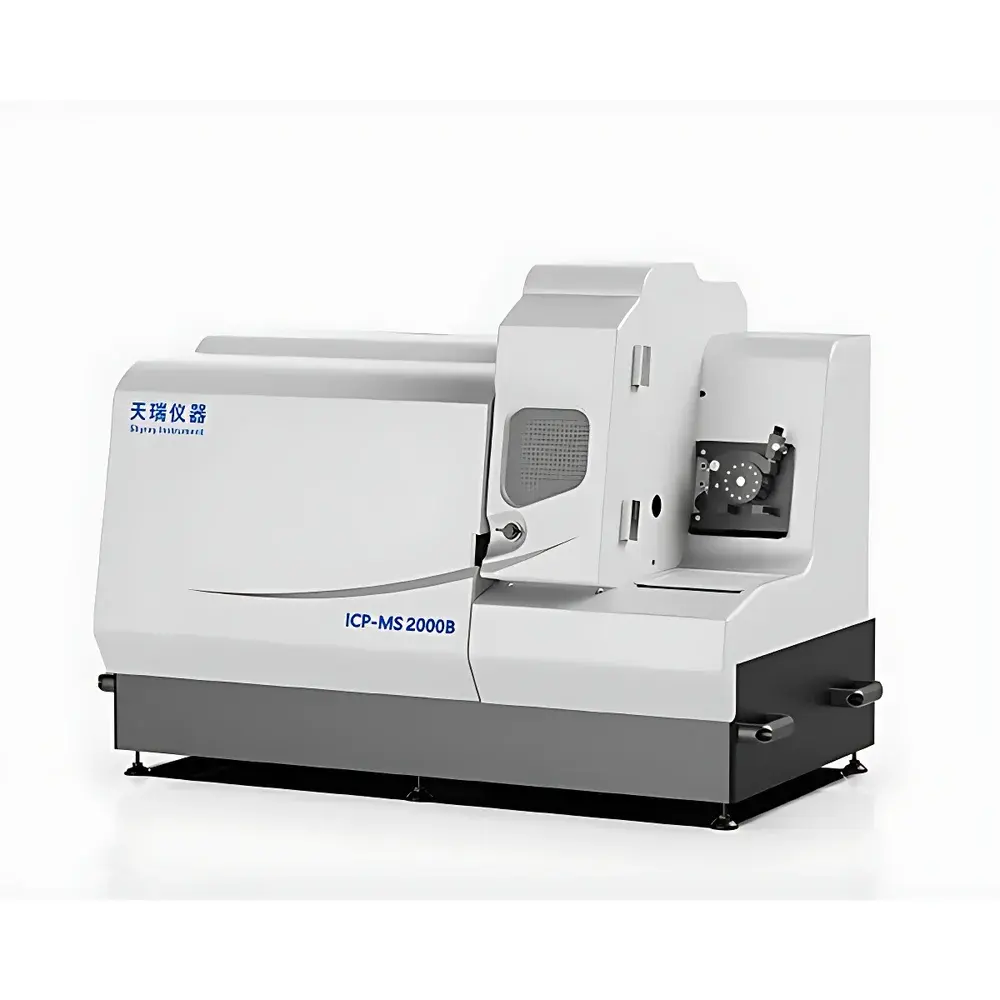
SkyRay ICP-MS 2000 Series Inductively Coupled Plasma Mass Spectrometer
| Brand | SkyRay Instrument |
|---|---|
| Origin | Jiangsu, China |
| Manufacturer Type | Original Equipment Manufacturer (OEM) |
| Product Line | ICP-MS 2000 Series |
| Mass Analyzer Type | Quadrupole Mass Spectrometer |
| Intended Use | Laboratory-Based Elemental Analysis |
| Regulatory Compliance | Meets or exceeds GB/T 35791–2018 (Chinese National Standard for ICP-MS Performance Verification) |
| Software Platform | Windows 2000/XP/Vista/7 (32-bit & 64-bit) Compatible Control System |
| Sample Introduction | Integrated Peltier-Cooled Glass Cyclonic Spray Chamber (–20 °C to +20 °C), One-Piece Quartz Concentric Torch, Open-Access Nebulizer Assembly |
| Vacuum Interface | Dual-Conical Interface with Removable Sampling Cone (1.1 mm orifice) and High-Salt/High-Sensitivity Skimmer Cone Options (0.75 mm standard) |
| Ion Optics | Asymmetrically Mounted Extraction & Deflection Lenses, ETP Dual-Mode Detector (Analog/Digital Switching), Computer-Controlled Auto-Tuning |
| Automation | 250-Position Autosampler (Ethernet-Controlled, Positioning Accuracy < 500 µm) |
| RF Generator | Solid-State Frequency-Tunable Generator with Cold Plasma Mode, Collision/Reaction Cell Mode, and Standard Mode Support |
| Collision/Reaction Cell | Hexapole-Based, H₂/He Mixed-Gas KED Mode Enabled |
| Detection Modes | Full-Scan, Peak-Hopping, Time-Resolved Analysis (TRA) |
Overview
The SkyRay ICP-MS 2000 Series is a quadrupole-based inductively coupled plasma mass spectrometer engineered for high-sensitivity, multi-element trace and ultra-trace elemental analysis in regulated and research laboratory environments. Operating on the fundamental principle of ion generation via high-temperature argon plasma (≈7,000–10,000 K), followed by mass separation in a radiofrequency-driven quadrupole mass filter and detection using an extended dynamic range electron multiplier, the system delivers sub-pg·L⁻¹ detection limits for most elements across the periodic table. Designed and manufactured in Jiangsu, China, the ICP-MS 2000 Series complies with national performance verification standards (GB/T 35791–2018) and supports method development aligned with internationally recognized protocols including EPA Method 6020B, ISO 17294-2, and ASTM D5673. Its architecture integrates plasma source stability, vacuum integrity, and ion transmission efficiency to ensure reproducible quantification across complex matrices—particularly in environmental monitoring, semiconductor process control, pharmaceutical impurity profiling, clinical trace metal studies, and nuclear fuel cycle analysis.
Key Features
- Frequency-tunable solid-state RF generator enabling seamless switching between standard, cold plasma, and collision/reaction cell operating modes within a single analytical sequence—eliminating manual reconfiguration and minimizing downtime.
- Patented plasma shielding technology enhances low-mass sensitivity (e.g., Na, Mg, Al, K, Ca) without requiring reactive gases; achieves detection limits ≤1 ng·L⁻¹ for alkali and alkaline earth elements under cold plasma conditions.
- Hexapole collision/reaction cell with H₂/He mixed-gas capability operates in kinetic energy discrimination (KED) mode to suppress polyatomic interferences—including 40Ar35Cl⁺ on 75As⁺ and 40Ar1H⁺ on 41K⁺—without hardware or gas-line switching.
- Computer-controlled XYZ-adjustable plasma torch positioning (0.1 mm resolution) ensures optimal ion sampling efficiency and long-term signal stability across varying sample matrices.
- Peltier-cooled cyclonic spray chamber with rapid thermal stabilization (≤3 min from ambient to 2 °C) enables precise aerosol temperature control for volatile or high-dissolved-solid samples.
- Modular dual-cone interface with tool-free access allows cone replacement without venting the vacuum system—reducing maintenance time and preserving detector lifetime.
- Asymmetric lens mounting and off-axis ion optics design minimize neutral particle and electron transmission into the mass analyzer, lowering background noise and improving signal-to-noise ratios.
- Self-aligning open-access nebulizer assembly and one-piece quartz concentric torch simplify routine maintenance and reduce risk of misalignment-induced signal drift.
Sample Compatibility & Compliance
The ICP-MS 2000 Series accommodates aqueous solutions, digested environmental solids (EPA SW-846 Methods 3050B, 3051A, 3052), biological tissues (microwave-assisted acid digestion), semiconductor rinse waters (ASTM F2289), and high-purity reagents (SEMI C1/C2 grade). It supports direct analysis of low-salinity samples (<0.2% TDS) and, with optional high-salt skimmer cones, handles up to 0.5% total dissolved solids. All operational parameters—including RF power, coolant gas flow, auxiliary gas, nebulizer gas, and lens voltages—are fully programmable and audit-trail enabled per GLP/GMP requirements. While not pre-certified to FDA 21 CFR Part 11, the software architecture supports user-defined electronic signatures, password-protected method editing, and timestamped data logging—facilitating internal validation for regulated workflows.
Software & Data Management
SkyRay’s proprietary control software provides full instrument automation: startup/shutdown sequencing, auto-tuning of ion optics and detector gain, real-time mass calibration, and integrated autosampler control. The interface supports method templates compliant with ISO/IEC 17025 documentation requirements, including automatic generation of calibration curves, QC check reports (spike recovery, duplicate precision, blank evaluation), and raw data export in .csv and .txt formats. All tuning parameters, acquisition logs, and instrument status events are stored with timestamps and user IDs. The software runs natively on Windows platforms (32-bit and 64-bit) and interfaces via Ethernet with third-party LIMS systems through ODBC-compliant drivers.
Applications
- Environmental Testing: Quantification of heavy metals (Pb, Cd, Hg, As) and rare earth elements in drinking water, wastewater, soil leachates, and airborne particulates per EPA 6020B and ISO 17294-2.
- Pharmaceutical Quality Control: Residual catalyst screening (Pd, Pt, Rh) in active pharmaceutical ingredients (APIs) and elemental impurity testing per ICH Q3D guidelines.
- Semiconductor Manufacturing: Ultra-trace contamination monitoring (Na, K, Fe, Cu, Ni) in ultrapure water, photoresists, and etchants at sub-part-per-quadrillion levels.
- Clinical & Nutritional Research: Multi-element profiling in serum, urine, and tissue homogenates for biomarker discovery and nutritional status assessment.
- Nuclear Applications: Isotopic ratio measurements (e.g., 235U/238U, 239Pu/240Pu) in safeguards and fuel cycle material characterization.
FAQ
Does the ICP-MS 2000 Series support isotopic ratio measurements?
Yes—its mass resolution (M/ΔM ≥ 300 at 10% valley) and stable ion beam enable precise isotopic ratio determination for applications such as uranium enrichment verification and geochemical tracer studies.
Can the system analyze high-salt matrices like seawater or brines?
With the optional high-salt skimmer cone and optimized cool plasma parameters, it achieves robust performance for seawater analysis (e.g., Mg, Ca, Sr) with minimal cone clogging and signal drift over extended runs.
Is remote diagnostics supported?
The instrument includes embedded Ethernet connectivity and supports secure remote access via authorized VNC sessions for troubleshooting and preventive maintenance planning.
What vacuum pump configuration is used?
A two-stage turbomolecular pump system backed by a dry scroll forepump maintains base pressure below 1×10⁻⁷ mbar in the mass analyzer region, ensuring consistent quadrupole stability and detector longevity.
Are application notes and method packages available?
SkyRay provides validated application notes for environmental, pharmaceutical, and semiconductor use cases—including complete SOPs, calibration protocols, and interference correction tables—available upon request to qualified laboratories.
Related Products





