
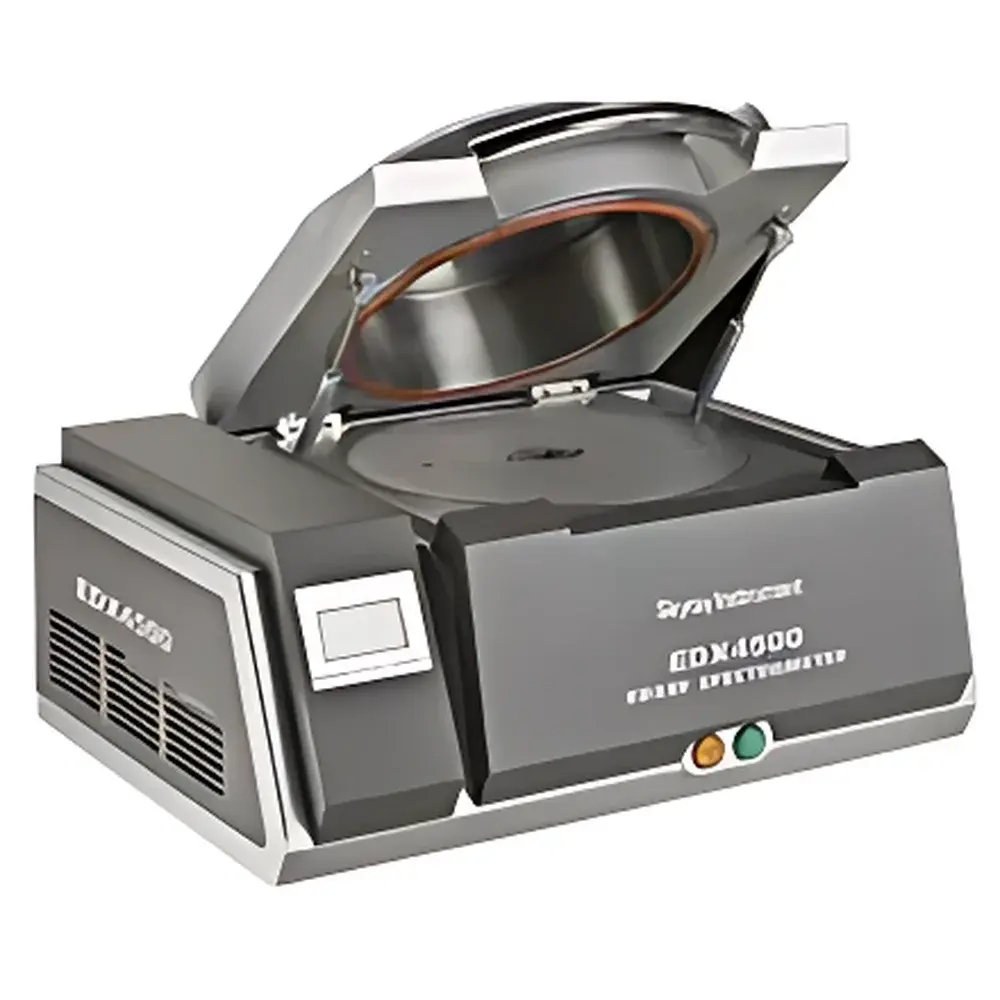
SkyRay Instrument EDX 4500 Energy Dispersive X-Ray Fluorescence Spectrometer
| Brand | SkyRay Instrument |
|---|---|
| Origin | Jiangsu, China |
| Manufacturer Type | Manufacturer |
| Product Category | Domestic |
| Model | EDX 4500 |
| Form Factor | Benchtop/Floor-standing |
| Application Type | General-purpose |
| Elemental Range | Na (11) to U (92) |
| Quantitative Range | 0.1 ppm – 99.99% (matrix- and element-dependent) |
| Energy Resolution | ≤125 eV at Mn Kα |
| Detector | FAST-SDD (Silicon Drift Detector) |
Overview
The SkyRay Instrument EDX 4500 is a high-performance benchtop/floor-standing energy dispersive X-ray fluorescence (EDXRF) spectrometer engineered for precise, non-destructive elemental analysis across diverse sample matrices. Based on the fundamental principle of X-ray fluorescence—where primary X-rays excite atoms in a sample, causing emission of characteristic secondary (fluorescent) X-rays—the EDX 4500 delivers quantitative and semi-quantitative compositional data from sodium (Na, Z=11) through uranium (U, Z=92). Its optimized optical path, vacuum-compatible sample chamber (Φ320 mm × 100 mm), and integrated high-vacuum pump enable reliable detection of light elements—including Na, Mg, Al, Si, P, and S—without atmospheric absorption interference. Designed for routine laboratory use in QC/QA, materials science, geology, environmental monitoring, and recycling applications, the system operates with a tube voltage range of 5–50 kV and tube current of 50–1000 µA, ensuring flexibility across low-Z and high-Z element excitation.
Key Features
- FAST-SDD detector with ≤125 eV energy resolution at Mn Kα, delivering superior peak-to-background ratio, excellent energy linearity, and high count-rate capability (up to 100,000 cps)
- Digital pulse processing with multi-channel analyzer (MCA) architecture for real-time spectral acquisition, improved statistical precision, and reduced dead time
- Ultra-thin window X-ray tube optimized for enhanced low-energy X-ray transmission, critical for accurate light-element quantification
- Intelligent auto-vacuum system that dynamically engages based on selected analytical mode—enabling seamless transition between air, helium flush, and high-vacuum measurement environments
- Automated collimator and filter changer with motorized positioning—eliminating manual intervention and ensuring reproducible excitation geometry across heterogeneous samples
- Onboard automatic spectrum stabilization system maintaining long-term spectral fidelity without user recalibration
- Integrated high-resolution CMOS camera (≥5 MP) with coaxial illumination for precise sample positioning and morphology documentation
- 90 mm × 70 mm industrial-grade LCD panel displaying live operational parameters: tube voltage, tube current, vacuum pressure, and detector temperature
- Triple-layer hardware safety interlock system—comprising door sensor, X-ray emission monitor, and over-pressure cutoff—fully compliant with IEC 61010-1 and GB/T 18806-2002 radiation safety standards
Sample Compatibility & Compliance
The EDX 4500 accommodates solid, powder, and liquid samples up to 320 mm in diameter and 100 mm in height. Its robust steel-frame mechanical design ensures vibration resistance and thermal stability during extended acquisition cycles (60–200 s typical). Sample preparation requires minimal handling—no conductive coating or pelletization needed for most conductive solids. For regulatory compliance, the instrument supports audit-ready workflows aligned with ISO/IEC 17025:2017 requirements for testing laboratories. Spectral deconvolution algorithms and matrix correction models (including fundamental parameter and empirical calibration approaches) are traceable to NIST SRM reference materials. While not FDA 21 CFR Part 11–certified out-of-the-box, the system architecture permits integration with validated LIMS and electronic signature modules for GLP/GMP environments upon customer-specific qualification.
Software & Data Management
The proprietary SkyRay EDX Analysis Suite provides full control of acquisition, processing, and reporting functions via intuitive Windows-based GUI. Key capabilities include peak deconvolution using iterative least-squares fitting, multi-parameter linear regression for inter-element absorption/enhancement correction, and customizable calibration curves with internal standard or standardless FP quantification options. All spectra and metadata—including instrument settings, sample ID, operator log, and timestamp—are stored in encrypted SQLite databases with configurable backup intervals. Export formats include CSV, PDF reports (with embedded spectra), and ASTM E1361-compliant .trc files. Software updates are delivered via secure HTTPS channel with SHA-256 integrity verification.
Applications
- Metallurgy & alloy grade identification (e.g., stainless steels, aluminum alloys, superalloys)
- RoHS/WEEE screening of restricted substances (Pb, Cd, Hg, Cr⁶⁺, Br, Cl) in electronics and polymers
- Geological exploration—major, minor, and trace element profiling in ores, soils, and sediments
- Cement and construction material composition control per ASTM C114 and EN 196-2
- Environmental analysis of heavy metals in fly ash, sludge, and contaminated soils
- Recycling stream sorting and purity verification of scrap metals and e-waste fractions
- Quality assurance of catalysts, pigments, and battery electrode materials
FAQ
What is the minimum detection limit (MDL) for common elements?
MDLs vary by element, matrix, and measurement conditions; typical values range from 0.1 ppm (e.g., Pb in polymer) to 5–10 ppm (e.g., Mg in silicate glass) under vacuum and 100 s counting time.
Does the EDX 4500 support quantitative analysis without certified standards?
Yes—it includes fundamental parameter (FP) algorithms enabling standardless quantification, though accuracy improves significantly with matrix-matched calibration standards.
Can the system be integrated into an automated production line?
The EDX 4500 features RS-232, Ethernet (TCP/IP), and optional PLC-compatible digital I/O for external trigger and status signaling—supporting semi-automated batch analysis in controlled industrial settings.
Is helium purge capability available as an option?
Yes—a factory-installed helium flush module is available for enhanced light-element sensitivity when vacuum operation is impractical.
What maintenance is required for long-term performance stability?
Annual detector energy calibration and vacuum pump oil replacement are recommended; the FAST-SDD requires no periodic cooling gas refills due to its Peltier-based thermoelectric cooling system.
Related Products



