
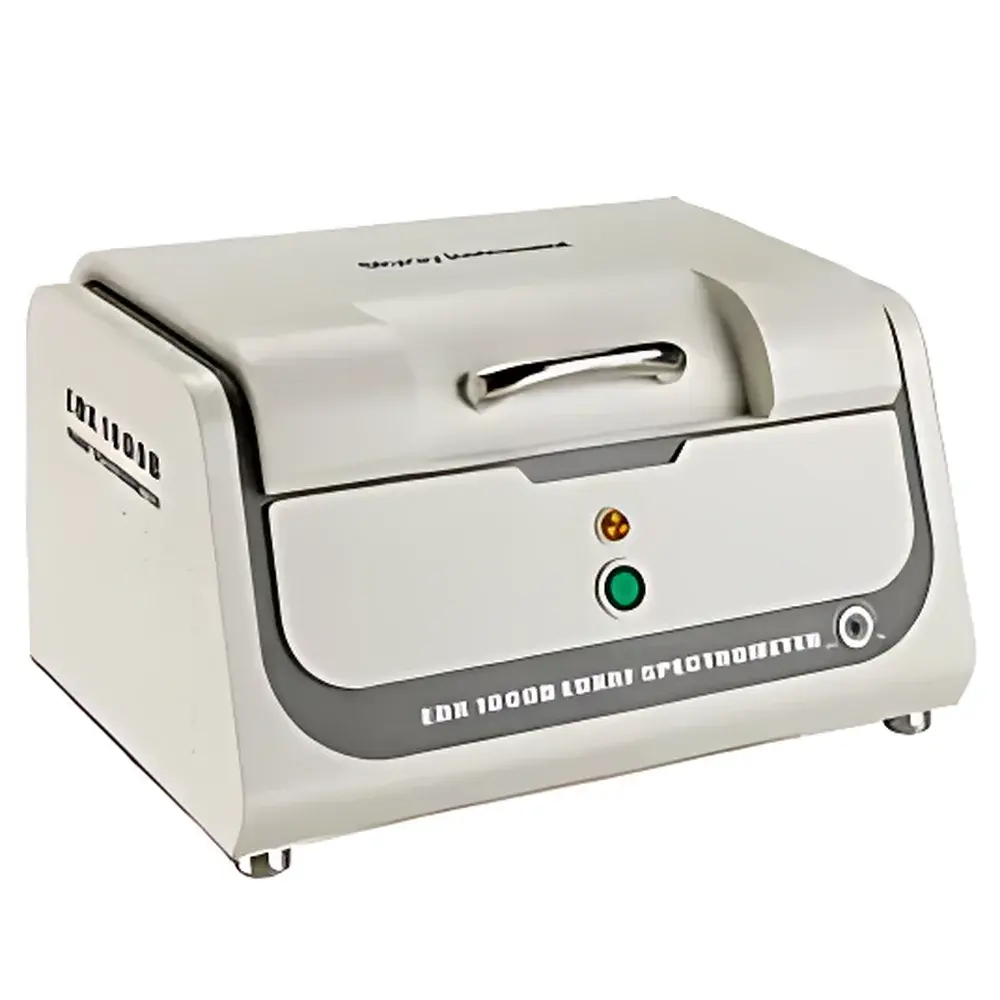
SkyRay Instrument EDX1800B Energy Dispersive X-Ray Fluorescence Spectrometer
| Brand | SkyRay Instrument |
|---|---|
| Origin | Jiangsu, China |
| Manufacturer Type | Direct Manufacturer |
| Product Type | Benchtop/Stand-Alone ED-XRF |
| Model | EDX1800B |
| Element Range | S (16) to U (92) |
| Detection Limit | 1 ppm |
| Quantification Range | 1 ppm – 99.99 wt% |
| Energy Resolution | 125 eV (at Mn Kα) |
| Repeatability | ≤0.05% RSD (for major elements >96 wt%) |
| Detector | Si-PIN Semiconductor Detector |
| Dimensions (W×D×H) | 550 × 416 × 333 mm |
| Sample Chamber | 460 × 298 × 98 mm |
| Weight | 45 kg |
| Operating Temperature | 15–30 °C |
| Power Supply | AC 220 V ±5 V |
Overview
The SkyRay Instrument EDX1800B is a benchtop energy dispersive X-ray fluorescence (ED-XRF) spectrometer engineered for precise, non-destructive elemental analysis of solid, powder, and liquid samples. Based on the fundamental principle of X-ray fluorescence—where primary X-rays excite atoms in a sample, causing emission of characteristic secondary (fluorescent) X-rays—the EDX1800B quantifies elemental composition by measuring the energy and intensity of these emitted photons using a high-resolution Si-PIN semiconductor detector. Designed as an evolution of the widely deployed EDX1800 platform, the EDX1800B integrates a next-generation high-power (up to 50 W) X-ray tube and digitally stabilized high-voltage generator to enhance signal-to-noise ratio, measurement reproducibility, and throughput—particularly critical in regulated environments requiring routine screening and compliance verification.
Key Features
- Optimized Excitation Geometry: Downward-facing optical configuration enables flexible positioning of irregularly shaped, large, or heavy samples without requiring vacuum or helium purge—ideal for industrial QA/QC workflows.
- Automated Collimator & Filter Selection: Motorized switching between multiple collimators (e.g., Ø1 mm, Ø3 mm, Ø6 mm) and primary beam filters (e.g., Al, Cu, Ti) allows real-time optimization of excitation conditions for light-element sensitivity or high-Z suppression.
- Manual Precision Sample Stage: High-stability XYZ translation platform with fine-adjustment micrometers ensures repeatable positioning of analysis points—essential for mapping heterogeneous surfaces or multi-layer coatings.
- High-Resolution Si-PIN Detector: Cooled Peltier-detector system with 125 eV energy resolution at Mn Kα (5.9 keV) delivers improved peak separation for overlapping transitions (e.g., S Kα/Pb Mα, Ca Kα/Ti Kβ), enhancing accuracy in complex matrices.
- Robust Power Architecture: Digitally regulated high-voltage supply (up to 50 kV, 1 mA) paired with a thermally managed X-ray tube ensures long-term stability and minimal drift during extended batch analysis.
Sample Compatibility & Compliance
The EDX1800B accommodates a broad range of sample forms—including bulk metals, pressed pellets, fused beads, thin films, electroplated layers, and packaged consumer goods—without destructive preparation. Its open-sample chamber (460 × 298 × 98 mm) supports direct analysis of RoHS-compliant electronics assemblies, jewelry items, and geological specimens up to 45 kg. The instrument complies with IEC 61000-6-3 (EMC) and IEC 61000-6-4 standards, and its radiation safety design meets GBZ 18871-2002 (China) and aligns with international requirements for Class I X-ray equipment under ISO 20888:2020. While not inherently 21 CFR Part 11 compliant, audit-ready data export (CSV, PDF, XML) and user-access logs support GLP/GMP-aligned documentation when integrated into validated laboratory information management systems (LIMS).
Software & Data Management
The proprietary SkyRay Q-Spec software provides quantitative analysis via fundamental parameter (FP) algorithms, empirical calibration curves, and optional matrix-matched standard libraries. It includes built-in multivariate non-linear regression models for inter-element correction (e.g., absorption, enhancement effects), independent base-matrix correction modules for alloys vs. polymers vs. ceramics, and automated peak deconvolution. All spectral acquisitions, calibration records, and report metadata are timestamped and stored locally with configurable backup intervals. Raw spectra and processed results can be exported in ASTM E1358-compliant formats for third-party review or regulatory submission.
Applications
- RoHS/WEEE Screening: Rapid detection of restricted elements (Pb, Cd, Hg, Cr⁶⁺, Br) in printed circuit boards, cables, and plastic housings per EN 62321-5:2013.
- Alloy & Geochemical Analysis: Grade identification of stainless steels, brasses, aluminum alloys, and ore concentrates; quantification of major/minor elements (Fe, Ni, Cu, Zn, Mn, Si, Al) in mining and metallurgical QC.
- Coating Thickness & Composition: Non-destructive measurement of single/multi-layer metallic coatings (e.g., Ni/Cu on PCBs, Zn on steel) and plating bath concentration monitoring.
- Precious Metal Assaying: Direct analysis of Au, Ag, Pt, and Pd content in jewelry, scrap, and bullion—validated against fire assay reference methods per ISO 11426:2016.
- Environmental & Consumer Goods Testing: Screening of hazardous elements in toys, packaging inks, ceramics, and catalyst materials per CPSIA and EU REACH Annex XVII.
FAQ
What is the minimum detectable limit for sulfur (S) under standard air conditions?
Typical S detection limit is 1–3 ppm for homogenous polymer matrices; performance improves to sub-ppm levels under He flush or vacuum for light-element optimization.
Can the EDX1800B quantify chlorine (Cl) in PVC or bromine (Br) in flame-retardant plastics?
Yes—Cl and Br are routinely quantified using optimized filter/collimator combinations and FP-based calibration; detection limits are ~2–5 ppm in air for 100 s live time.
Is external calibration required for each new sample type?
No—factory-installed FP models cover most common matrices; however, matrix-matched calibrations are recommended for highest accuracy in high-precision applications such as precious metal certification.
Does the system support automated batch analysis of multiple samples?
The manual stage requires operator intervention per sample; for unattended operation, integration with third-party autosamplers (e.g., XYZ robotic stages) is supported via RS-232 or Ethernet API.
How is instrument performance verified over time?
Built-in daily verification uses certified check standards (e.g., NIST SRM 2782, 2783); drift correction protocols and energy calibration routines are accessible through service mode with password-protected access.



