
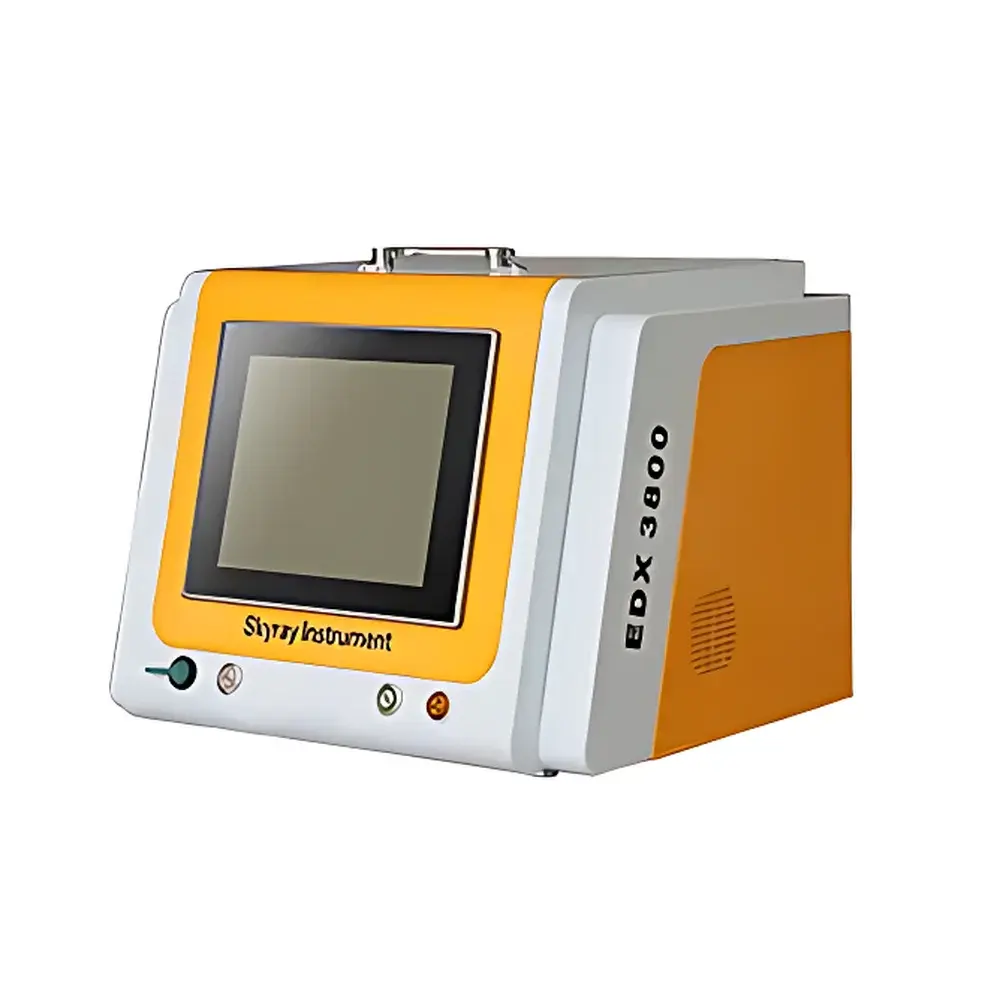
Skyray Instrument EDX3800 Energy Dispersive X-Ray Fluorescence Spectrometer
| Brand | Skyray Instrument |
|---|---|
| Origin | Jiangsu, China |
| Manufacturer Type | Direct Manufacturer |
| Regional Classification | Domestic (China) |
| Model | EDX3800 |
| Form Factor | Benchtop / Floor-standing |
| Application Scope | General-purpose |
| Elemental Detection Range | 0.5 ppm – 99.99% |
| Detectable Elements | Al to U (Atomic Number 13–92) |
| Energy Resolution | 125 eV / 145 eV / 165 eV (Selectable Si-PIN or SDD Detectors) |
| Repeatability | ≤0.04% RSD (for elements >95% concentration) |
Overview
The Skyray Instrument EDX3800 Energy Dispersive X-Ray Fluorescence (ED-XRF) Spectrometer is a high-performance benchtop/floor-standing elemental analyzer engineered for precision, regulatory compliance, and operational robustness in industrial QA/QC, materials research, and environmental safety testing. Based on the fundamental principle of energy-dispersive X-ray fluorescence—where primary X-rays excite characteristic secondary (fluorescent) X-rays from sample atoms—the EDX3800 delivers quantitative and semi-quantitative multi-element analysis without destructive sample preparation. Its architecture integrates a high-power, high-voltage X-ray tube (up to 50 kV/1 mA), ultra-low-loss optical path design, Peltier-cooled semiconductor detectors (Si-PIN or silicon drift detector options), and intelligent spectral deconvolution algorithms compliant with ISO 82556 and ASTM E1621–22. Designed for long-term stability under continuous operation, the instrument features independent thermal management channels that maintain detector and tube temperature uniformity—critical for minimizing spectral drift and ensuring measurement reproducibility across shifts and ambient conditions.
Key Features
- High-sensitivity detection system: Selectable detector configurations—including 125 eV (SDD), 145 eV (high-speed SDD), or 165 eV (Si-PIN)—optimized for resolution, count rate, or cost-efficiency trade-offs per application.
- Dual-mode sample handling: Manual positioning support for irregular, large, or fragile samples; optional 85-position automated sample changer with industrial-grade 4-axis collaborative robotic arm (ISO/TS 15066 compliant), enabling unattended batch analysis with collision-sensing safety logic.
- Intelligent one-touch analysis: Pre-calibrated, matrix-matched quantification workflows for RoHS, ELV, toy safety (EN71-3), and precious metal assays—requiring no operator intervention beyond sample placement.
- Multi-layer radiation safety architecture: Interlocked shutter mechanism, real-time beam status monitoring, software-enforced exposure limits, physical maze shielding, and hardware-based emergency cutoff—fully aligned with IEC 62495 and national Class II X-ray device regulations.
- Thermal and electrical stability engineering: Dedicated airflow pathways isolate detector cooling, X-ray tube heat dissipation, and electronics compartments—reducing cross-component thermal interference and sustaining 95%).
Sample Compatibility & Compliance
The EDX3800 accommodates solid, powder, liquid, and thin-film specimens up to 300 mm × 300 mm × 100 mm (W×D×H). Its open-sample chamber supports non-vacuum, helium-flushed, or vacuum analysis modes—enabling reliable quantification of light elements (Al–Cl) and heavy metals (Pb, Cd, Hg, Cr, Br) in accordance with EU RoHS Directive 2011/65/EU Annex II, China’s GB/T 33352–2016, US EPA Method 6200, and IEC 62321-5:2013. All factory-installed calibrations are traceable to NIST SRM reference materials. The system meets GLP audit requirements with full electronic record retention, user access control, and FDA 21 CFR Part 11–compliant audit trail functionality when paired with Skyray’s certified LabManager Pro software.
Software & Data Management
LabManager Pro v4.2 (included) provides ISO 17025–aligned data acquisition, peak deconvolution (based on fundamental parameter + empirical correction hybrid modeling), limit-of-detection (LOD) calculation per element, and customizable reporting templates exportable to PDF, CSV, or XML. The software supports multi-user role-based permissions, method versioning, calibration history logging, and automatic QC flagging against control chart rules (e.g., Westgard criteria). Raw spectral files (.spc) retain full metadata—including tube parameters, live time, dead time, and environmental sensor readings—for retrospective reprocessing and third-party validation.
Applications
- Routine compliance screening: RoHS/ELV/WEEE restricted substances (Pb, Cd, Hg, Cr⁶⁺, Br, Cl), toy safety (EN71-3), and packaging material verification (94/62/EC).
- Metallurgical QA: Alloy grade identification (stainless steels, aluminum alloys, brass), coating thickness (Ni, Zn, Sn, Cr on steel), and electroplating bath composition monitoring.
- Precious metal assay: Au, Ag, Pt, Pd quantification in jewelry, scrap, and refining feedstocks with certified uncertainty <0.3 wt% at 99.9% purity level.
- Geological & environmental analysis: Soil heavy metal profiling (As, Se, U), catalyst composition (Co–Mo–Al oxides), and petrochemical additive screening (S, Ca, Zn, P).
- Pharmaceutical excipient screening: Catalyst residue detection (Pd, Pt, Ni) and elemental impurity profiling per ICH Q3D guidelines.
FAQ
What regulatory standards does the EDX3800 support out-of-the-box?
Pre-loaded methods comply with IEC 62321-5:2013 (RoHS), EN 14362-1:2017 (textiles), ASTM F2617 (jewelry), and GB/T 33352–2016 (China RoHS). Custom method development is supported via FP+empirical calibration tools.
Is vacuum operation required for light element analysis?
No—helium purge mode enables reliable Al–Cl quantification without vacuum pumps; optional vacuum chamber upgrade extends sensitivity down to Na (Z=11).
Can the EDX3800 be integrated into a LIMS environment?
Yes—via ODBC-compliant database export, HL7 message support, and RESTful API for bidirectional data exchange with major LIMS platforms (e.g., Thermo Fisher SampleManager, LabVantage).
What maintenance intervals are recommended for routine operation?
Detector performance verification quarterly; X-ray tube output calibration annually; full system alignment and vacuum/helium line inspection every 18 months—documented in ISO/IEC 17025–compatible maintenance logs.
Does the automated sampler require external safety caging?
No—the 4-axis collaborative robot operates under ISO/TS 15066 power-and-force limiting protocols and includes dynamic stop-on-contact response, permitting safe human-robot co-location without physical barriers.





