
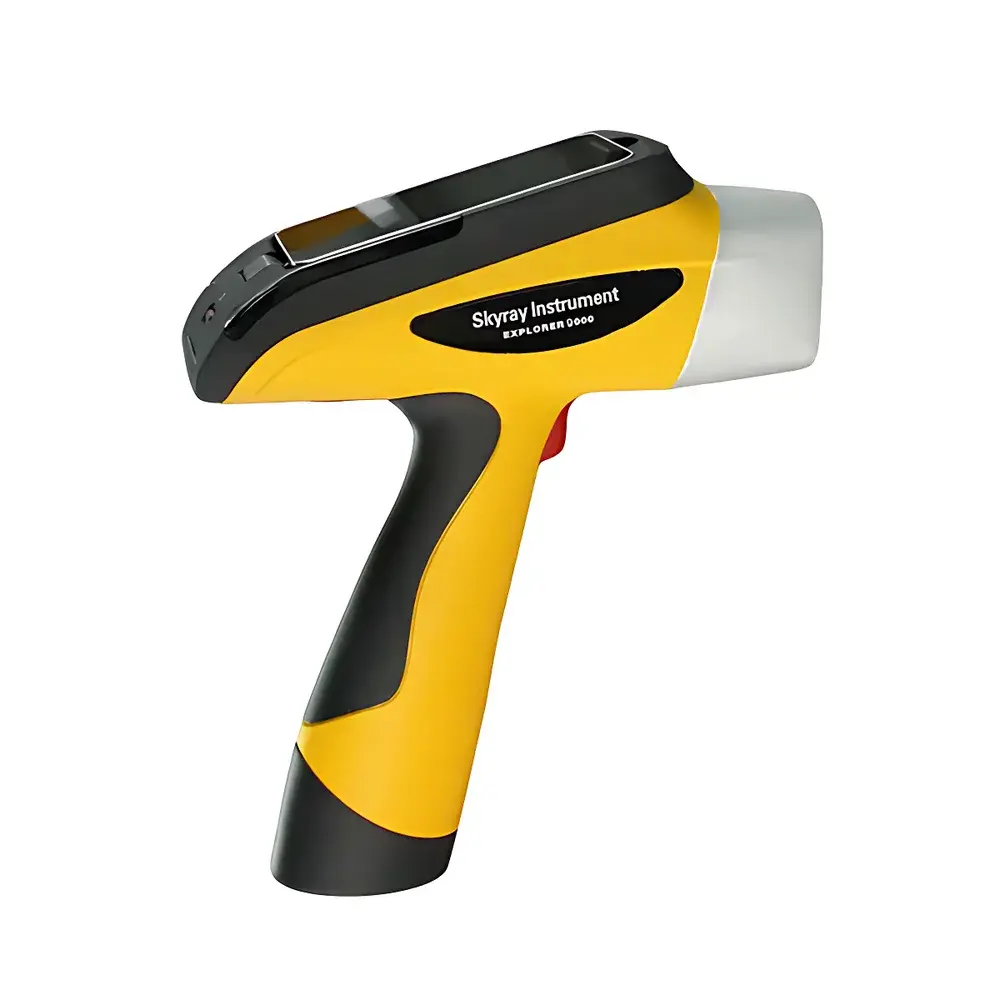
Skyray Instrument EXPLORER 9000 Portable Energy Dispersive X-Ray Fluorescence Spectrometer for Soil Heavy Metal Analysis
| Brand | Skyray Instrument |
|---|---|
| Origin | Jiangsu, China |
| Manufacturer Type | Manufacturer |
| Product Origin | Domestic (China) |
| Model | EXPLORER 9000 |
| Application | Handheld / Portable |
| Industry-Specific Use | Soil and Atmospheric Environmental Monitoring |
| Elemental Range | Mg (Z=12) to U (Z=92) |
| Concentration Range | 1 ppm to 99.99% |
| Energy Resolution | 125 eV |
| Repeatability | RSD ≤ 1% at concentrations >10× LOD |
| Detector | Silicon Drift Detector (SDD) |
Overview
The Skyray Instrument EXPLORER 9000 is a field-deployable, handheld energy dispersive X-ray fluorescence (ED-XRF) spectrometer engineered for rapid, non-destructive elemental analysis of soils in situ. It operates on the fundamental principle of X-ray fluorescence: when a primary X-ray beam from a miniature high-brightness X-ray tube excites atoms in the sample, characteristic secondary (fluorescent) X-rays are emitted. These photons are energy-resolved by a high-performance silicon drift detector (SDD), enabling quantitative and semi-quantitative determination of elemental composition without sample digestion or preparation. Designed specifically for environmental soil screening, the EXPLORER 9000 delivers laboratory-grade precision in a rugged, battery-powered platform—meeting the operational demands of regulatory field surveys, brownfield assessments, agricultural land evaluation, and emergency response scenarios.
Key Features
- High-resolution SDD detector with 125 eV energy resolution at Mn Kα, ensuring superior peak separation for overlapping transitions (e.g., As Kα/Pb Lα, Cr Kα/V Kα) in complex soil matrices.
- Optimized excitation geometry featuring ultra-short source-to-sample distance and multi-layer collimation–filter combinations (up to 12 configurable filter paths), enhancing signal-to-background ratio and minimizing matrix effects.
- 270° rotatable 5-inch high-brightness LCD touchscreen with multi-touch support, fully operable under direct sunlight and extreme ambient lighting conditions.
- IP54-rated sealed enclosure with reinforced ergonomic grip and integrated instrument holster—certified for continuous operation in dusty, humid, or rain-exposed environments.
- Integrated GPS module (GPS/GLONASS/BeiDou) with sub-meter positional accuracy, enabling georeferenced data logging and real-time mapping of contamination gradients across large survey areas.
- Dual-mode operation: handheld mode for rapid scanning (≤1 s per measurement) and benchtop cradle mode for extended counting (up to 60 s) to achieve lower detection limits in low-concentration scenarios.
- Triple safety interlock system: automatic beam shutdown upon loss of sample contact; thickened tungsten-alloy shielding around the X-ray path; removable lead-acrylic safety hood for low-Z matrix suppression.
Sample Compatibility & Compliance
The EXPLORER 9000 is validated for direct surface analysis of heterogeneous, unprepared soil samples—including clay-rich, organic, sandy, and gravelly substrates—without grinding, drying, or pelletization. Its calibration suite includes matrix-matched certified reference materials (CRMs) traceable to NIST SRM 2710a, 2711a, and GBW07401–GBW07408 series. The instrument complies with IEC 62495:2010 (safety requirements for portable XRF devices), meets EU RoHS Directive (2011/65/EU) for restricted substances, and supports audit-ready data integrity workflows aligned with EPA Method 6200 and ISO 12847:2014 (soil characterization). Optional firmware modules enable compliance with GLP/GMP documentation standards, including electronic signatures, user access control, and full 21 CFR Part 11–compliant audit trails.
Software & Data Management
The embedded analytical software features dual operational modes: User Mode for standardized soil heavy metal screening (Pb, Cd, Hg, As, Cr, Ni, Cu, Zn, Mn, Co, V) with immediate pass/fail flagging against regional regulatory thresholds (e.g., China GB 15618–2018, US EPA Region 9 TCLP limits); and Expert Mode for method development, custom curve extension, spectral deconvolution, and empirical matrix correction. All spectra and metadata—including GPS coordinates, timestamp, operator ID, and environmental parameters—are stored locally in encrypted SQLite databases and exportable as ASTM E135–22–compliant .csv or .xrf files. Onboard thermal printer support enables field-generated compliance reports with QR-coded traceability links. Data synchronization via USB-C or Wi-Fi enables seamless integration into enterprise LIMS platforms.
Applications
- Rapid soil geochemical mapping for national-scale heavy metal baseline studies and long-term monitoring programs.
- Pre-remediation site characterization and post-remediation verification per ASTM D6729 and ISO 17294–2 protocols.
- Real-time delineation of contamination plumes during spill response, supporting dynamic decision-making for containment and excavation boundaries.
- Regulatory compliance screening of agricultural topsoil, urban playgrounds, landfill cover soils, and industrial brownfield sites.
- Supporting ISO 14001 environmental management systems through automated generation of spatially referenced contamination heatmaps and trend analytics.
FAQ
Does the EXPLORER 9000 require sample preparation before analysis?
No—soil samples are analyzed directly in their natural state, eliminating acid digestion, drying, or homogenization steps.
What is the typical detection limit for lead (Pb) in dry soil matrix?
Under standard 30-s measurement conditions, the instrument achieves a practical quantification limit of ~5 ppm Pb in typical loam soils, verified using NIST SRM 2710a.
Can the instrument be calibrated for total vs. bioavailable metal fractions?
The EXPLORER 9000 measures total elemental content. For bioavailability assessment, it must be used in conjunction with sequential extraction protocols (e.g., BCR or Tessier methods) followed by separate XRF analysis of extracted fractions.
Is firmware upgrade supported remotely?
Yes—field-upgradable firmware packages are distributed via secure Skyray portal with version-controlled release notes and validation summaries.
How is data integrity maintained during extended field deployments?
All measurements include cryptographic hash signatures, tamper-evident timestamps, and write-once storage architecture. Battery-backed memory ensures zero data loss during hot-swap battery replacement.





