
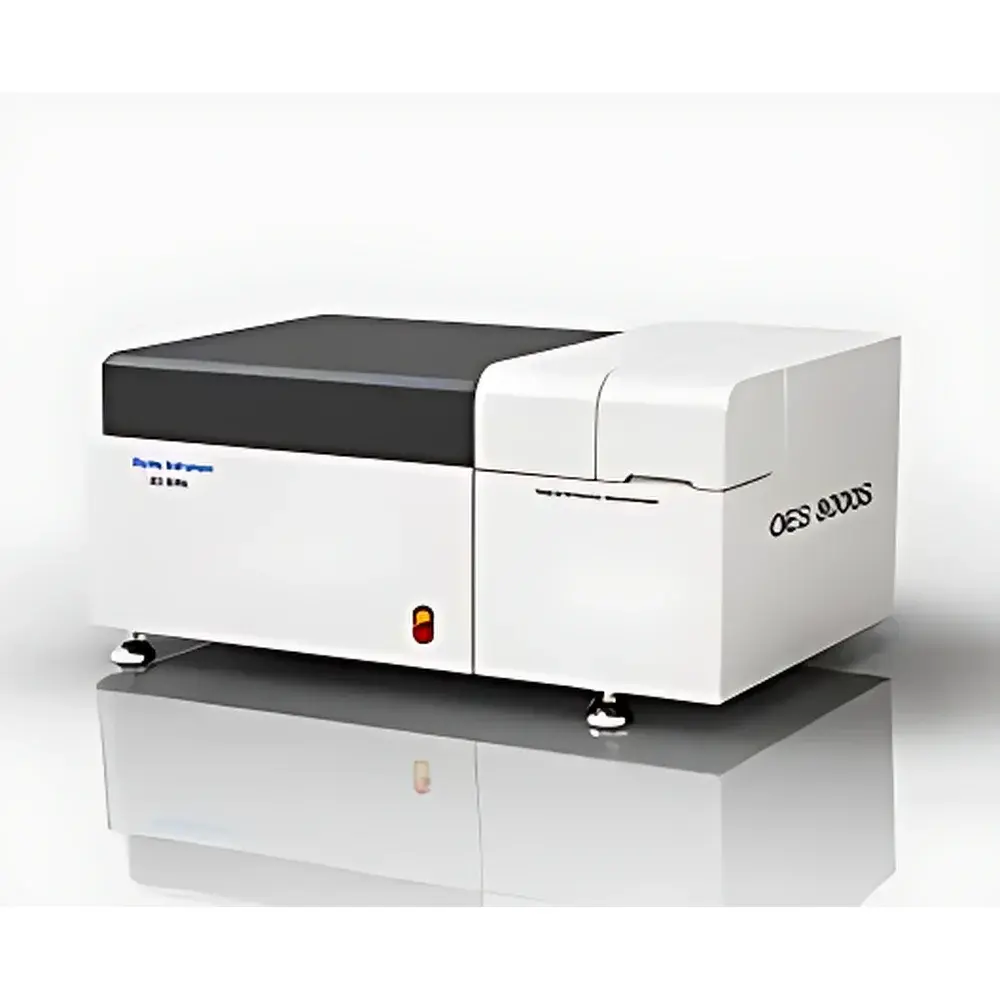
Skyray Instrument OES8000S Full-Spectrum Direct-Reading Optical Emission Spectrometer
| Brand | Skyray Instrument |
|---|---|
| Origin | Jiangsu, China |
| Manufacturer Type | Manufacturer |
| Product Category | Domestic |
| Model | OES8000S |
| Price Range | USD 28,000 – 70,000 |
| Instrument Type | Full-Spectrum Direct-Reading |
| Detection Limit | ≤0.001 wt% |
| Repeatability | ≤1.5% RSD |
| Stability | ≤1.2% RSD |
| Wavelength Range | 140–680 nm |
| Optical Resolution | 10 pm |
| Spectrometer Design | Paschen-Runge mounting with 400 mm Rowland circle diameter |
| Grating | 3600 lines/mm concave holographic grating |
| Detector | High-performance linear CMOS array |
| Excitation Source | Fully digital plasma spark source with HEPS (High-Energy Pre-Spark) technology |
| Analysis Time | <40 s per sample |
| Argon Consumption | Optimized low-flow gas system |
| Operating Temperature | 15–30 °C |
| Relative Humidity | ≤70% RH |
| Power Requirement | 220 V ±5%, 50 Hz, single-phase, ground resistance <1 Ω |
Overview
The Skyray Instrument OES8000S is a full-spectrum direct-reading optical emission spectrometer (OES) engineered for high-precision elemental analysis of metallic materials. Based on the fundamental principle of inductively coupled plasma–optical emission spectroscopy (ICP-OES) adapted to spark discharge excitation, the OES8000S utilizes controlled electrical discharge in an argon atmosphere to atomize and excite sample surfaces, generating element-specific atomic emission lines across the UV-VIS range (140–680 nm). Its core architecture features a Paschen-Runge monochromator with a 400 mm Rowland circle, enabling simultaneous detection of all spectral lines within its optical window. Unlike traditional multi-channel OES systems with fixed photomultiplier tubes, the OES8000S employs a high-sensitivity linear CMOS detector—manufactured by Hamamatsu Photonics (Japan)—to capture the entire spectrum at once, supporting flexible method development, post-acquisition reprocessing, and retrospective multi-element quantification without hardware modification.
Key Features
- Full-spectrum acquisition using a high-resolution linear CMOS detector, delivering pixel-level spectral data with 10 pm optical resolution
- Paschen-Runge optical bench with thermally stabilized 400 mm Rowland circle; temperature-controlled at 33 °C ±0.2 °C via feedback-heated chamber and thermal insulation layers
- Holographic concave grating (3600 lines/mm) supplied by Zeiss (Germany) or JY Horiba (France), ensuring consistent spectral dispersion and minimal aberration
- Digital plasma spark source with High-Energy Pre-Spark (HEPS) technology, adjustable frequency (100–1000 Hz) and current (1–80 A) for optimized excitation across diverse matrices
- Low-argon-consumption spark stand featuring 3 mm analytical gap, jet-electrode design, and precision gas flow regulation
- Compact footprint (900 × 600 × 450 mm, 120 kg) suitable for regulated laboratory environments with limited floor space
- Intermittent vacuum system reducing pump runtime to <5% of operational time, extending maintenance intervals and minimizing mechanical wear
Sample Compatibility & Compliance
The OES8000S is validated for quantitative analysis of solid metallic samples across major industrial matrices including Fe-, Al-, Cu-, Ti-, Mg-, Co-, Pb-, and Zn-based alloys. It supports standardized testing per ASTM E415, ASTM E1086, ISO 11577, ISO 6892-1 (for compositional correlation), and GB/T 4336–2016 (Chinese national standard for carbon steel and low-alloy steel). Its calibration methodology adheres to GLP principles: all factory-installed analytical programs are traceably calibrated using NIST-traceable certified reference materials (CRMs) and international standard samples (e.g., BCS, IRMM, NIST SRMs). The instrument’s software maintains full audit trails—including user actions, parameter changes, and calibration events—in compliance with FDA 21 CFR Part 11 requirements when configured with electronic signature modules.
Software & Data Management
The proprietary SkyAnalysis™ software provides intuitive workflow management from sample registration to report generation. It enables spectral library indexing, automatic peak identification, multivariate calibration modeling (including internal standardization and matrix correction algorithms), and real-time interference correction. All raw spectral data are stored in vendor-neutral HDF5 format, supporting third-party spectral processing tools. Calibration models include built-in drift compensation routines based on reference line intensity monitoring. Data export complies with LIMS-ready formats (CSV, XML, PDF) and supports direct integration into enterprise QA/QC databases via OPC UA or ODBC protocols. Routine recalibration requires only 2–3 certified standard samples per matrix—eliminating the need for extensive CRM libraries.
Applications
The OES8000S serves as a primary analytical tool in metallurgical R&D labs, foundry QC departments, scrap sorting facilities, and incoming material inspection units. Typical use cases include: rapid grade identification of stainless steels (e.g., 304 vs. 316), verification of alloying elements (Cr, Ni, Mo, V, Nb) in high-temperature superalloys, trace impurity screening (Pb, Sn, As, Sb) in aluminum die-castings, and precise control of residual elements (Cu, Ni, Cr) in recycled copper feedstocks. Its sub-40-second analysis cycle supports high-throughput production line monitoring, while its full-spectrum capability allows retrospective investigation of unexpected interferences or unanticipated elements without retesting.
FAQ
What types of samples can be analyzed on the OES8000S?
Solid conductive metallic samples only—typically disk- or puck-shaped specimens (≥20 mm diameter, ≥4 mm thickness) prepared by lathe turning or milling to ensure flat, oxide-free surfaces.
Is vacuum pumping required during routine operation?
No. The intermittent vacuum system activates only during initial purging and low-wavelength (<190 nm) measurements, reducing pump duty cycle to under 5% and enhancing long-term reliability.
How often is recalibration needed?
Under stable environmental conditions and regular use, daily standardization using one control sample is sufficient; full recalibration is recommended every 3–6 months or after major maintenance.
Does the instrument support remote diagnostics or service access?
Yes—optional secure remote connectivity enables Skyray-certified engineers to perform firmware updates, spectral diagnostics, and parameter optimization with customer authorization and encrypted session logging.
Can the OES8000S comply with ISO/IEC 17025 accreditation requirements?
Yes—when operated with documented SOPs, scheduled performance verification (using CRMs), and complete electronic records, the system meets technical requirements for ISO/IEC 17025:2017 clause 5.9 (assuring measurement traceability and uncertainty estimation).




