
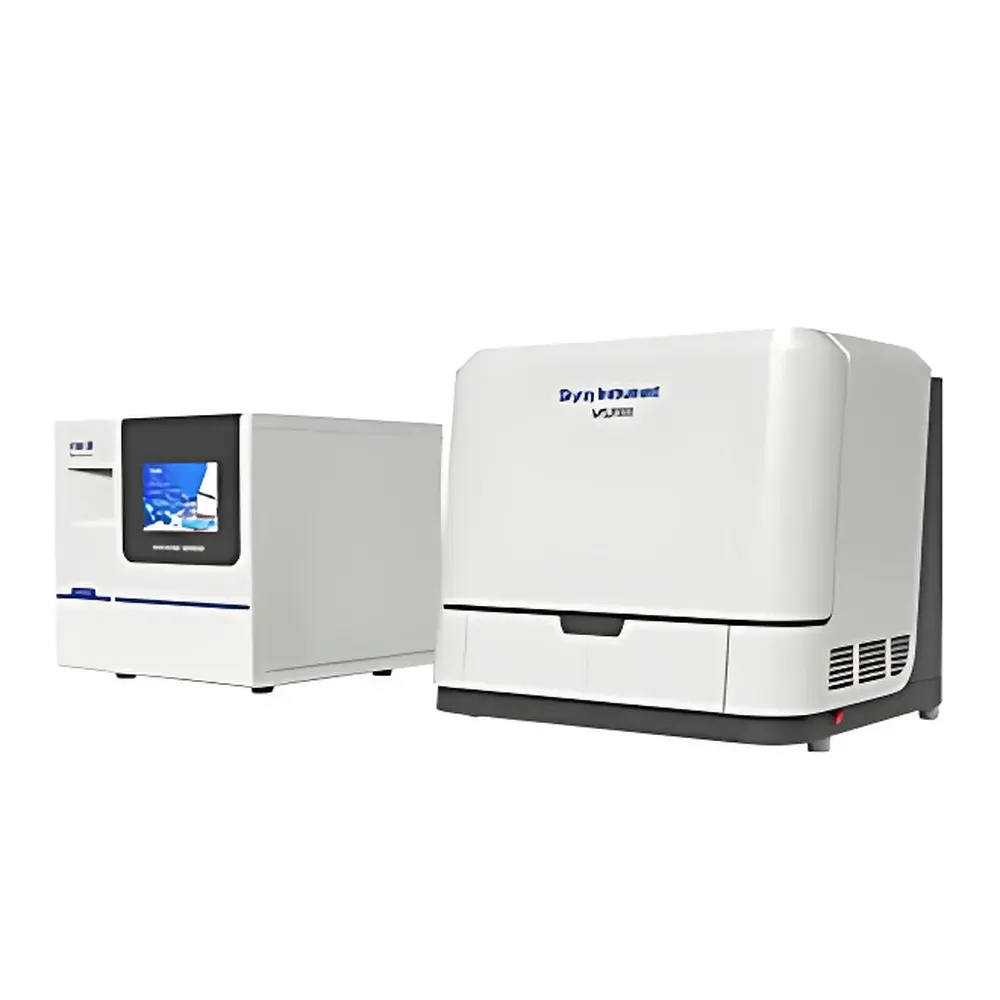
SkyRay Instrument TDM3000-MS Two-Dimensional Liquid Chromatography Mass Spectrometry System
| Brand | SkyRay Instrument |
|---|---|
| Origin | Jiangsu, China |
| Manufacturer Type | Original Equipment Manufacturer (OEM) |
| Country of Origin | China |
| Model | TDM3000-MS |
| Mass Range | m/z 10–2000 amu |
| Sensitivity | >0.4 pg (positive ion mode), >0.8 pg (negative ion mode) |
| Analyzer Type | Single Quadrupole |
| Application Domain | Therapeutic Drug Monitoring (TDM)–Specific Clinical Use |
| Sample Throughput | Up to 150 samples per day |
| Online Sample Cleanup | Integrated protein/ phospholipid/salt removal via dual-column extraction and valve-switching architecture |
| Extraction Column Lifetime | ≥2000 injections |
| Ionization Source | Electrospray Ionization (ESI) |
| Detection Mode | Quantitative and Qualitative Analysis of Small Organic Molecules in Human Serum |
Overview
The SkyRay Instrument TDM3000-MS is a purpose-built two-dimensional liquid chromatography–mass spectrometry (2D-LC-MS) system engineered specifically for therapeutic drug monitoring (TDM) in clinical laboratories. It integrates high-resolution two-dimensional liquid chromatography with a robust single quadrupole mass spectrometer to deliver trace-level quantification and structural identification of low-molecular-weight organic analytes—including endogenous biomarkers (e.g., amino acids, vitamins, steroid hormones) and exogenous therapeutic or toxic compounds (e.g., immunosuppressants, antiepileptics, antibiotics)—directly from human serum. Unlike conventional LC-UV or immunoassay platforms, the TDM3000-MS operates on the principle of selective ionization, mass filtering, and retention-time–correlated peak integration, enabling unambiguous compound identification and highly reproducible quantitation without reliance on derivatization or isotopic internal standards. Its design addresses critical gaps in clinical MS adoption: poor method standardization, insufficient traceability, high operator dependency, and inadequate automation for high-volume sample workflows.
Key Features
- Automated online sample cleanup: Integrated dual-column solid-phase extraction (SPE) with programmable valve switching removes proteins, phospholipids, and salts directly prior to MS analysis—eliminating manual precipitation, centrifugation, and evaporation steps.
- Phospholipid depletion optimization: Proprietary SPE chemistry reduces matrix-induced ion suppression in ESI source by >90%, achieving near-100% analyte recovery and enabling external calibration with minimal inter-batch variability.
- High-throughput capability: Robotic autosampler with 4°C temperature control supports up to 150 serum samples per 24-hour cycle; extraction columns rated for ≥2000 injections ensure long-term operational consistency.
- Stable ESI source architecture: Temperature- and flow-stabilized electrospray interface maintains ion signal stability across extended run times (>72 h continuous operation), minimizing recalibration frequency.
- Single-quadrupole mass analyzer: Delivers unit-mass resolution (FWHM ≤ 0.7 Da) over m/z 10–2000, optimized for selected ion monitoring (SIM) and full-scan acquisition in both positive and negative ion modes.
- Third-generation precision LC modules: Dual-gradient pumps with servo-controlled stepper-motor-driven syringe actuators provide sub-microliter flow accuracy and <0.2% RSD retention time repeatability across multi-day sequences.
Sample Compatibility & Compliance
The TDM3000-MS is validated for direct analysis of deproteinized human serum, plasma, and whole blood extracts. It complies with ISO/IEC 17025:2017 requirements for testing laboratory competence and supports alignment with CLIA, CAP, and ISO 15189–accredited clinical workflows. All hardware and software components meet electromagnetic compatibility (EMC) standards IEC 61326-1 and safety standard IEC 61010-1. The system’s analytical performance adheres to FDA Bioanalytical Method Validation Guidance (2018) for selectivity, linearity (1 ppb–10 ppm), LLOQ (≤0.5 pg on column), precision (<8% CV), and accuracy (85–115%). Full audit trail functionality satisfies 21 CFR Part 11 requirements for electronic records and signatures.
Software & Data Management
The proprietary SkyRay LC-MS Control Suite features a fully localized English/Chinese bilingual interface with role-based access control (RBAC), timestamped audit logs, and immutable electronic signatures. It enables seamless integration with hospital information systems (HIS) and laboratory information systems (LIS) via HL7 v2.5 and ASTM E1384 interfaces. Method files encapsulate instrument parameters, calibration curves, integration rules, and report templates—ensuring method portability and version-controlled deployment. Data archiving follows DICOM-MS and mzML 1.1 open formats; raw data, processed chromatograms, and quantitative reports are stored in encrypted SQLite databases with automated backup scheduling. The software supports GLP-compliant batch processing, cross-run peak comparison, and customizable QC flagging based on predefined acceptance criteria.
Applications
- Therapeutic drug monitoring of calcineurin inhibitors (tacrolimus, cyclosporine), mTOR inhibitors (sirolimus), antimetabolites (mycophenolic acid), and anticonvulsants (valproic acid, lamotrigine).
- Endogenous metabolite profiling for inborn errors of metabolism (e.g., aminoacidopathies, organic acidemias) using dried blood spot or serum matrices.
- Quantitative assessment of vitamin D metabolites (25-OH-D2/D3), cortisol, testosterone, and thyroid hormones in endocrine diagnostics.
- Support for clinical trial bioanalysis where regulatory-grade documentation, traceability, and method transferability are mandatory.
- Method development and validation support for ISO 17025-accredited reference laboratories performing metrological traceability to NIST SRMs.
FAQ
Is the TDM3000-MS compliant with 21 CFR Part 11 for regulated clinical environments?
Yes—the system includes full electronic signature capability, user authentication, audit trail generation, and secure data storage aligned with FDA requirements for electronic records.
Can the instrument perform simultaneous quantification of multiple analytes in a single run?
Yes—using SIM mode with dwell times optimized per transition, the system routinely quantifies up to 24 analytes in one 12-minute gradient without compromising sensitivity or precision.
What is the expected lifetime of the online extraction column under routine clinical use?
Under typical TDM workflow conditions (100–120 samples/week), the extraction column demonstrates stable performance for ≥2000 injections, corresponding to ≥18 months of service life.
Does the system require isotopic internal standards for accurate quantitation?
No—due to minimized matrix effects and high ESI source stability, external calibration with non-isotopic standards achieves <5% bias and <6% CV across five independent validation runs.
How does the TDM3000-MS compare to immunoassay methods such as FPIA or EMIT?
It offers superior specificity: no cross-reactivity with structurally similar metabolites or conjugates, eliminating false positives common in antibody-based assays—particularly critical for drugs with active metabolites (e.g., carbamazepine-10,11-epoxide).
Related Products






