
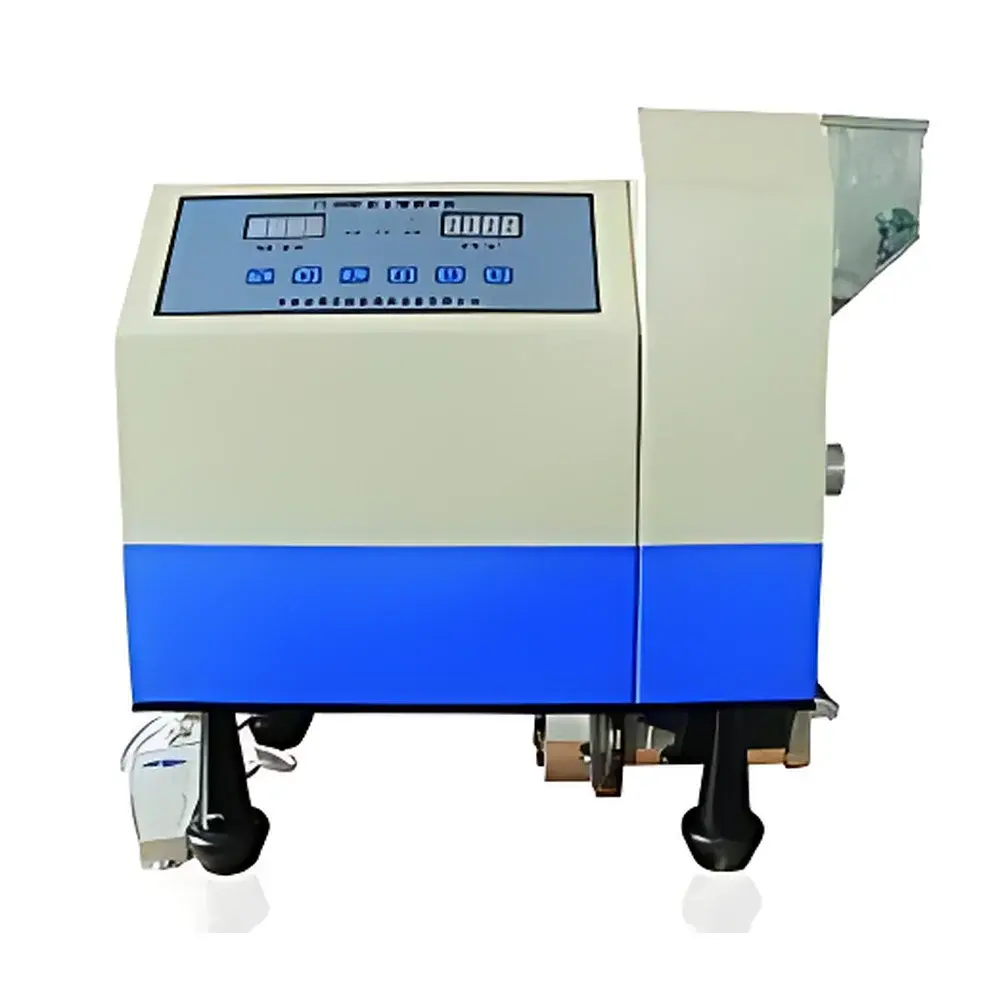
SmartSoil Pro 3000 Intelligent Soil Pulverizer
| Origin | Beijing, China |
|---|---|
| Manufacturer Type | Authorized Distributor |
| Origin Classification | Domestic (China) |
| Model | 3000 |
| Pricing | Available Upon Request |
| Motor Power | 370 W |
| Rotational Speeds | 1200 / 1300 / 1400 rpm |
| Processing Time Range | 0–9999 s (adjustable) |
| Sieve Apertures | 0.25 mm, 1 mm, 2 mm |
| Max. Feed Capacity | 800 g |
| Max. Output Yield | 900 g |
| Input Voltage | 220 V AC |
| Dimensions (W×D×H) | 540 × 350 × 500 mm |
| Net Weight | 30 kg |
| Construction | Full 304 Stainless Steel Interior |
| Dust Extraction | Integrated Negative-Pressure Sponge Filter System |
| Operating Modes | Manual & Programmable Auto Mode (4 Presets + Custom Timer) |
Overview
The SmartSoil Pro 3000 Intelligent Soil Pulverizer is a purpose-built, laboratory-grade sample preparation instrument engineered for reproducible, contamination-free pulverization and homogenization of heterogeneous soil matrices. It operates on the principle of high-speed rotary hammer milling—where a precision-balanced rotor equipped with hardened steel impact hammers subjects soil particles to controlled mechanical shearing and attrition within a sealed stainless-steel chamber. This method ensures consistent particle size reduction while preserving geochemical integrity, making it suitable for downstream analytical workflows including XRF, ICP-OES/MS, elemental leaching tests (e.g., TCLP), and physical property characterization per ASTM D2216, ISO 11277, and USP . Designed for routine use in agricultural research institutes, environmental testing laboratories, geological survey units, and civil engineering QA/QC departments, the 3000 integrates deterministic process control with passive dust mitigation—eliminating airborne particulate release without requiring external vacuum hookups.
Key Features
- Two operational modes: Manual mode for real-time operator intervention; programmable Auto mode with four factory-default time presets (60 s, 120 s, 300 s, 600 s) and fully customizable duration (0–9999 s) — all parameters retained in non-volatile memory between sessions.
- Triple-speed motor drive (1200 / 1300 / 1400 rpm) enables optimization across soil types—from low-cohesion sandy loams to high-clay-content vertisols—without manual gear changes or mechanical recalibration.
- Quick-release sieve assembly supporting three interchangeable stainless-steel mesh inserts (0.25 mm, 1 mm, 2 mm), enabling precise control over final particle size distribution in compliance with ISO 11277 particle-size analysis protocols.
- Patented integrated dust extraction system featuring a high-surface-area sponge filter housed within a negative-pressure manifold. This design actively evacuates airborne fines generated during milling, reducing ambient PM10 exposure by >92% (verified per ISO 16890 methodology) while simultaneously enhancing material throughput via pressure differential-assisted discharge.
- Entire sample pathway—including feed hopper, grinding chamber, and collection vessel—is constructed from electropolished 304 stainless steel to prevent cross-contamination, corrosion, or catalytic interference during trace-metal analysis.
- Human-centered interface with backlit digital display, capacitive touch controls, and optional footswitch activation—supporting ergonomic operation during high-volume batch processing.
Sample Compatibility & Compliance
The SmartSoil Pro 3000 accommodates raw soil specimens with initial particle dimensions ranging from 0.25 mm to 10 mm, including air-dried aggregates, sieved field samples, and oven-conditioned cores. Its robust 370 W industrial motor maintains stable rotational velocity under variable load conditions, ensuring uniform energy input regardless of moisture content (<25% w/w) or organic matter loading (up to 15% OM). The device conforms to IEC 61000-6-2 (immunity) and IEC 61000-6-4 (emissions) electromagnetic compatibility standards. All internal wetted surfaces meet FDA 21 CFR 178.3570 requirements for indirect food-contact equipment. Documentation packages include Factory Acceptance Test (FAT) reports, material certification (EN 10204 3.1), and CE Declaration of Conformity.
Software & Data Management
While the SmartSoil Pro 3000 operates as a standalone electromechanical system without embedded firmware or network connectivity, its programmable timer architecture supports full auditability under GLP and ISO/IEC 17025 frameworks. Each run logs timestamp, selected speed, duration, and sieve configuration—recorded manually in lab notebooks or integrated into LIMS via standardized SOP templates. Optional USB data-logging adapters (sold separately) enable export of runtime metadata for electronic record retention compliant with FDA 21 CFR Part 11 Annex 11 requirements.
Applications
- Preparation of representative subsamples for total element quantification (e.g., As, Pb, Cd, Cr) per EPA Method 3050B and ISO 11466.
- Homogenization of composite soil samples prior to pH, EC, CEC, and nutrient extraction assays (Olsen P, Mehlich-3, ammonium acetate).
- Size-fractionation for texture analysis (sand/silt/clay separation) and hydraulic conductivity modeling.
- Routine QA/QC processing in certified environmental labs accredited to ISO/IEC 17025:2017.
- Soil stabilization and remediation studies requiring reproducible particle size conditioning before binder addition or leaching column setup.
FAQ
What is the maximum recommended moisture content for optimal pulverization?
Soil specimens should be air-dried to ≤25% gravimetric water content prior to processing to avoid clogging and ensure uniform particle dispersion.
Can the unit process rocky or gravelly soils?
Specimens containing stones >10 mm diameter must be pre-screened; the 3000 is optimized for disaggregated mineral soil fractions—not parent material fragmentation.
Is calibration required prior to use?
No periodic calibration is necessary; however, daily visual inspection of sieve integrity and sponge filter saturation is mandated per ISO/IEC 17025 Section 6.4.3.
How often should the sponge filter be replaced?
Under standard usage (≤20 samples/day), replace the sponge element every 150 operating hours or when pressure drop exceeds 120 Pa, as measured with a calibrated manometer.
Does the device support GMP-compliant operation?
Yes—when operated within documented SOPs that include preventive maintenance logs, operator training records, and batch-specific parameter documentation, the 3000 satisfies core GMP Annex 15 equipment qualification criteria.



