
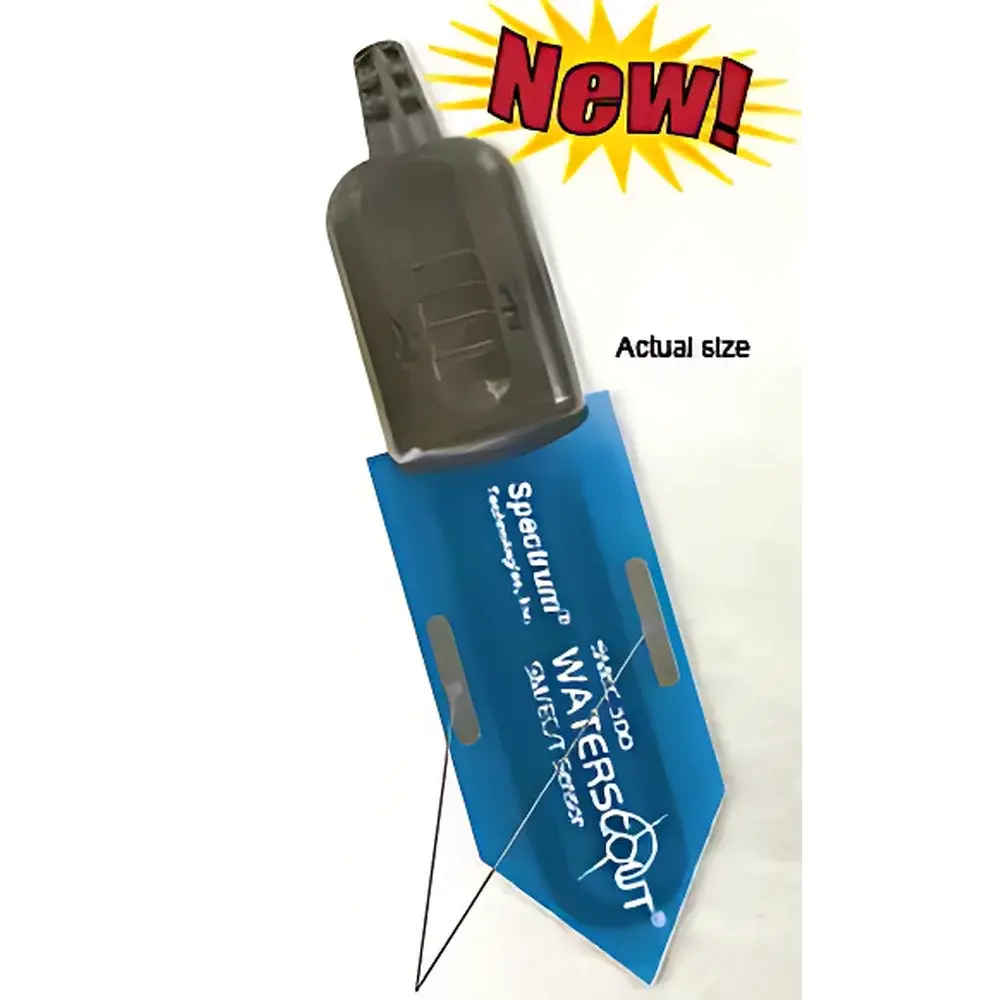
SMEC SMEC300 Tri-Parameter Soil Moisture, Temperature & EC Sensor
| Origin | USA |
|---|---|
| Manufacturer Type | Authorized Distributor |
| Origin Category | Imported |
| Model | SMEC300 |
| Instrument Type | Soil Moisture / Water Potential Analyzer |
| Interface Compatibility | WatchDog Weather Stations, FieldScout TDR Handheld Meters |
| Measurement Range | Volumetric Water Content (VWC): 0–saturation (% vol) |
| Electrical Conductivity (EC) | 0–10 mS/cm |
| Temperature | 0–50°C (32–122°F) |
| Resolution | VWC: 0.1% vol |
| EC | 0.01 mS/cm |
| Temp | 0.1°C (0.18°F) |
| Accuracy | VWC: ±3% vol (typical, in mineral soils) |
| EC | ±2% of reading |
| Temp | ±0.45°C (±0.8°F) |
| Sensing Volume | 5.72 cm × 1.91 cm cylindrical zone |
| Cable Options | Standard 1.8 m and 6.1 m |
| Power Requirement | 3 V DC, 6–10 mA |
| Output Signal | Analog voltage (0–2.5 V or 0–5 V configurable), time-division multiplexed for multi-sensor networks |
Overview
The SMEC SMEC300 Tri-Parameter Soil Moisture, Temperature & EC Sensor is an engineered field-deployable probe designed for simultaneous, in situ measurement of volumetric water content (VWC), bulk electrical conductivity (EC), and soil temperature. It operates on well-established physical principles: dielectric permittivity sensing at 80 MHz for VWC determination—leveraging the stark contrast between the dielectric constant of water (~80) and dry soil matrix (~3–5); two-electrode carbon ink-based conductance measurement for bulk EC, calibrated to reflect soluble salt concentration in the soil solution phase; and integrated thermistor-based temperature compensation within the sensor body to ensure thermal stability and cross-parameter correction. Unlike single-parameter probes, the SMEC300 delivers co-located, time-synchronized tri-variate data—critical for interpreting salinity stress thresholds, irrigation efficiency, solute transport dynamics, and root-zone microclimate conditions. Its robust stainless-steel housing and tapered tip enable repeatable insertion across diverse soil textures—from sandy loam to clay-rich profiles—without compromising structural integrity or measurement fidelity.
Key Features
- Triple-parameter co-location: Simultaneous acquisition of VWC, bulk EC, and temperature from a single physical footprint minimizes spatial aliasing and improves data correlation reliability.
- High-frequency capacitance sensing (80 MHz): Enables low-sensitivity to soil texture and density variations, delivering improved repeatability across heterogeneous field sites compared to lower-frequency TDR or FDR systems.
- Carbon ink electrode pair: Chemically stable, corrosion-resistant electrodes optimized for long-term deployment in saline or organic-rich soils without polarization drift.
- Tapered stainless-steel probe tip: Facilitates minimal-disturbance insertion into undisturbed soil profiles, reducing compaction artifacts and enabling precise depth-specific monitoring (e.g., at 10 cm, 20 cm, or 30 cm root zones).
- Modular analog output architecture: Provides 0–2.5 V or 0–5 V analog signals compatible with industry-standard dataloggers—including Campbell Scientific CR series, Onset HOBO, and Spectrum Technologies FieldScout platforms—as well as WatchDog weather station ecosystems.
- Low-power operation (6–10 mA @ 3 V DC): Supports extended battery life in remote, solar-powered monitoring networks; cable extension up to 15 m preserves flexibility in sensor placement without signal degradation.
Sample Compatibility & Compliance
The SMEC300 is validated for use in mineral soils, potting media, greenhouse substrates, turfgrass profiles, and agricultural topsoil layers. It is not intended for saturated peat, highly organic muck soils (>30% OM), or frozen ground conditions. While not certified to ISO 11277 or ASTM D5859 (which pertain to laboratory-based gravimetric and extract-based EC methods), its field-measured bulk EC correlates strongly with 1:5 soil:water extract EC under controlled calibration protocols. The sensor meets CE marking requirements for electromagnetic compatibility (EN 61326-1) and carries RoHS-compliant construction. For regulatory reporting contexts—such as USDA NRCS irrigation scheduling or EPA Region 9 agricultural runoff assessments—the SMEC300 supports GLP-aligned data collection when paired with audit-trail-capable dataloggers (e.g., those compliant with FDA 21 CFR Part 11 metadata logging).
Software & Data Management
Raw analog outputs are digitized and logged via external data acquisition systems. When integrated with Onset HOBOware Pro, Campbell LoggerNet, or Spectrum’s FieldScout Mobile App, users gain access to automated unit conversion (e.g., EC → pore-water salinity estimates using Rhoades or Hilhorst models), temperature-compensated EC normalization (to 25°C), and time-series visualization tools. Export formats include CSV, Excel, and XML—enabling direct ingestion into agronomic decision-support platforms (e.g., CropX, Granular, or FarmLogs). All timestamped readings retain embedded sensor ID and calibration coefficients, supporting traceability per ISO/IEC 17025 documentation workflows.
Applications
- Irrigation scheduling optimization in precision agriculture and viticulture, where real-time VWC–EC–Temp triads inform deficit irrigation thresholds and leaching fraction calculations.
- Salinity monitoring in coastal farmland, reclaimed soils, or drip-irrigated orchards to detect early-stage sodicity buildup before visible phytotoxicity occurs.
- Greenhouse substrate management, particularly in hydroponic and container-grown ornamental production, where rapid EC shifts indicate nutrient lockout or pH drift.
- Ecological restoration projects tracking rhizosphere moisture–salinity gradients during native species establishment on disturbed or saline sites.
- Academic research in soil physics and biogeochemistry requiring synchronized, high-temporal-resolution soil state variables for model validation (e.g., HYDRUS-1D, SWAP).
FAQ
Does the SMEC300 require soil-specific calibration?
Yes—while factory-calibrated for mineral soils, optimal accuracy requires site-specific VWC calibration using gravimetric sampling at representative depths. Bulk EC does not require calibration but benefits from periodic verification against 1:5 extract EC.
Can multiple SMEC300 sensors share one datalogger channel?
Yes—via time-division multiplexing (TDM) using compatible multiplexers (e.g., AM16/32B). Each sensor’s analog output is gated sequentially, preserving individual identity and timing resolution.
Is temperature measurement used for automatic EC compensation?
Yes—the internal thermistor provides real-time temperature input to the datalogger, enabling automatic EC normalization to 25°C using the standard 2%/°C coefficient.
What is the recommended minimum distance between adjacent SMEC300 probes?
A minimum lateral separation of 20 cm is advised to avoid electromagnetic crosstalk and ensure independent sensing volumes, especially in high-EC soils.
How often should the carbon electrodes be cleaned during long-term deployment?
Inspection and gentle wiping with isopropyl alcohol are recommended every 3–6 months in high-salinity environments; no abrasive cleaning is permitted to preserve electrode integrity.
Related Products







