
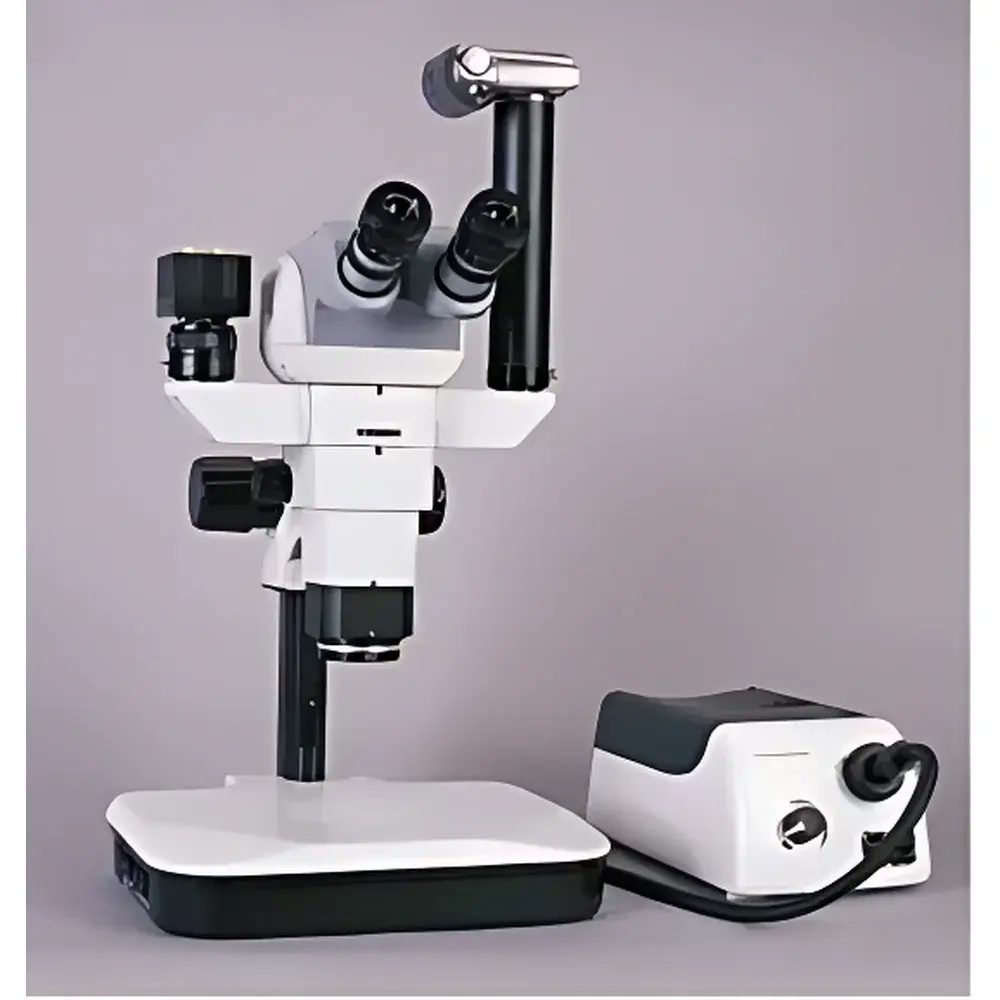
SMP-POL Continuous Zoom Stereo Microscope
| Origin | Beijing, China |
|---|---|
| Manufacturer Type | Authorized Distributor |
| Origin Category | Domestic (PRC) |
| Model | SMP-POL |
| Price | USD 3,050 (FOB Beijing) |
| Optical System | Parallel-Beam Zoom Architecture |
| Zoom Ratio | 1:6.6 (0.68× – 4.5× objective magnification) |
| Eyepieces | Widefield High-Eye-Point WFH10×/22 mm |
| Working Distance | 92 mm (max. 333 mm) |
| Field of View | 4.8 mm – 33 mm (max. 118 mm diameter) |
| Focus Travel | 45 mm |
| Interpupillary Adjustment | 52–80 mm |
| Diopter Compensation | ±6 D |
| Viewing Angle Adjustment | 0°–30° continuous tilt |
| Total Magnification Range | 2.1× – 281× (with optional auxiliary lenses and eyepiece combinations) |
Overview
The SMP-POL Continuous Zoom Stereo Microscope is an ergonomically engineered optical instrument designed for high-fidelity stereoscopic observation across industrial quality control, life science research, forensic documentation, and precision manufacturing environments. It implements a parallel-beam (Galilean-type) zoom optical architecture with a shared-objective, non-coaxial imaging path—distinct from traditional Greenough-style stereo systems—to deliver uniform edge-to-edge resolution, minimal geometric distortion, and exceptional depth perception across the entire magnification range. This design eliminates parallax-induced image shift during zooming and ensures consistent color fidelity and contrast without chromatic aberration. The system supports both binocular (SMP-POL) and trinocular (SMG-POL-TR) configurations, enabling simultaneous visual inspection and digital imaging without mechanical beam-splitter switching—a critical advantage for time-sensitive documentation workflows in GLP-compliant labs and ISO 17025-accredited testing facilities.
Key Features
- Continuous zoom optics with 1:6.6 magnification ratio (0.68×–4.5× at objective level), enabling seamless transition between macro and meso-scale observation without discrete steps or lens swapping.
- Widefield high-eye-point WFH10×/22 mm eyepieces provide extended eye relief (≥22 mm), reducing ocular fatigue during prolonged use—particularly beneficial for users wearing corrective eyewear.
- Adjustable viewing head (0°–30° tilt) accommodates diverse operator anthropometrics and workstation configurations, supporting ergonomic compliance per ISO 9241-5 and ANSI/HFES 100 standards.
- Extended working distance (92 mm standard; up to 333 mm with optional long-working-distance objectives) facilitates integration with manipulators, soldering stations, and sample-stage automation systems.
- Integrated diopter compensation (±6 D per eyepiece) allows individualized focus calibration for binocular disparity correction—essential for sustained visual accuracy in QC and pathology applications.
- Robust modular housing constructed from die-cast aluminum alloy ensures thermal stability and vibration damping, minimizing drift during high-magnification imaging or micro-manipulation tasks.
Sample Compatibility & Compliance
The SMP-POL accommodates opaque, translucent, and semi-reflective specimens—including PCB assemblies, metallurgical cross-sections, botanical tissues, forensic trace evidence, and live small-model organisms—without requiring specialized preparation. Its incident and transmitted illumination compatibility (via optional LED base or ring light modules) supports Köhler illumination alignment per ISO 10934-1. The optical train meets ISO 8578:2022 requirements for stereo microscope performance verification, including MTF measurement protocols at multiple spatial frequencies. All mechanical adjustments conform to ISO 10110-7 surface quality specifications for optical components. The system is suitable for use in environments governed by FDA 21 CFR Part 11 (when paired with validated digital imaging software), EU Annex 11, and ISO/IEC 17025 documentation traceability frameworks.
Software & Data Management
When coupled with optional trinocular port and USB 3.0 CMOS camera modules (e.g., 5 MP or 12 MP resolution), the SMP-POL integrates with industry-standard imaging platforms—including Olympus cellSens, Zeiss ZEN Blue, and open-source Fiji/ImageJ—supporting TIFF, RAW, and multi-layered OME-TIFF export. Calibration routines embedded in compatible software enable pixel-to-micron scaling traceable to NIST-traceable stage micrometers. Audit trail functionality (user login, timestamped acquisition metadata, parameter lockout) satisfies GLP audit requirements. Exported datasets retain EXIF-compatible headers compliant with DICOM Supplement 145 for digital pathology archiving.
Applications
- Electronics inspection: Solder joint integrity assessment, component placement verification, and counterfeit IC detection under variable magnification and oblique lighting.
- Materials science: Grain structure analysis, fracture surface characterization, and coating thickness estimation via depth-of-field stacking.
- Forensic science: Toolmark comparison, fiber morphology documentation, and latent print enhancement using polarized or dark-field illumination add-ons.
- Biological education & research: Dissection guidance, embryonic development staging, and invertebrate morphology studies with minimal specimen handling stress.
- Medical device QA: Visual verification of laser-weld seam continuity, catheter tip geometry, and polymer film uniformity per ISO 13485 clause 7.5.1.
FAQ
What is the maximum total magnification achievable with the SMP-POL system?
With standard WFH10× eyepieces and the built-in 0.68×–4.5× zoom objective, total magnification ranges from 2.1× to 281× when combined with optional 2× auxiliary lenses and 15× widefield eyepieces.
Is the SMP-POL compatible with third-party digital cameras?
Yes—the trinocular version (SMG-POL-TR) features a standardized C-mount interface and adjustable beam-splitting ratio (0:100 / 50:50 / 100:0), enabling direct coupling to scientific CMOS, sCMOS, or CCD sensors without vignetting.
Does the microscope support polarization contrast?
The “POL” designation indicates factory-installed polarizing filters in both illumination and analyzer paths, optimized for birefringence visualization in polymers, crystals, and biological anisotropic tissues.
Can the focus mechanism be motorized for automated Z-stacking?
While the base model uses manual coaxial coarse/fine focusing, OEM-compatible stepper-motor focus drives (with encoder feedback) are available as field-upgrade kits, supporting programmable step sizes down to 0.5 µm.
What calibration documentation is provided?
Each unit ships with a factory-issued Certificate of Conformance (CoC) referencing ISO/IEC 17025-accredited calibration of zoom linearity, magnification accuracy, and working distance tolerance—traceable to national metrology institutes.




