
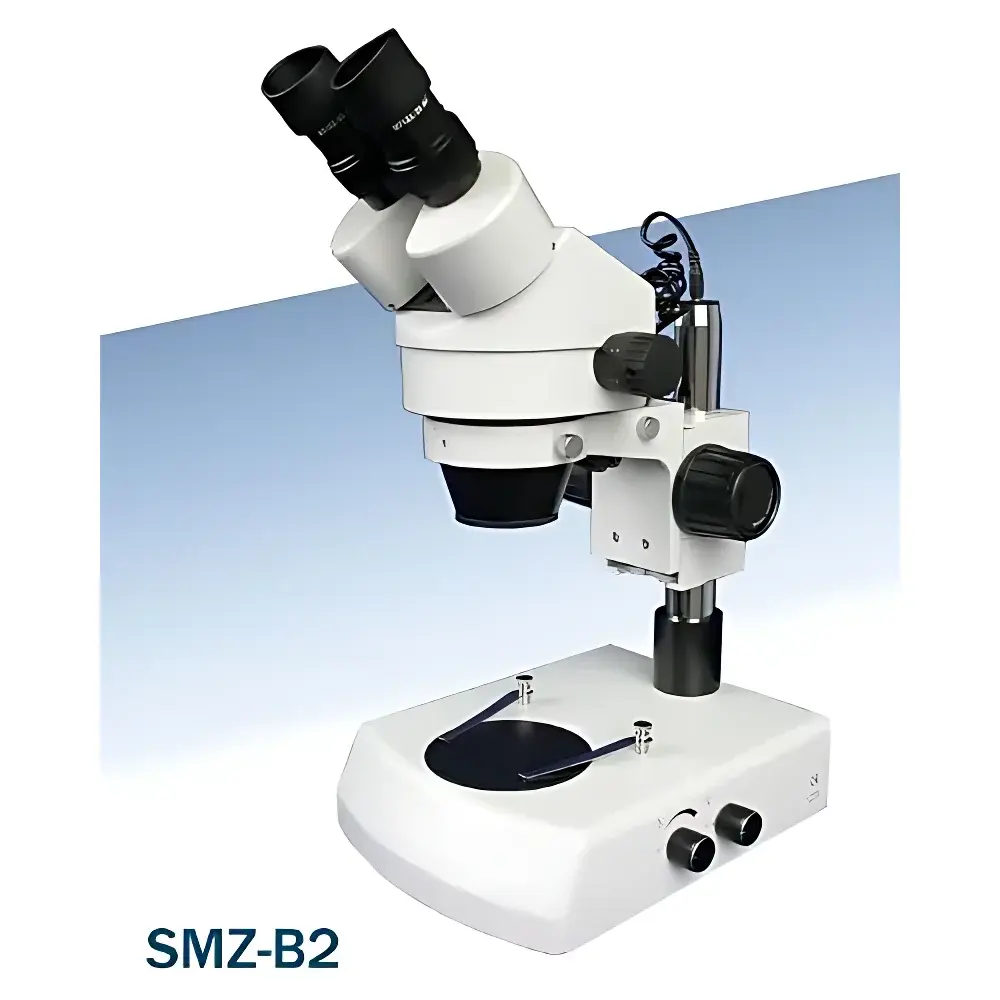
SMZ-B2 Stereo Microscope (Dissecting Microscope)
| Origin | Jiangsu, China |
|---|---|
| Manufacturer Type | Distributor |
| Origin Category | Domestic |
| Model | SMZ-B2 |
| Price | USD 395 (FOB) |
| Magnification Range | 2.1×–225× (with auxiliary lenses & eyepieces) |
| Zoom Ratio | 1:6.5 (0.7×–4.5× objective zoom) |
| Working Distance | 36 mm – 316 mm |
| Eyepieces | WF10×/20 mm, WF10×/22 mm, WF15×, WF20×, WF25×, 10× reticle |
| Auxiliary Objectives | 0.3×, 0.5×, 0.75×, 1.5×, 2× |
| C-Mount Adapters | 0.35×, 0.5×, 1× |
| Camera Interfaces | Nikon F-mount, Olympus OM-mount, Pentax PK, Minolta MD, Canon FD (via adapter) |
| Digital Imaging Options | DV130 (1.3 MP), DV200 (2.0 MP) USB cameras |
| Illumination | 12 V / 15 W adjustable halogen epi-illuminator with reflector bowl |
| Trinocular Port | 20% / 80% beam splitter, simultaneous visual and imaging output |
| Interpupillary Adjustment | 54–76 mm |
| Diopter Compensation | ±5 D |
| Head Inclination | 45°, rotatable 360° |
| Power Supply | 220 V AC, 50 Hz |
Overview
The SMZ-B2 Stereo Microscope is a high-performance, continuously variable zoom dissecting microscope engineered for precision observation in life science, industrial quality control, and forensic analysis. Based on the Galilean optical design, it delivers true stereoscopic vision through dual optical paths with independent focus and parallax-corrected optics—enabling accurate depth perception and spatial orientation during manipulation or inspection tasks. Its 1:6.5 zoom ratio (0.7×–4.5× objective magnification) provides seamless magnification continuity across a total usable range of 2.1×–225× when combined with standard WF10× eyepieces and auxiliary objectives. The long working distance—spanning 36 mm at highest magnification to 316 mm at lowest—accommodates bulky specimens, micro-manipulators, and integrated lighting configurations without interference. Designed for ergonomic operation, the 45° inclined, 360° rotatable observation head supports extended use in laboratory and production environments while maintaining operator comfort and posture integrity.
Key Features
- Continuous zoom optics with 1:6.5 magnification ratio and parfocal, apochromatic correction for consistent image fidelity across the entire zoom range
- Trinocular port with fixed 20%/80% beam splitting for simultaneous real-time observation and high-fidelity digital imaging
- Modular optical interface system supporting C-mount adapters (0.35×, 0.5×, 1×) and native lens mounts (Nikon F, Olympus OM, Pentax PK, Minolta MD) for seamless integration with scientific-grade CCD, CMOS, and DSLR imaging platforms
- High-eye-point wide-field eyepieces (WF10×/20 mm, WF10×/22 mm, WF15×, WF20×, WF25×, and 10× reticle) optimized for users wearing corrective eyewear
- Adjustable interpupillary distance (54–76 mm) and ±5 diopter compensation per ocular for personalized binocular alignment
- Dual-illumination architecture: integrated 12 V / 15 W halogen epi-illuminator with reflector bowl and intensity control; optional transmitted illumination modules including adjustable halogen, U-shaped fluorescent, and cold-light LED sources
- Expandable mechanical platform: compatible with custom stands—including articulated arms, vertical posts, boom stands, and vibration-damped bases—for application-specific specimen positioning
Sample Compatibility & Compliance
The SMZ-B2 accommodates a broad spectrum of opaque, translucent, and low-contrast specimens without requiring sectioning or coating—including electronic PCBs, solder joints, botanical samples, entomological specimens, forensic trace evidence, pharmaceutical tablets, and metallurgical fracture surfaces. Its large depth of field and extended working distance permit hands-on manipulation under observation—critical for micro-surgery simulation, micro-assembly, and failure analysis. While not certified to ISO 13528 or ASTM E2917 for metrological traceability, the instrument’s optical calibration stability meets routine QC requirements in GLP-aligned laboratories. Optional accessories—including calibrated stage micrometers and NIST-traceable reference standards—support internal verification protocols compliant with ISO/IEC 17025 documentation frameworks.
Software & Data Management
The microscope interfaces natively with industry-standard imaging software suites (e.g., ToupView, Ocular, MicroPublisher, and ImageJ-compatible drivers) via USB 2.0 connections from supported DV130 (1.3 MP) and DV200 (2.0 MP) digital cameras. All bundled drivers support TIFF, BMP, JPEG, and RAW formats with embedded metadata (magnification, exposure time, lens configuration). For regulated environments, optional audit-trail-enabled acquisition modules comply with FDA 21 CFR Part 11 requirements—recording user ID, timestamp, parameter changes, and image hash values to ensure data integrity and reproducibility. Exported datasets integrate directly into LIMS and ELN platforms via CSV or DICOM-compliant metadata wrappers.
Applications
- Microelectronics: SMT component inspection, solder joint evaluation, PCB trace continuity verification, and wafer-level defect mapping
- Life Sciences: Dissection of model organisms (Drosophila, zebrafish embryos), histological tissue grossing, pollen morphology studies, and mycological spore analysis
- Forensics: Hair/fiber comparison, toolmark documentation, gunshot residue distribution analysis, and document examination (ink differentiation, erasure detection)
- Materials Science: Coating uniformity assessment, corrosion pattern characterization, composite laminate delamination inspection, and additive manufacturing layer fidelity verification
- Pharmaceutical QA: Tablet coating thickness estimation, capsule shell integrity checks, granule size distribution screening, and excipient homogeneity validation
- Education & Training: Modular dissection labs, STEM microscopy curricula, and technician certification programs requiring standardized optical performance metrics
FAQ
What is the maximum total magnification achievable with the SMZ-B2?
With the standard WF10× eyepieces and 2× auxiliary objective, the system achieves up to 225× magnification. Higher magnifications are possible using optional WF25× eyepieces—but resolution is constrained by optical diffraction limits and practical depth-of-field trade-offs.
Is the SMZ-B2 compatible with modern machine vision software?
Yes—its C-mount interface and USB digital camera outputs support GenICam-compliant SDKs and third-party libraries (OpenCV, HALCON, NI Vision) for automated measurement, feature recognition, and batch image processing pipelines.
Can the SMZ-B2 be used for photomicrography under GMP conditions?
When paired with Part 11–compliant acquisition software and validated camera modules, the system satisfies documentation and traceability requirements for photographic evidence in regulated pharmaceutical and medical device manufacturing environments.
Does the microscope include calibration documentation?
Factory calibration certificates are provided upon request. Users may perform in-house verification using NIST-traceable stage micrometers and resolution test targets (e.g., USAF 1951) following ISO 10934-1 guidelines.
What maintenance is required to sustain optical performance?
Annual cleaning of external optics with lens-grade solvent and lint-free wipes is recommended. Internal alignment should be verified biannually by authorized service personnel using collimation test benches and interferometric verification tools.





