
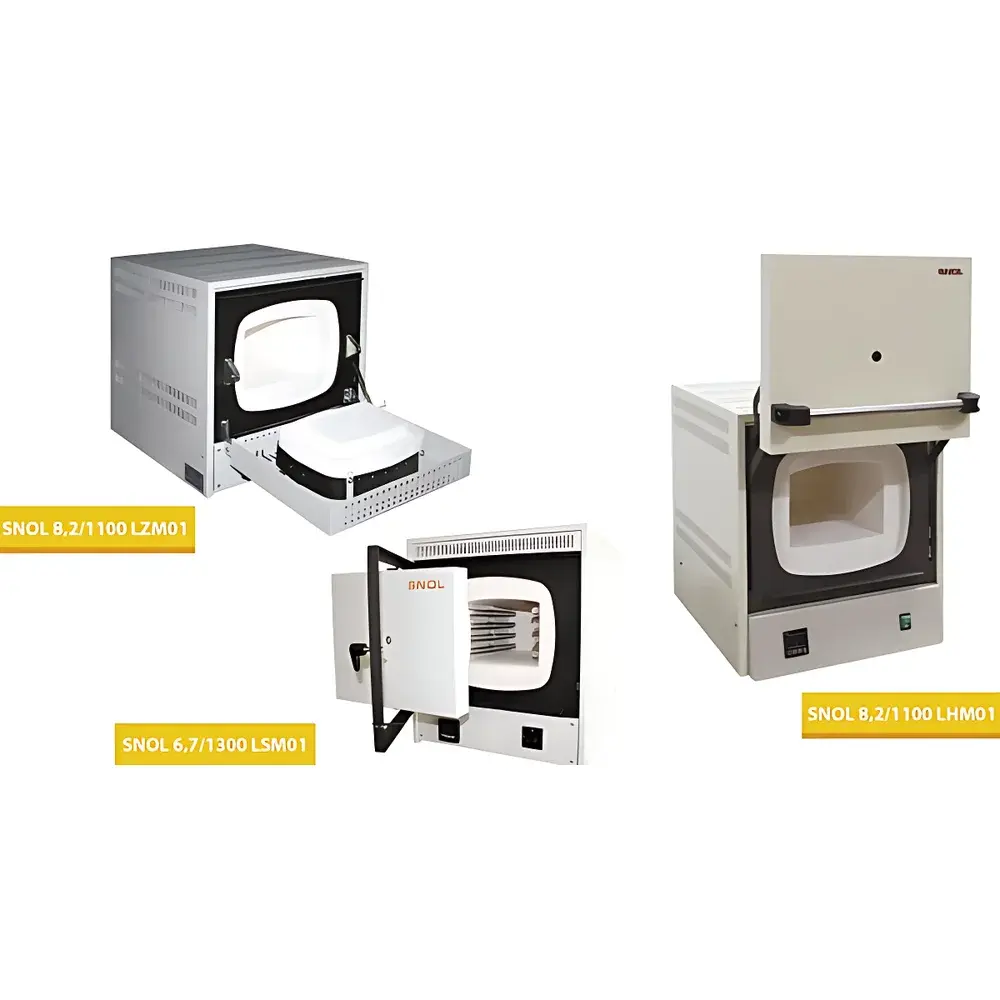
SNOL SNOL 1100/1300 Series Fibre-Insulated Laboratory Muffle Furnace
| Origin | Imported |
|---|---|
| Manufacturer Type | Authorized Distributor |
| Model | SNOL 1100/1300 Series |
| Instrument Type | Box-Type Muffle Furnace |
| Heating Element Configuration | Vacuum-Embedded Fibre Insulation (≤1100 °C) / Ceramic Tube-Mounted Elements (≤1300 °C) |
| Control System | Microprocessor-Based PID Temperature Controller |
| Chamber Lining | High-Purity Refractory Ceramic Fibre with Low Thermal Mass |
| Floor Plate | Solid Alumina Ceramic Hearth Plate |
| Surface Finish | RAL 7035 Textured Powder Coating |
| Safety Features | Dual Independent Over-Temperature Protection, Automatic Cut-Off |
| Optional Interfaces | RS232 / RS-485 / USB for Data Logging and Remote Monitoring |
| Compliance | Designed to support GLP/GMP-aligned thermal process validation workflows |
Overview
The SNOL 1100/1300 Series Fibre-Insulated Laboratory Muffle Furnace is a precision-engineered box-type muffle furnace designed for controlled high-temperature thermal processing in research laboratories, academic institutions, pharmaceutical development labs, and industrial quality control environments. Operating at maximum temperatures of either 1100 °C or 1300 °C, the furnace employs low-density, high-purity ceramic fibre insulation—engineered for minimal thermal mass and rapid thermal response—enabling precise ramp-hold-cool cycles with exceptional temperature uniformity (±3 °C typical across working zone). Unlike traditional brick-lined furnaces, the fibre-insulated chamber eliminates cold spots and reduces standby energy consumption by up to 40%. The furnace isolates samples within a fully enclosed, gas-tight muffle chamber; heat is delivered exclusively via resistive heating elements embedded directly in the insulation matrix (for ≤1100 °C models) or mounted on high-strength alumina ceramic tubes (for ≤1300 °C variants), ensuring zero contamination from element volatilisation and optimal thermal stability under inert, oxidising, or mildly reducing atmospheres.
Key Features
- Ultra-low thermal mass ceramic fibre insulation enabling heating rates up to 20 °C/min and cooling rates of 10–15 °C/min (ambient to 100 °C) without forced air assistance
- Microprocessor-based PID controller with programmable multi-segment ramp/soak profiles, real-time deviation monitoring, and auto-tuning capability
- Alumina ceramic hearth plate rated for continuous service at 1300 °C, resistant to thermal shock and chemical attack from oxides, carbonates, and metal salts
- Dual-stage over-temperature protection: primary controller limit + independent mechanical safety cut-off switch
- RAL 7035 textured powder-coated steel enclosure providing corrosion resistance and mechanical durability in shared lab environments
- Modular door orientation options (top-, side-, or bottom-opening configurations) to accommodate workflow integration and fume extraction requirements
- Optional integrated ventilation port with flanged connection for ducting to external exhaust systems or scrubbers
Sample Compatibility & Compliance
The SNOL 1100/1300 series accommodates crucibles, boats, and trays made from alumina, silicon carbide, quartz, or platinum-group metals—compatible with ASTM E1112 (standard practice for calibration of laboratory furnaces), ISO 9001 thermal process validation protocols, and USP pyrogen testing furnace qualification criteria. The muffle design ensures sample isolation from combustion by-products and heater degradation residues, making it suitable for ash content determination (AOAC 942.05), loss-on-ignition (LOI) analysis, catalyst calcination, and pre-sintering of ceramic green bodies. All models comply with IEC 61000-6-3 (EMC emissions) and IEC 61000-6-2 (immunity), and support audit-ready documentation when paired with optional data loggers meeting FDA 21 CFR Part 11 requirements for electronic records.
Software & Data Management
Standard RS232/RS-485 serial interfaces enable seamless integration with laboratory information management systems (LIMS) and SCADA platforms. Optional USB interface supports direct connection to Windows-based PCs running vendor-provided configuration and logging software—capable of exporting time-stamped temperature profiles in CSV format with metadata tagging (operator ID, batch number, protocol ID). The system supports configurable alarm triggers (e.g., deviation >±5 °C for >30 s), event logging with timestamped entries for all setpoint changes and fault conditions, and encrypted export for GLP-compliant archiving. Firmware updates are performed via secure signed binary upload to maintain traceability and integrity.
Applications
- Thermal gravimetric analysis (TGA) sample preparation and residue quantification
- Metallurgical heat treatment: annealing of stainless steels, normalising of tool steels, stress-relieving of welded assemblies
- Pharmaceutical excipient characterisation: moisture removal, polymorph screening, residual solvent volatilisation
- Environmental testing: soil/sediment ashing per EPA Method 3050B, fly ash fusion point determination
- Ceramic and composite R&D: binder burnout, sintering trials, phase transformation studies
- Calibration lab use: reference material annealing (e.g., NIST SRM 720e), thermocouple ageing verification
FAQ
What is the recommended maintenance schedule for the ceramic fibre insulation?
Ceramic fibre linings require no routine replacement under normal operation; however, visual inspection every 200 operating hours is advised for signs of cracking, delamination, or surface dusting. Avoid thermal cycling below 200 °C when the chamber contains moisture to prevent hydrothermal degradation.
Can this furnace be operated under vacuum or controlled atmosphere?
The standard model is not vacuum-rated; however, optional gas-tight modifications—including flanged ports, quartz viewing window (Ø35 mm, rated to 1100 °C), and purge fittings—are available for inert gas purging (N₂, Ar) or low-pressure reducing atmospheres (5–50 mbar).
Is third-party calibration certification included?
Factory calibration is performed using NIST-traceable reference thermocouples prior to shipment. ISO/IEC 17025-accredited calibration certificates are available as an add-on service, including as-found/as-left data and uncertainty budgets.
How is temperature uniformity validated across the working chamber?
Uniformity is verified per ASTM E2203 using a 9-point thermocouple mapping grid during commissioning. Typical results show ±2.5 °C at 1000 °C and ±3.5 °C at 1300 °C within the specified working volume.
What safety interlocks prevent accidental exposure during operation?
A mechanically actuated door switch disables power to heating elements upon opening. An additional thermal fuse interrupts main supply if internal ambient temperature exceeds 150 °C—preventing enclosure overheating in case of controller failure.



