
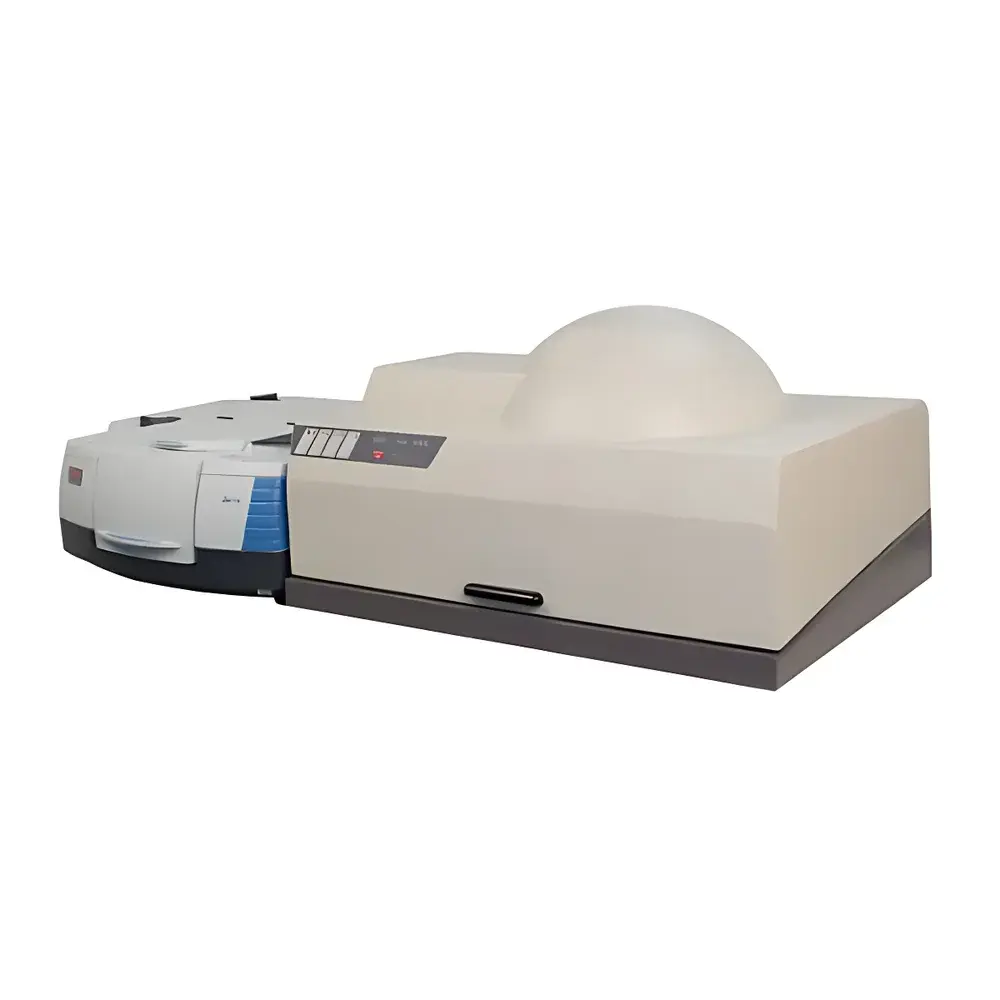
SOC SurfaceOptics SOC100 HDR Hemispherical Directional Reflectometer
| Brand | SOC/SurfaceOptics |
|---|---|
| Origin | USA |
| Manufacturer Type | Authorized Distributor |
| Origin Category | Imported |
| Model | SOC100 HDR |
| Price | USD 525,000 (FOB US Port) |
Overview
The SOC SurfaceOptics SOC100 HDR Hemispherical Directional Reflectometer is an engineered optical characterization system designed for high-fidelity, angle-resolved measurement of directional-hemispherical reflectance, transmittance, and emissivity across the mid- to far-infrared spectrum. Unlike conventional integrating sphere-based systems—whose usable spectral range is inherently limited by detector cutoff and sphere wall absorption—the SOC100 employs a precision-engineered 2π hemi-ellipsoidal collection geometry illuminated by a stabilized 700 °C blackbody source. This architecture enables true directional reflectance measurements from 10° to 80° incidence angle with polarization control (s-, p-, and unpolarized), while maintaining radiometric traceability and angular reproducibility within ±0.2°. When coupled with a Nicolet FTIR spectrometer, the system delivers spectral coverage from 2–25 μm as standard, extendable to 50 μm via customer-specified FTIR configuration. Integrated sample heating capability supports in situ thermal emission studies up to 500 °C, enabling direct acquisition of angle-wavelength-temperature emissivity functions essential for infrared signature modeling and thermal management validation.
Key Features
- Hemi-ellipsoidal optical collection path with motorized top mirror for precise angular alignment and stray-light suppression
- Blackbody source calibrated to NIST-traceable standards (700 °C nominal, stability ±0.5 °C over 30 min)
- Full polarization control: selectable s-, p-, or unpolarized incident beam; simultaneous detection of co- and cross-polarized components
- Angle-resolved reflectance measurement at user-defined incidence angles from 10° to 80° in 0.1° increments
- Integrated high-temperature sample stage with vacuum-compatible design and thermocouple feedback (operating range: ambient to 500 °C, ramp rate ≤5 °C/min)
- FTIR synchronization interface compliant with Thermo Scientific OMNIC™ v10+ and compatible with third-party spectral acquisition software via TCP/IP or RS-232
- Modular software architecture supporting ASTM E1933-19 (Standard Test Methods for Measuring and Compensating for Emissivity Using Infrared Imaging Systems) and ISO 18434-1 (Condition monitoring — Thermography)
Sample Compatibility & Compliance
The SOC100 accommodates flat, opaque, semi-transparent, and powdered samples with dimensions up to 50 mm × 50 mm × 25 mm (L×W×H). Its non-contact, non-destructive methodology complies with GLP and GMP documentation requirements when used with audit-trail-enabled software modules. Measurement protocols align with ASTM C1371 (Standard Test Method for Determination of Emittance of Materials Near Room Temperature Using Portable Emissometers), ASTM E423 (Standard Practice for Calibrating Spectral Radiometers), and ISO 10545-10 (Ceramic tiles — Part 10: Determination of coefficient of thermal expansion). Data export formats include ASCII, CSV, and HDF5, ensuring compatibility with MATLAB®, Python-based analysis pipelines, and enterprise LIMS platforms. All firmware and calibration files are digitally signed and version-controlled per FDA 21 CFR Part 11 Annex 11 guidelines.
Software & Data Management
The native Windows®-based SOC Control Suite provides instrument orchestration, real-time spectral preview, automated sequence execution, and metadata-rich data archiving. It integrates natively with Thermo Fisher OMNIC™ for spectral acquisition and baseline correction. Optional application modules include: (1) Optical Constants Solver (OCS) for Kramers–Kronig–consistent extraction of complex refractive index (n, k) from directional reflectance datasets; (2) Coating Design Studio (CDS) for multilayer thin-film optimization using measured substrate optical properties; (3) IR Scene Generator (IRSG) for physics-based synthetic infrared image synthesis; and (4) Thermal Emission Analyzer (TEA) for computing total hemispherical emissivity εh(T) and directional spectral emissivity εθ,λ(T) under programmable thermal boundary conditions. All modules support batch processing, parameter sweeps, and export of uncertainty-annotated reports conforming to ISO/IEC 17025 requirements.
Applications
- Infrared signature prediction and stealth material qualification for defense and aerospace platforms
- Thermal barrier coating (TBC) development and degradation monitoring under elevated temperature cycling
- Quantitative contamination assessment on optical substrates and semiconductor wafers via spectral reflectance deviation analysis
- Characterization of bidirectional reflectance distribution function (BRDF) for remote sensing calibration targets
- Optical constant derivation for novel metamaterials, MOFs, and ceramic composites in the FIR regime
- Validation of radiative heat transfer models in high-temperature furnaces and nuclear reactor cladding simulations
- Quality assurance of IR-transparent windows (e.g., ZnSe, Ge, Si) and anti-reflective coatings for thermal imaging systems
FAQ
What spectral range does the SOC100 support with a standard Nicolet FTIR?
The base configuration covers 2–25 μm (5000–400 cm⁻¹); extension to 50 μm (200 cm⁻¹) is available with customized FTIR optics and DTGS or bolometer detectors.
Can the SOC100 measure both specular and diffuse reflectance simultaneously?
Yes—its hemi-ellipsoidal geometry captures full angular scattering distribution; software deconvolves specular and diffuse contributions using calibrated reference standards and geometric correction algorithms.
Is the system compatible with vacuum or inert gas environments?
The sample chamber supports optional vacuum flanges (KF40/KF50) and purge ports for N₂ or Ar purging; maximum operating pressure differential is 1 atm (absolute) to 10⁻³ mbar.
How is calibration traceability maintained?
Primary calibration uses NIST-traceable gold-coated mirrors and blackbody sources; secondary verification is performed using certified reference materials (CRMs) such as NIST SRM 2036 (gold film reflectance standard) and SRM 1921b (infrared emissivity standard).
Does the software support automated compliance reporting for ISO/IEC 17025?
Yes—audit trail logging, electronic signatures, calibration certificate embedding, and uncertainty propagation reporting are enabled in the optional QA/QC Module, fully compliant with Clause 7.7 of ISO/IEC 17025:2017.



