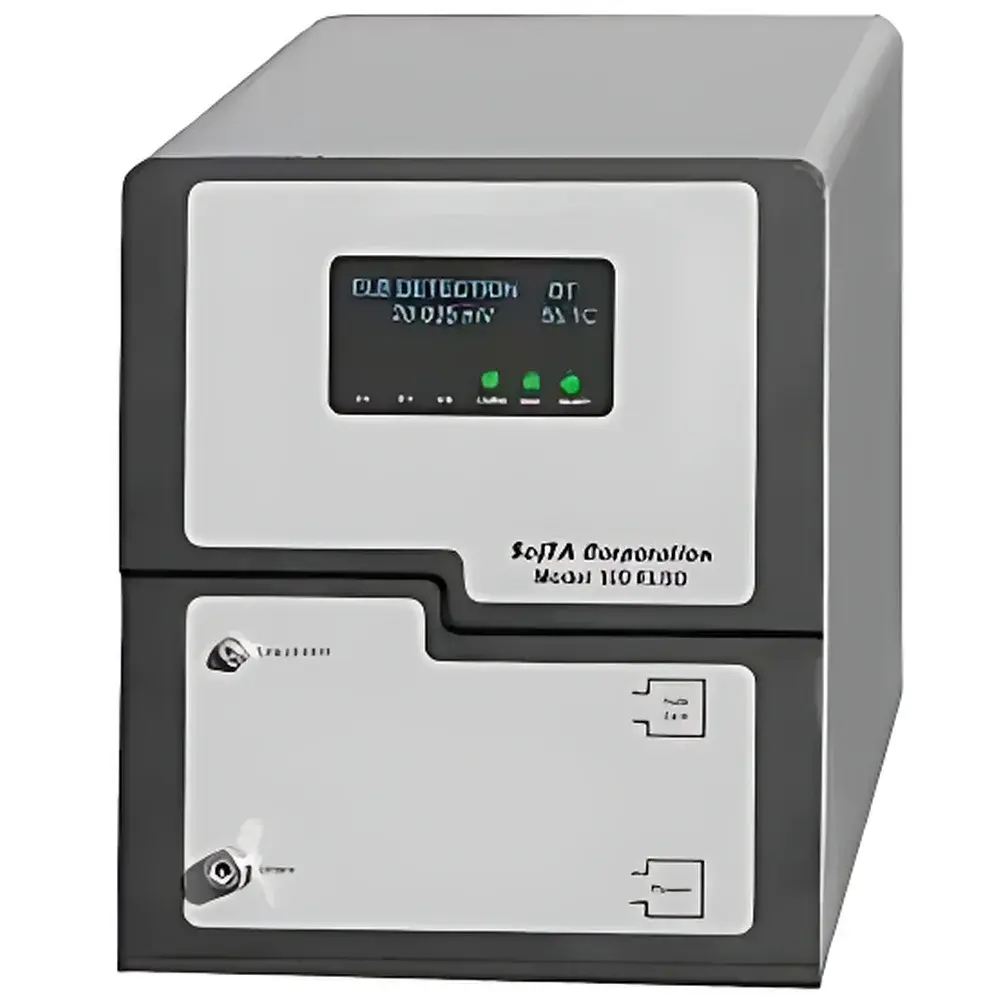
SofTA Model 100 ELSD9 Evaporative Light Scattering Detector
| Brand | SofTA |
|---|---|
| Origin | USA |
| Model | Model 100 ELSD9 |
| Detection Principle | Evaporative Light Scattering |
| Light Source | 670 nm laser (<5 mW) |
| Detection Limit | 10 ng |
| Dynamic Range | 4 orders of magnitude |
| RSD | <2% |
| Operating Nebulizer Temperature | 55 °C |
| Gas Requirement | 50 psi inert gas (N₂), ~2.5 SLPM |
| Flow Rate Compatibility | 0–5 mL/min |
| Power | 120/240 VAC, 50/60 Hz, 600 W |
| Dimensions | 24.9 × 45.7 × 29.2 cm (W×D×H) |
| Weight | 10.4 kg (23 lbs) |
| Interface | RS-232 |
| Display | 2×20-character VFD |
| Housing Materials | Stainless steel, electroplated chrome, PTFE |
Overview
The SofTA Model 100 ELSD9 is a precision-engineered evaporative light scattering detector designed for integration into high-performance liquid chromatography (HPLC) and ultra-high-performance liquid chromatography (UHPLC) systems. Unlike UV-Vis or refractive index (RI) detectors, the ELSD9 operates on the principle of nebulization, solvent evaporation, and light scattering detection—making it universally responsive to non-volatile and semi-volatile analytes regardless of chromophore presence. This enables reliable quantification of carbohydrates, lipids, polymers, surfactants, natural products, and other UV-transparent compounds. Its design adheres to fundamental aerosol physics and optical detection standards, ensuring mass-proportional response across a broad concentration range. The detector is optimized for gradient-compatible operation, eliminating baseline drift and negative peaks commonly observed with RI detectors under mobile phase composition changes. Engineered for laboratory robustness and analytical reproducibility, the Model 100 ELSD9 delivers consistent performance in regulated and research environments alike.
Key Features
- Pre-programmed startup protocol enabling full operational readiness within 30 minutes of power-on—only gas supply, waste line, column outlet, and data system connection required
- Low-temperature nebulizer operation at 55 °C, minimizing thermal degradation of labile compounds and reducing energy consumption
- High-sensitivity detection with a verified limit of detection of 10 ng and a dynamic linear range spanning four orders of magnitude
- Exceptional quantitative reproducibility (<2% RSD) achieved through stabilized laser optics, precision temperature control, and closed-loop gas flow regulation
- No consumable optical components—the 670 nm laser diode is rated for >10,000 hours of continuous operation, eliminating routine replacement costs
- Flexible gas sourcing: compatible with nitrogen cylinders, oil-free compressors, or nitrogen generators; requires only 50 psi and ~2.5 SLPM
- Integrated self-diagnostic system continuously monitors nebulizer temperature, gas pressure, detector voltage, and optical path integrity—alerts displayed via VFD interface
- Compact benchtop footprint (24.9 × 45.7 × 29.2 cm) and lightweight aluminum-chassis construction facilitate easy integration into existing HPLC workstations
Sample Compatibility & Compliance
The Model 100 ELSD9 supports universal detection of non-volatile and low-volatility analytes across diverse sample matrices—including pharmaceutical actives, botanical extracts, synthetic polymers, glycolipids, and excipients. It is fully compatible with reversed-phase, HILIC, and normal-phase separations using volatile mobile phases (e.g., acetonitrile/water, methanol/water, THF/hexane). Gradient elution is inherently supported without signal suppression or baseline artifacts. From a regulatory standpoint, the detector meets essential requirements for GLP and GMP-compliant laboratories: its RS-232 interface enables secure data capture in validated chromatography data systems (CDS), and all operational parameters—including temperature setpoints, gas pressure, and signal gain—are logged and traceable. While not intrinsically 21 CFR Part 11 compliant, its deterministic behavior and audit-ready parameter logging support integration into Part 11–enabled workflows when paired with compliant CDS software.
Software & Data Management
The Model 100 ELSD9 communicates exclusively via RS-232 serial interface, supporting seamless integration with industry-standard chromatography data systems including Waters Empower, Agilent OpenLab CDS, Thermo Chromeleon, and Shimadzu LabSolutions. No proprietary driver or middleware is required—standard ASCII-based command protocols enable bidirectional communication for status queries, parameter adjustment, and real-time analog output (0–5 VDC). All critical operating variables—including nebulizer temperature, photodiode gain, and gas pressure—are continuously monitored and accessible via the front-panel VFD display or remote query. The absence of firmware-upgradable embedded software ensures long-term stability and eliminates version-control complications in validated environments. For labs requiring electronic records, raw detector output is captured as analog voltage signals synchronized with chromatographic time, permitting full traceability within compliant CDS audit trails.
Applications
- Quantitative analysis of UV-inactive pharmaceuticals (e.g., heparin, insulin analogs, PEGylated proteins)
- Stability-indicating assays for degradation products lacking chromophores
- Characterization of natural product extracts where reference standards are unavailable
- Quality control of excipients such as lactose, mannitol, and polysorbates in solid-dosage forms
- Method development for lipidomics and glycomics workflows requiring mass-sensitive detection
- Validation of cleaning procedures in multi-product facilities via residue detection of non-UV-absorbing compounds
FAQ
Can the Model 100 ELSD9 be used with UHPLC systems operating above 1000 bar?
Yes—its flow cell design accommodates flow rates from 0 to 5 mL/min and is compatible with post-column flow splitting for high-pressure applications.
Does the detector require column heating or backpressure regulation?
No—unlike some ELSD designs, the Model 100 does not mandate post-column restrictors or heated transfer lines; standard stainless-steel tubing suffices.
Is the 10 ng LOD achievable with all solvents?
The stated LOD is validated using common volatile mobile phases (e.g., acetonitrile/water); non-volatile buffers or ion-pairing reagents must be avoided to maintain sensitivity.
How is calibration performed?
Calibration is typically conducted using a series of mass-injected standards; response is linear over four decades, allowing single-point or multi-point calibration per ICH Q2(R2) guidelines.
What maintenance is required beyond routine gas filter replacement?
Annual verification of laser alignment and photodiode responsivity is recommended; no optical cleaning or lamp replacement is necessary during normal operation.
Related Products