
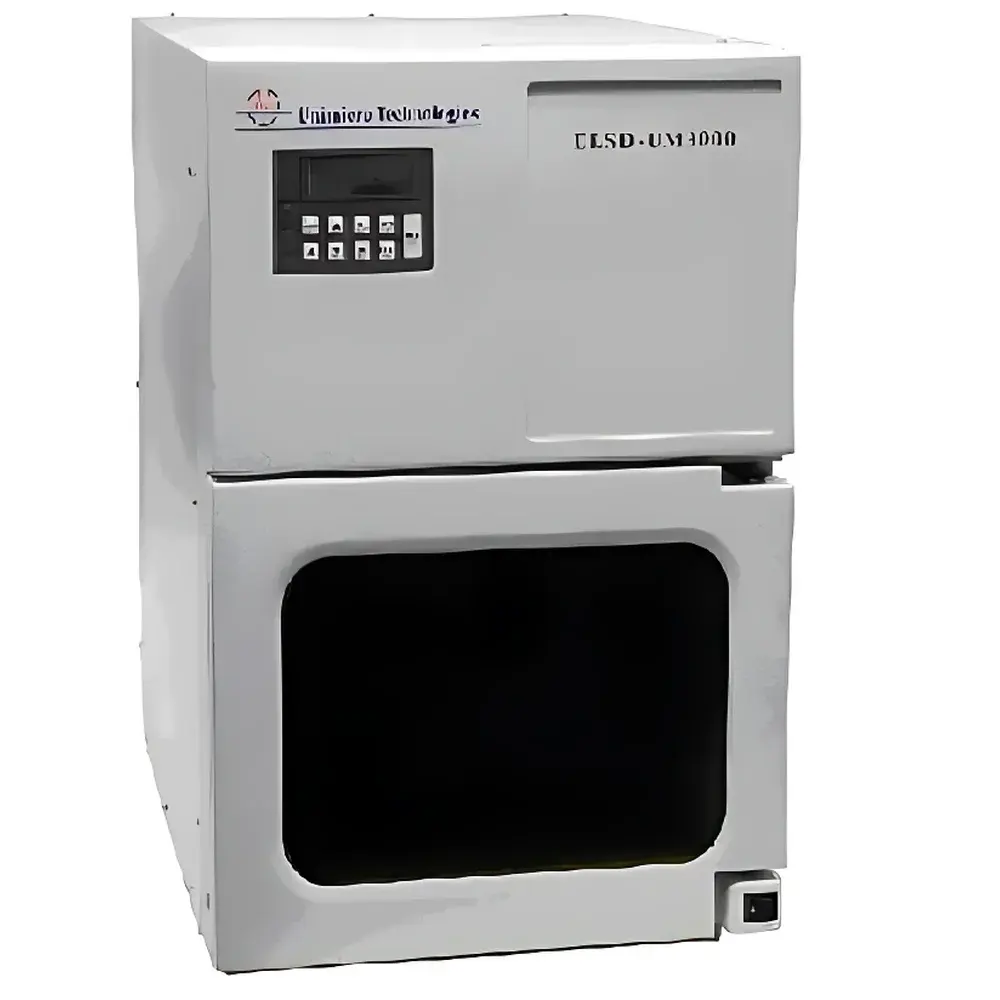
SofTA UM3000 Evaporative Light Scattering Detector (ELSD)
| Brand | SofTA |
|---|---|
| Origin | USA |
| Model | UM3000 |
| Detection Principle | Evaporative Light Scattering |
| Light Source | 650 nm Laser Diode |
| Detector | Photomultiplier Tube (PMT) |
| Evaporation Zone Temp Range | Ambient to 130 °C |
| Nebulizer Tube Temp Range | Ambient to 80 °C |
| Temp Control Increment | 1 °C |
| Temp Accuracy | ±1 °C |
| Mobile Phase Flow Rate | 10 µL/min to 3 mL/min |
| Carrier Gas | Nitrogen or Compressed Air |
| Gas Input Pressure | 2–5 bar |
| Gas Pressure Measurement Accuracy | 0.01 bar |
| Gas Consumption | 1–4 L/min |
| Detection Limit | <1 ng (glucose, direct injection) |
| Typical Quantitation Range | 0.2–10 µg (glucose, HPLC) |
| Noise Level | <0.1 mV (at 1 mL/min) |
| Signal Output | 0–10 mV DC or 0–1 V DC |
| Interface | RS232 |
| Detection Angle | 120° |
| Display | LCD |
| Operating Environment | 15–35 °C, RH <90% |
| Power Supply | 220 VAC, 50 Hz |
Overview
The SofTA UM3000 Evaporative Light Scattering Detector (ELSD) is a robust, benchtop-compatible universal detector engineered for integration with high-performance liquid chromatography (HPLC), ultra-high-performance liquid chromatography (UHPLC), and preparative LC systems. Unlike UV-Vis or fluorescence detectors, the UM3000 operates on the principle of nebulization, solvent evaporation, and light scattering—enabling detection of non-chromophoric, non-ionic, or weakly absorbing analytes without structural modification. Its core measurement sequence involves converting the column effluent into fine droplets via a heated nebulizer, evaporating the mobile phase under precisely controlled thermal conditions, and detecting the residual non-volatile analyte particles by laser light scattering at a fixed angle (120°) using a high-gain photomultiplier tube. This physical detection mechanism ensures consistent response across compound classes—including carbohydrates, lipids, fatty acids, amino acids, natural products, synthetic polymers, and small-molecule pharmaceuticals—regardless of chromophore presence or ionization efficiency.
Key Features
- Universal detection capability for analytes with volatility lower than the mobile phase—no requirement for UV absorbance, fluorescence, or electrochemical activity
- Optimized low-temperature nebulization and evaporation architecture, preserving thermally labile compounds while maintaining high mass sensitivity
- Independent, high-stability temperature control for both nebulizer tube (ambient to 80 °C) and evaporation chamber (ambient to 130 °C), adjustable in 1 °C increments with ±1 °C accuracy
- Dual-gas compatibility (nitrogen or compressed air) with integrated pressure regulation and real-time monitoring (0.01 bar resolution)
- Low-noise analog signal output (0–10 mV DC or 0–1 V DC) and RS232 serial interface for seamless integration with legacy and modern data systems
- Compact, modular design with front-panel LCD display; fully compatible with all standard HPLC/UHPLC platforms via standard 1/16″ stainless-steel tubing connections
Sample Compatibility & Compliance
The UM3000 supports broad-spectrum analytical workflows across regulated and research environments. It is routinely deployed in method development and QC testing compliant with USP , ICH Q5C, and ASTM D7212 for carbohydrate quantification, lipid profiling, and polymer molecular weight distribution analysis. Its gradient-compatible operation eliminates solvent front interference—a critical advantage over refractive index (RI) detectors—and delivers stable baselines during multi-solvent elution programs. While the UM3000 itself does not include 21 CFR Part 11-compliant audit trail functionality, its analog output and RS232 interface support integration with validated chromatography data systems (CDS) that meet GLP/GMP documentation requirements. All operating parameters—including gas pressure, temperature setpoints, and flow rate ranges—are traceable and reproducible under standard laboratory conditions (15–35 °C, RH <90%).
Software & Data Management
The UM3000 operates as a standalone analog detector with no embedded software or proprietary acquisition suite. Signal output is delivered as calibrated voltage (mV or V DC), enabling direct digitization through any third-party analog input module (e.g., Agilent ChemStation, Waters Empower, Thermo Chromeleon, or custom LabVIEW-based acquisition). The RS232 port provides access to real-time status parameters—including current temperature setpoints, gas pressure reading, and operational mode—for external logging or supervisory control. Users retain full ownership of raw signal processing, baseline correction, peak integration, and calibration curve generation within their existing CDS environment—ensuring continuity with validated SOPs and minimizing requalification burden when replacing legacy ELSD units.
Applications
- Quantitative analysis of carbohydrates (mono-, di-, and oligosaccharides) in food, fermentation broths, and biopharmaceutical excipients
- Profiling of glycerides, phospholipids, and free fatty acids in nutraceuticals and clinical lipidomics samples
- Stability-indicating assays for non-UV-absorbing drug substances and degradation products
- Molecular weight distribution assessment of synthetic and natural polymers (e.g., PEG, dextran, chitosan)
- Method transfer from RI or CAD detectors in regulated QC laboratories seeking improved sensitivity and gradient tolerance
- Preparative LC fraction detection where post-column derivatization is impractical or undesirable
FAQ
Is the UM3000 compatible with UHPLC systems operating above 1000 bar?
Yes—the UM3000 has no internal pressure rating constraints; it interfaces downstream of the column outlet via standard low-dead-volume fittings. System pressure tolerance is determined solely by the connecting tubing and HPLC system components.
What carrier gas purity is recommended for optimal signal-to-noise performance?
For routine applications, oil-free compressed air meeting ISO 8573-1 Class 2:2:2 is sufficient. For trace-level quantitation or extended PMT lifetime, nitrogen with ≤1 ppm hydrocarbon and ≤5 ppm moisture is advised.
Can the UM3000 be used with aqueous mobile phases containing >20% water?
Yes—evaporation efficiency is maintained across common reversed-phase gradients (e.g., water/acetonitrile, water/methanol), provided the total non-volatile content remains below saturation limits in the evaporation chamber.
Does the UM3000 require routine optical alignment or lamp replacement?
No—the 650 nm laser diode and PMT are factory-aligned and sealed; no user-serviceable optical adjustments or consumable light sources are required during normal operation.
Is firmware upgrade support available for second-hand UM3000 units?
SofTA no longer provides firmware updates or technical support for discontinued models; however, hardware-level functionality remains fully operational per original specifications, and all electrical/mechanical interfaces remain unchanged.




