
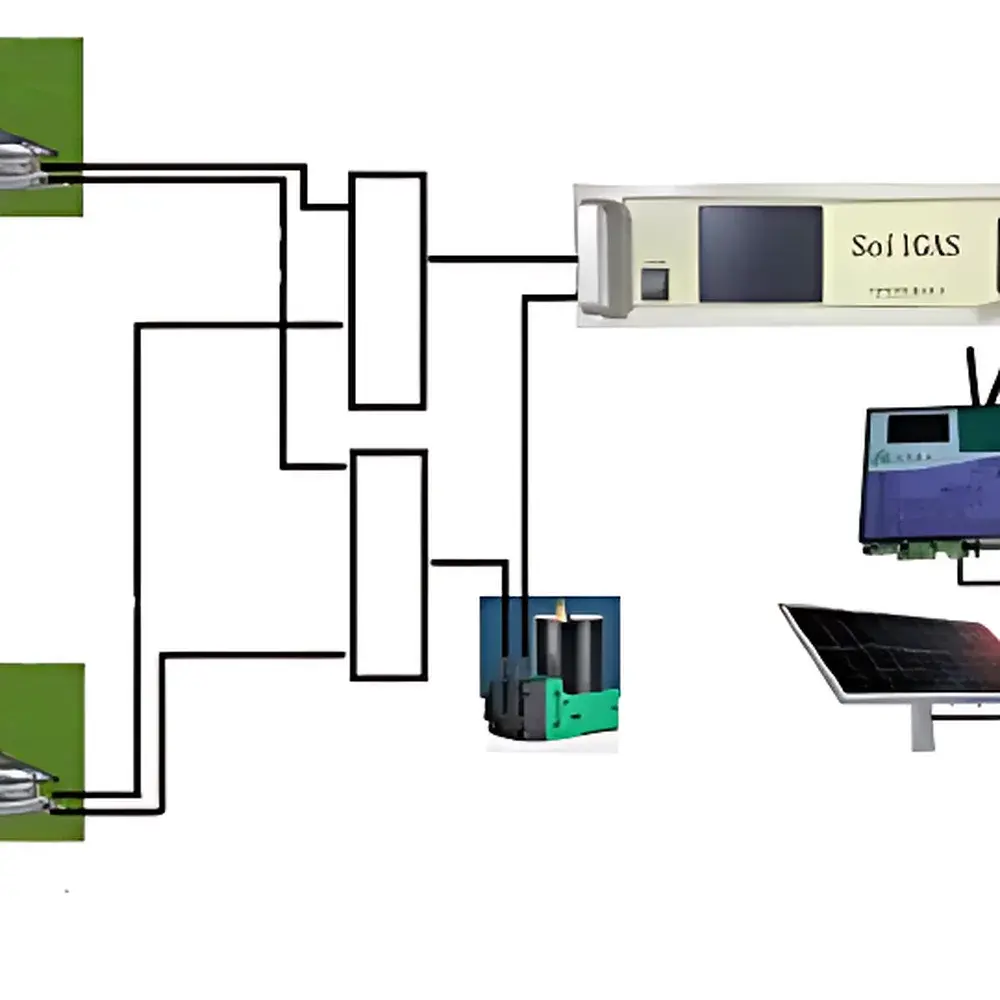
SoilGAS Aboveground Multicomponent Gas Flux Monitoring System
| Brand | AZ (Beijing Aozuo) |
|---|---|
| Origin | Beijing, China |
| Manufacturer | AZ Instrument Co., Ltd. |
| Model | SoilGAS |
| Instrument Principle | Tunable Diode Laser Absorption Spectroscopy (TDLAS) |
| Configuration | Online, Automated Chamber-Based System |
| Measured Gases | CO₂, CH₄, N₂O, H₂O |
| Repeatability | ≤0.15 ppm (CO₂), ≤10 ppb (CH₄), ≤10 ppb (N₂O), ≤1 ppm (H₂O) |
| Chamber Options | iChamber-S120 (Ø1.2 m × 2.0 m), iChamber-S62 (Ø0.62 m × 1.1 m), iChamber-S35 (Ø0.35 m × 0.5 m) |
| Optical Transmittance | >92% (UV-Vis-NIR range) |
| Height Adjustment | Motorized, continuous, plant-height adaptive (0.5–2.0 m) |
| Compliance | ASTM D6584, ISO 14064-3, IPCC Tier 2/3 methodology support, GLP-aligned data traceability |
Overview
The SoilGAS Aboveground Multicomponent Gas Flux Monitoring System is an integrated, field-deployable platform engineered for high-temporal-resolution, non-invasive quantification of ecosystem-scale carbon, nitrogen, and water vapor exchange. It combines tunable diode laser absorption spectroscopy (TDLAS)—a physics-based, line-by-line molecular detection technique—with a family of motorized, height-adaptive iChamber enclosures to enable continuous, chamber-based flux measurements across diverse vegetation structures. Unlike static or manually operated chambers, the SoilGAS system operates autonomously over extended periods (weeks to seasons), delivering time-synchronized, multi-gas concentration time-series from which net ecosystem exchange (NEE), ecosystem respiration (Re), soil respiration (Rs), and evapotranspiration (ET) are derived using first-order differential analysis of gas accumulation rates. Its design directly addresses methodological limitations inherent in eddy covariance (EC) and biometric approaches—particularly the inability of EC to partition GPP and Re under low-turbulence conditions, and the infrequent sampling bias of manual chamber methods. By scaling chamber dimensions to match canopy height and maintaining optical transparency during light-period measurements, SoilGAS supports physiological fidelity in flux estimation while complying with IPCC Good Practice Guidance for land-use and land-cover change inventories.
Key Features
- Motorized iChamber enclosures with fully programmable vertical actuation: adjusts chamber height continuously (0.5–2.0 m) to track real-time vegetation growth, eliminating manual repositioning and ensuring consistent measurement geometry.
- Three standardized chamber configurations: iChamber-S120 (1.2 m diameter × 2.0 m height) for shrublands, wetlands, and young forests; iChamber-S62 (0.62 m diameter × 1.1 m height) optimized for croplands, vineyard understories, and urban green spaces; iChamber-S35 (0.35 m diameter × 0.5 m height) for short-grass and alpine meadow applications.
- Optically transparent enclosure material with >92% transmittance across 200–2500 nm, enabling concurrent photosynthetic activity during daytime NEE measurement; optional opaque variant available for dark-period respiration-only protocols.
- TDLAS-based multicomponent gas analyzer with simultaneous, real-time detection of CO₂ (0–10,000 ppm), CH₄ (0–100 ppm), N₂O (0–100 ppm), and H₂O (0–5% v/v); all channels calibrated traceably to NIST-certified standards.
- Integrated multi-port controller supporting up to 16 independent chamber zones per system, with sequential or parallel measurement scheduling, pressure/temperature compensation, and automated zero/span validation cycles.
- Ruggedized outdoor enclosure rated IP65, operational at –20 °C to +50 °C ambient, with internal thermal stabilization to maintain analyzer performance stability across diurnal temperature swings.
Sample Compatibility & Compliance
The SoilGAS system is validated for use across terrestrial ecosystems including agricultural fields, temperate and boreal grasslands, restored wetlands, desert shrublands, urban parks, and early-successional forest stands. Chamber footprint and height selection follow established best practices documented in peer-reviewed literature (e.g., Wang et al., *Agricultural and Forest Meteorology*, 2021; Wang & Wang, *Global Change Biology*, 2019) and align with FAO/UNEP guidelines for GHG inventory reporting. All flux calculations conform to the mass balance equation described in ISO 14064-3:2019 Annex B and support Tier 2/Tier 3 reporting under the IPCC 2006 Guidelines. Data acquisition firmware includes audit-trail logging compliant with GLP principles, recording operator actions, calibration events, environmental metadata (PAR, soil T, air T, RH, barometric P), and instrument diagnostics with timestamped digital signatures.
Software & Data Management
The SoilGAS Control Suite is a Windows-based application providing configuration, real-time monitoring, and post-processing workflows. It implements standardized flux calculation algorithms—including linear and exponential curve-fitting for non-steady-state concentration rise—and exports time-series data in CF-compliant NetCDF format. Raw spectral data, intermediate concentration values, and QA/QC flags are stored in SQLite databases with configurable retention policies. Remote access via secure HTTPS enables centralized fleet management across distributed field sites. Export modules support direct integration with EDI (Ecological Metadata Language), ICOS Carbon Portal ingestion schemas, and R/Python-based flux modeling pipelines (e.g., REddyProc, EddyPro-compatible outputs). All software binaries undergo annual third-party cybersecurity review per IEC 62443-4-1.
Applications
- Long-term monitoring of net ecosystem productivity (NEP) and carbon sink/source strength in response to drought, fertilization, grazing, or land-use conversion.
- Quantifying nitrous oxide emission factors from managed soils under variable nitrogen input regimes, supporting national GHG inventories and EU LULUCF reporting.
- Evaluating methane oxidation potential in restored peatlands and rice paddy systems using dual-chamber comparative designs (transparent vs. opaque).
- Validating satellite-derived gross primary production (GPP) and evapotranspiration products through ground-truthing at eddy covariance tower footprints.
- Supporting DOE, NSF, and Horizon Europe-funded projects requiring high-frequency, multi-gas flux datasets for process-model parameterization (e.g., CLM, ORCHIDEE, LPJ-GUESS).
FAQ
What chamber sizes are available, and how do I select the appropriate one for my ecosystem?
The iChamber-S120 (1.2 m Ø × 2.0 m H) is recommended for tall herbaceous or shrubby vegetation; the S62 (0.62 m Ø × 1.1 m H) suits row crops and mixed understory; the S35 (0.35 m Ø × 0.5 m H) is optimal for short grasses and moss-dominated surfaces. Selection should prioritize ≥3× canopy height and ≥5× dominant plant spacing.
Does the system comply with regulatory reporting requirements for greenhouse gas inventories?
Yes—SoilGAS output meets methodological specifications outlined in IPCC 2006 Guidelines (Chapter 4, Section 4.2.2.2) and ISO 14064-3:2019 for chamber-based flux quantification. Calibration traceability and data audit trails support verification under national MRV frameworks.
Can the system operate unattended for extended field deployments?
Yes—field-tested deployments exceeding 12 months demonstrate stable performance with scheduled maintenance intervals every 90 days. Integrated battery backup and solar charging options extend autonomy in off-grid locations.
Is it possible to integrate SoilGAS data with existing eddy covariance infrastructure?
Yes—the system outputs time-synchronized, UTC-referenced NetCDF files compatible with EddyPro and TK3 processing suites. Optional analog/digital I/O allows hardware-level synchronization with EC tower data loggers.
How does the system handle condensation and particulate interference in humid or dusty environments?
The TDLAS optical path employs heated purge gas (dry N₂ or synthetic air) and thermally stabilized multipass cells. An integrated particle filter (0.3 µm cutoff) and dew-point-controlled sample conditioning module prevent optical contamination and water vapor saturation artifacts.







