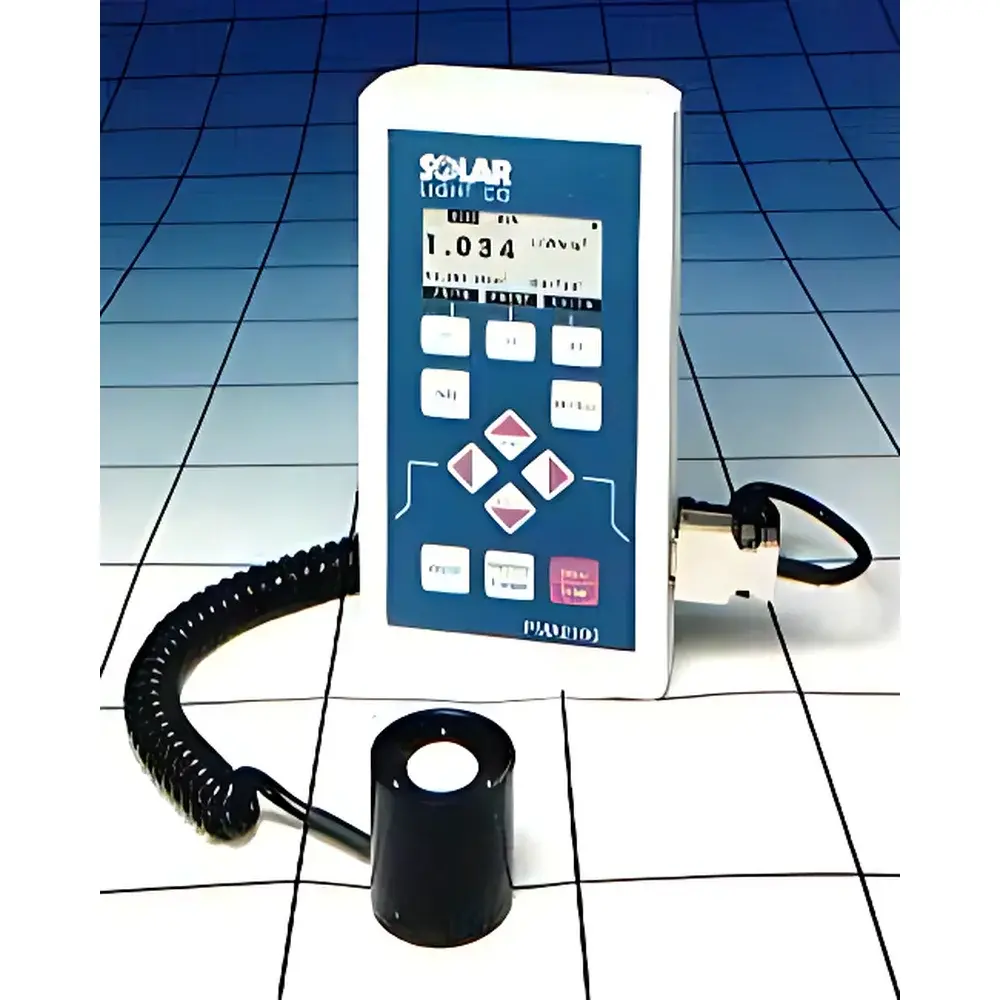
Solar Light SL-3201 UV-B and UVC Radiometer for Tanning Bed Compliance Testing
| Brand | Solar Light |
|---|---|
| Origin | USA |
| Model | SL-3201 |
| Instrument Type | Portable Radiometer |
| Wavelength Capability | Multi-band (UV-B & UVC) |
| UV-B Range | 0–19.99 MED/h |
| UVC Range | 0–19.99 mW/cm² |
| Resolution | 0.01 MED/h or mW/cm² |
| Accuracy | ±0.2% FS |
| Nonlinearity | ≤0.02% FS |
| Temperature Coefficient | ≤50 ppm/°C |
| Operating Temp | 0–50°C (instrument) |
| Power | 4×AA NiCd/alkaline or 9–12 V DC/AC adapter |
| Weight | 480 g |
| Dimensions | 10 × 19.5 × 4.5 cm |
| UV-B Detector Spectral Response | 280–320 nm |
| UVC Detector Spectral Response | 275–285 nm |
| Cosine Error | ±5% (0–60°) |
| Data Logging | Internal memory with PC export (CSV/Excel-compatible) |
Overview
The Solar Light SL-3201 UV-B and UVC Radiometer is a portable, precision-calibrated optical measurement instrument engineered for quantitative assessment of ultraviolet radiation output from commercial tanning beds and UV-emitting devices. It operates on the principle of spectrally selective photodetection, utilizing two independent, NIST-traceable detectors optimized for distinct biological and regulatory spectral bands: the UV-B detector (280–320 nm) quantifies erythemally weighted irradiance in Minimal Erythemal Dose per hour (MED/h), while the UVC detector (275–285 nm) delivers absolute irradiance measurements in milliwatts per square centimeter (mW/cm²). Designed to comply with EN 60335-2-27 (Household and similar electrical appliances – Safety – Part 2-27: Particular requirements for appliances for skin exposure to ultraviolet and infrared radiation) and aligned with IEC 62471 (Photobiological safety of lamps and lamp systems), the SL-3201 supports clinical, regulatory, and quality assurance workflows in dermatology clinics, tanning facility compliance audits, and UV device certification laboratories.
Key Features
- Two-channel, dual-detector architecture enabling simultaneous, independent UV-B (280–320 nm) and UVC (275–285 nm) irradiance measurement
- NIST-traceable calibration with documented uncertainty budgets for both detector channels
- High-resolution digital display showing real-time readings at 0.01 MED/h or 0.01 mW/cm² resolution
- Internal data logger storing time-stamped irradiance values with configurable sampling intervals
- PC connectivity via USB or serial interface for post-acquisition analysis using Solar Light’s proprietary software suite
- Rugged, handheld form factor (480 g) with ergonomic design and IP54-rated enclosure for field use
- Thermally compensated electronics ensuring stability across operational temperature range (0–50°C)
- Low-drift analog front-end with ≤0.02% full-scale nonlinearity and ≤50 ppm/°C temperature coefficient
Sample Compatibility & Compliance
The SL-3201 is not a sample-based analytical instrument but a radiometric field sensor intended for direct irradiance mapping of UV-emitting surfaces. Its cosine-corrected detectors (±5% error up to 60° incidence angle) ensure accurate spatial averaging of divergent UV beams typical of tanning bed lamp arrays. The UV-B channel conforms to the CIE Erythema Action Spectrum (ISO 17166:2019 / CIE S 007/E-1998), enabling MED/h calculation per EN 13251:2008. The UVC channel meets spectral selectivity requirements specified in EN 60335-2-27 Annex BB for germicidal band verification. Device firmware and calibration certificates support GLP-compliant recordkeeping, including audit trails for calibration date, operator ID, and measurement location metadata—essential for FDA-regulated facilities and EU Notified Body assessments.
Software & Data Management
The SL-3201 interfaces with Solar Light’s Windows-based Data Acquisition Software (v4.x), which provides real-time graphing, statistical summary (min/max/mean/stdev), and automated report generation compliant with ISO/IEC 17025 documentation standards. Logged datasets export natively to CSV and Excel formats; time-series plots can be annotated with pass/fail thresholds based on EN 60335-2-27 maximum permissible exposure limits (e.g., 0.3 MED/h averaged over 20 min for UV-B). The software includes built-in validation tools for detector response drift monitoring and supports 21 CFR Part 11-compliant user authentication and electronic signature modules when deployed in regulated QA/QC environments.
Applications
- Pre-operational safety verification of tanning bed UV output prior to client exposure
- Periodic maintenance testing to detect lamp aging, reflector degradation, or ballast failure
- Regulatory compliance auditing against EU Directive 2006/25/EC (Artificial Optical Radiation)
- Research-grade UV dosimetry in photobiology studies evaluating skin photoresponse kinetics
- Calibration reference for secondary UV sensors used in facility-wide monitoring networks
- Verification of UVC disinfection efficacy in hybrid tanning-disinfection units (where applicable)
FAQ
What regulatory standards does the SL-3201 directly support?
It is designed and validated for EN 60335-2-27, EN 13251, ISO 17166, and IEC 62471 compliance testing.
Can the SL-3201 measure broadband UV-A or visible light?
No—its detectors are spectrally restricted to UV-B (280–320 nm) and narrowband UVC (275–285 nm); it does not respond to UV-A (320–400 nm) or longer wavelengths.
Is the internal data logger capable of timestamped continuous logging?
Yes—logging interval is user-selectable from 1 second to 60 minutes, with storage capacity for up to 32,000 records.
How often does the instrument require recalibration?
Annual recalibration is recommended; Solar Light provides ISO/IEC 17025-accredited recalibration services with full traceability documentation.
Does the SL-3201 meet FDA requirements for Class II medical device servicing?
While not a medical device itself, its metrological performance satisfies measurement traceability and documentation requirements outlined in FDA Guidance for Industry: “General Principles of Software Validation” (2002) when used in regulated tanning equipment service protocols.
Related Products